Blog post
Insights
Ecommerce Email Marketing That Drives Repeat Sales

Automated emails generated 37% of sales from just 2% of email volume in Omnisend's analysis of 2024 activity covering 24 billion emails. That changes the practical question for ecommerce email marketing. Instead of asking how many campaigns to send, ask which customer actions deserve a useful response.
For a Shopify brand, email works best as event-driven infrastructure connecting customer behavior to the next appropriate message. Judge that system by additional purchases and profitable repeat revenue, not the size of the campaign calendar, inflated opens, or every sale an attribution dashboard claims.
Automated email versus scheduled campaigns
| Metric | Automated email | Scheduled campaigns | Gap and source |
|---|---|---|---|
| Share of sales versus send volume | 37% of sales from 2% of email volume | These figures describe automation, not campaign share | Omnisend's 2024 activity analysis, 24 billion emails |
| Clickers who purchase | 1 in 3 | 1 in 18 | About six times higher for automation clicks, Omnisend's 2024 activity analysis |
| Revenue per email | $3.41 | $0.155 | About 22 times higher, Omnisend's 2025 benchmarks, analyzing more than 20 billion campaign emails and 470 million automated sends |
| Conversion rate | 1.49% | 0.08% | About 19 times higher, the same Omnisend 2025 analysis of more than 27,000 brands |
These are associations, not controlled estimates of causation. People entering checkout and purchase flows already have different intentions from people receiving a scheduled announcement. The samples also differ, so don't combine their results into a single forecast for your store.
The comparison still gives a retention lead a useful starting point: prioritize messages attached to meaningful customer activity before increasing broadcast volume.
A flow starts because someone signs up, views a product, begins checkout, purchases, or becomes inactive. A campaign starts because your team chooses a date. Neither format is automatically good or bad, but the trigger gives an automated message context that a calendar alone can't provide.
Say someone begins checkout with a coffee grinder. A useful follow-up can show the selected model, answer questions about grind settings, and return the shopper to checkout. A general weekend promotion may reach that same person, but it doesn't necessarily resolve the uncertainty holding up the purchase.
Campaigns still serve launches, editorial stories, seasonal events, and stock announcements. The mistake is treating them as a substitute for responding to customer intent.
Practical rule: Fix the missing response to an important customer event before adding another broadcast.
Reliable automation requires more than a template and a delay. Your store must associate events with the correct customer, pass relevant product information into the email platform, and check whether the intended message still makes sense before sending.
Start with these inputs:
Then test state changes. A customer who purchases must leave checkout recovery. A subscriber who cancels permission must leave commercial messaging. A product that becomes unavailable shouldn't remain the main recommendation.
For a wider spending perspective, 3228 Digital UK's guide to getting more from your email marketing budget provides context for reviewing channel investment. Within your own account, allocate effort to reliable events, appropriate messages, and purchase measurement before buying more creative volume.
A shopper orders a face cleanser, receives a receipt, gets shipping updates, and later receives instructions for introducing it into a routine. Those emails belong to the same customer relationship, but they don't all do the same job.
Ecommerce email marketing is the system of messages connected to a store's customer records, purchase activity, and product information. It isn't a newsletter attached to an advertising account.
The most useful distinction is between confirming what happened and influencing what happens next:
Some content sits near the boundary. Product-use instructions can support the purchase experience while also preparing a customer for a sensible follow-up purchase. Keep the message's primary purpose clear, and don't assume permission to send operational notices automatically establishes permission for promotional mail.
This split has deep roots. The EmailCloud ecommerce timeline reports that Amazon began sending order confirmations in the mid-1990s and that automated confirmations and shipping notifications had become standard ecommerce practices by the early 2000s.
Think of a shop assistant who hands over a receipt, explains how to care for the purchase, and remembers which accessory the customer considered. Email can support those distinct tasks because the store already records the relevant activity.
For Shopify brands, that creates a practical advantage: a new message can start from an existing customer event without requiring another paid click. It doesn't make email free, independent of software, or immune to deliverability problems. It does make the store's own customer activity a useful starting point for retention.
A coffee order illustrates the design consequence. Confirmation begins with payment, preparation guidance becomes relevant around delivery, and a reorder suggestion belongs near expected depletion. Those aren't interchangeable opportunities to display the same discount.
Design each flow as an event with an entry, an exit, and a customer purpose, not as a prettier broadcast.
An automation can't compensate for an unclear subscription. Before building sequences, establish who agreed to receive marketing, what they expected, and how that permission is recorded.
Keep the first interaction straightforward. A visitor should understand the benefit of subscribing without having to decode vague language about updates or partner offers.
Build permission capture into places where visitors already have a reason to engage:
For a concrete destination to review while planning a dedicated signup page, you can sign up with EP Fine Jewelry. Evaluate your own page by asking whether a visitor can identify the sender, the benefit, and the action they're agreeing to take.
Store the signup source, timestamp, and consent wording on the customer profile. Preserve preference answers separately from permission, because selecting an interest isn't the same as agreeing to every future use of that information.
Use double opt-in when your market requirements and list-quality needs call for confirmation. The trade-off is practical: confirmation helps validate intent and address quality, but some people won't complete it.
Don't import purchased lists or treat an address collected for another purpose as a marketing subscription. Complaints and spam placement can affect messages beyond the original questionable send.
A useful subscriber record tells you why you're allowed to write and why the recipient might care.
Sync purchases and unsubscribes promptly, ideally as events occur. A checkout buyer shouldn't receive a prospect-only welcome incentive because the email platform is waiting for a batch update.
Measure signup-to-first-order rate by source. That distinguishes capture points that bring prospective buyers from forms that merely collect addresses.
If your store has a welcome note and a cart reminder, expand deliberately rather than adding disconnected sequences. Map the early purchase journey first.
The diagram shows the core progression from signup to post-purchase communication.
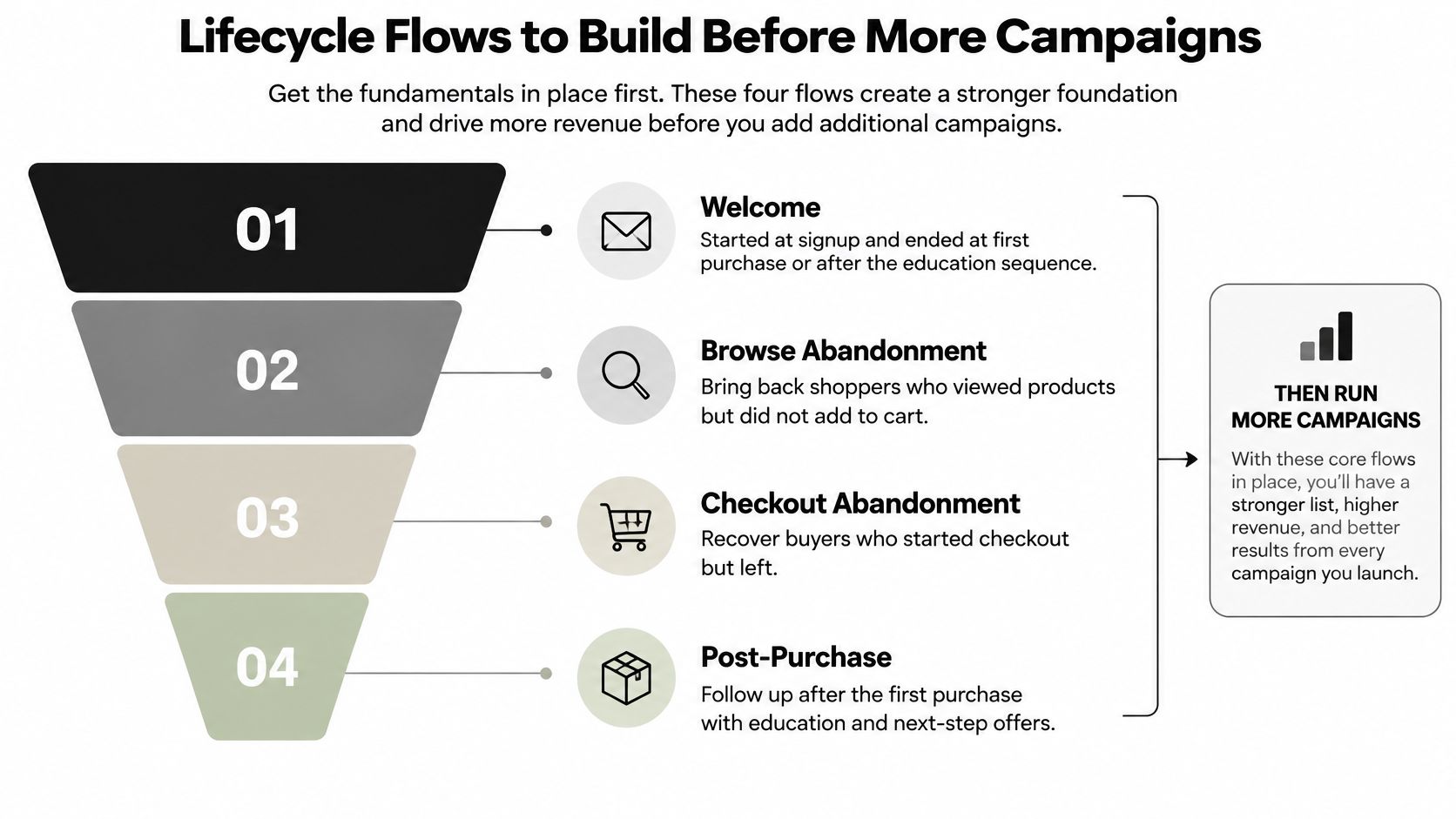
Welcome
Start when someone grants email permission. Explain the product range, buying considerations, and any signup promise. End the prospect sequence at first purchase or when its education path finishes.
Suppress existing buyers from first-order incentives. Apply the shared marketing frequency cap and define a first-order conversion window before launch.
Browse abandonment
Enter known, permissioned subscribers who view a product without progressing to a cart. Use product information to answer a likely question, not to announce that you've watched them browsing.
Exit on purchase or when fresher product interest supersedes the original event. Suppress anyone entering checkout recovery, apply the shared cap, and measure purchases within a declared browse-conversion window.
Checkout abandonment
Trigger when checkout begins without a completed order. Show the actual items and a functional route back, with delivery or product clarification where useful.
Exit immediately when the order exists. Suppress duplicate checkout events, enforce the cross-flow cap, and use a checkout-specific measurement window rather than borrowing the welcome window.
Thank-you and post-purchase
Start with the placed order, then schedule education around fulfillment and delivery. Teach setup, care, or use before presenting a complementary product.
Exit or branch on cancellation, refund, or relevant order changes. Keep essential service notices separate from commercial frequency controls, and evaluate repeat orders over a product-appropriate window.
Replenishment
Estimate when a consumable may run out using quantity, product guidance, and previous purchase intervals. Coffee, beauty products, and supplements require different assumptions.
Exit on reorder and skip reminders already covered by an active subscription. Respect the shared cap and assess reorders around the expected replenishment period.
Win-back
Enter customers whose inactivity exceeds a defined category-appropriate interval. Start with a reason to return that connects to their previous purchases.
End on purchase or after the final planned attempt. Suppress unresolved service cases, apply the marketing cap, and close measurement after the declared reactivation window.
Document entry, exit, frequency cap, and conversion window for every flow. Treat channel precedence as another decision rule: when email and SMS qualify for the same event, choose the lead channel rather than firing both automatically.
For broader journey planning, map these triggers against your customer lifecycle phases. Keep ownership clear so a change to checkout tracking doesn't inadvertently break recovery messages.
This video provides an additional format for exploring ecommerce email automation.
For agencies researching prospective clients' technology, AdvertiserLeads offers Shopify outreach leads filtered by Klaviyo. Keep that business-development activity separate from consumer subscription capture: using a particular platform doesn't establish permission to receive marketing.
Ship the lifecycle coverage with tested suppression before expanding launch and holiday broadcasts.
A demographic label rarely tells you what someone needs next. Two customers of the same age can need completely different emails because one hasn't purchased and the other has just received an order.
Lifecycle segmentation starts with customer state. Product interest, spending, and activity then refine the message.
The hierarchy below provides a useful working model, although high-value and lapsed status can overlap other purchase states.
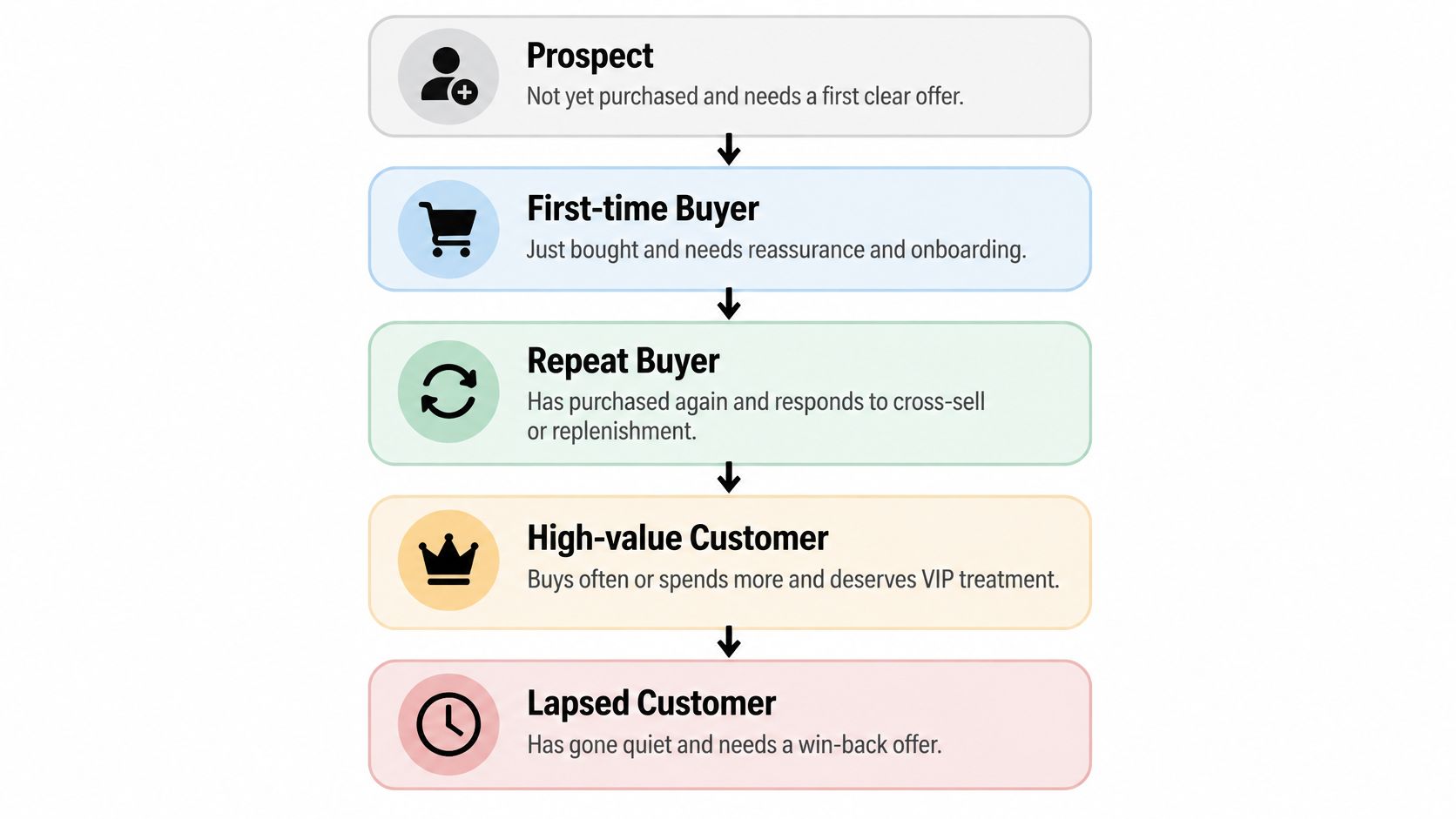
| Customer state | A useful message | What to avoid |
|---|---|---|
| Prospect | A buying guide, with incentives considered after clearer product interest | A discount before understanding the shopper's needs |
| First-time buyer | Instructions for the product just purchased | An immediate loyalty-tier pitch |
| Repeat buyer | A complementary product within a trusted category | Recommending the same durable item again |
| High-value customer | Outfit context, relevant previews, or early access | An undifferentiated sitewide coupon |
| Lapsed customer | A reason to return connected to previous purchases | An indefinite sequence of escalating offers |
These aren't permanent identities. A repeat buyer may qualify as high-value, then become lapsed. Define which status takes priority when messages conflict, and let the underlying purchase record update eligibility.
The commercial stakes are substantial, but attributed revenue still needs careful interpretation. A Klaviyo benchmark covering approximately 1,000 U.S. companies and 1.5 billion emails found that email-attributed purchases exceeded $230 million in Q4 and represented 27% of overall store revenue on average.
Useful ecommerce customer segmentation combines lifecycle state with information that affects the next decision:
Say a coffee subscriber also buys brewing equipment. They might qualify for a grinder-accessory recommendation but not a one-off coffee replenishment reminder already covered by their subscription.
The segment determines who is eligible. The event-triggered flow determines when to act. Updating both promptly reduces the delay between a meaningful customer action and a relevant response.
Retire open rate as a control for scaling or killing flows. Apple Mail Privacy Protection can load tracking pixels without someone reading the message; Technology Therapy's 2025 reporting states that it accounts for more than half of tracked email opens.
An apparent open can therefore represent a machine action rather than attention. Testing subject lines or defining engaged segments around that signal can push your team toward the wrong decisions.
Retention metrics when opens are unreliable
| Metric | Use it to judge | Where it misleads |
|---|---|---|
| Open rate | Almost nothing about purchase intent once privacy preload is common | Automated pixel loading can register unread messages |
| Click rate | Whether a recipient appears to have acted | A click isn't an order, and automated security checks may also create clicks |
| Placed-order rate | Orders within the conversion window | Later direct, search, or SMS purchases may receive misleading channel credit |
| Revenue per recipient | Revenue relative to the audience mailed | A high-intent list mix can flatter a weak offer |
| Repeat-purchase rate | Whether customers place another order | You may claim credit for orders that were already likely |
| Contribution margin | Commercial value after discounts and relevant costs | Revenue can rise while margin falls |
| Holdout incremental revenue | Lift against eligible people who weren't mailed | It requires a genuine randomized non-send group |
| Unsubscribe and complaint rate | Fatigue and potential deliverability damage | A high-revenue flow can still exhaust permission |
Keep metric definitions stable. State whether revenue per recipient uses unique recipients or delivered messages, and whether placed-order rate counts purchasers or orders. Don't compare platform reports until their denominators and attribution windows match.
Clicks help diagnose whether the offer and landing page attract action, but they don't establish business impact. Filter suspicious activity where your platform supports it, then follow the path through to orders.
A customer may click an email, return through branded search, and buy after receiving an SMS. Assigning the entire order to the last interaction doesn't describe the complete journey.
The harder question is whether the customer would have purchased anyway. That's especially important for replenishable products, where a reminder might accelerate an expected order rather than create additional demand.
Revenue credited to an email isn't necessarily revenue created by that email.
Use a randomized holdout to estimate the difference. Randomly assign eligible customers to a mailed group and a non-send group before the flow starts. Keep the holdout out of that flow for the full conversion window while maintaining comparable treatment elsewhere.
Compare revenue and contribution margin per eligible customer, not raw totals from groups of different sizes. Record concurrent promotions and channel exposure, and don't stop the test early because the first purchases look encouraging.
For repeat-purchase flows, inspect subsequent behavior too. An early reorder followed by a longer gap may represent shifted timing, not a lasting increase in demand.
Longer-term ecommerce customer lifetime value helps connect these decisions to the relationship beyond a single send. Use observed purchase cohorts alongside forecasts, and keep assumptions visible.
Promote a flow when revenue per recipient and repeat purchasing remain healthy without worsening unsubscribes or complaints. Use holdout evidence to decide whether scaling adds profitable revenue, rather than merely increasing the amount your dashboard attributes.
AI is more useful as a decision aid than as a copy button. The difficult question isn't whether it can write a recommendation, but whether the customer signal behind that recommendation is appropriate to use.
Privacy preferences deserve a place in that decision. Research summarized by Litmus and included in Shopify's email marketing statistics found subscribers prioritized transparency about data collection at 58%, avoiding third-party sharing at 54%, and control over personal information at 52%.
Zero-party data is information customers deliberately provide, such as quiz answers, preferred categories, or stated shopping needs. Inferred signals come from observed behavior, such as browsing a product page or repeatedly buying a category.
Those signals aren't equivalent. Someone who selects fragrance-free products has expressed a preference. Someone who views a skincare page hasn't necessarily invited a prediction about a health condition.
Use an operating model your team can explain:
The comparison below highlights where AI assistance can help and where human judgment remains necessary.
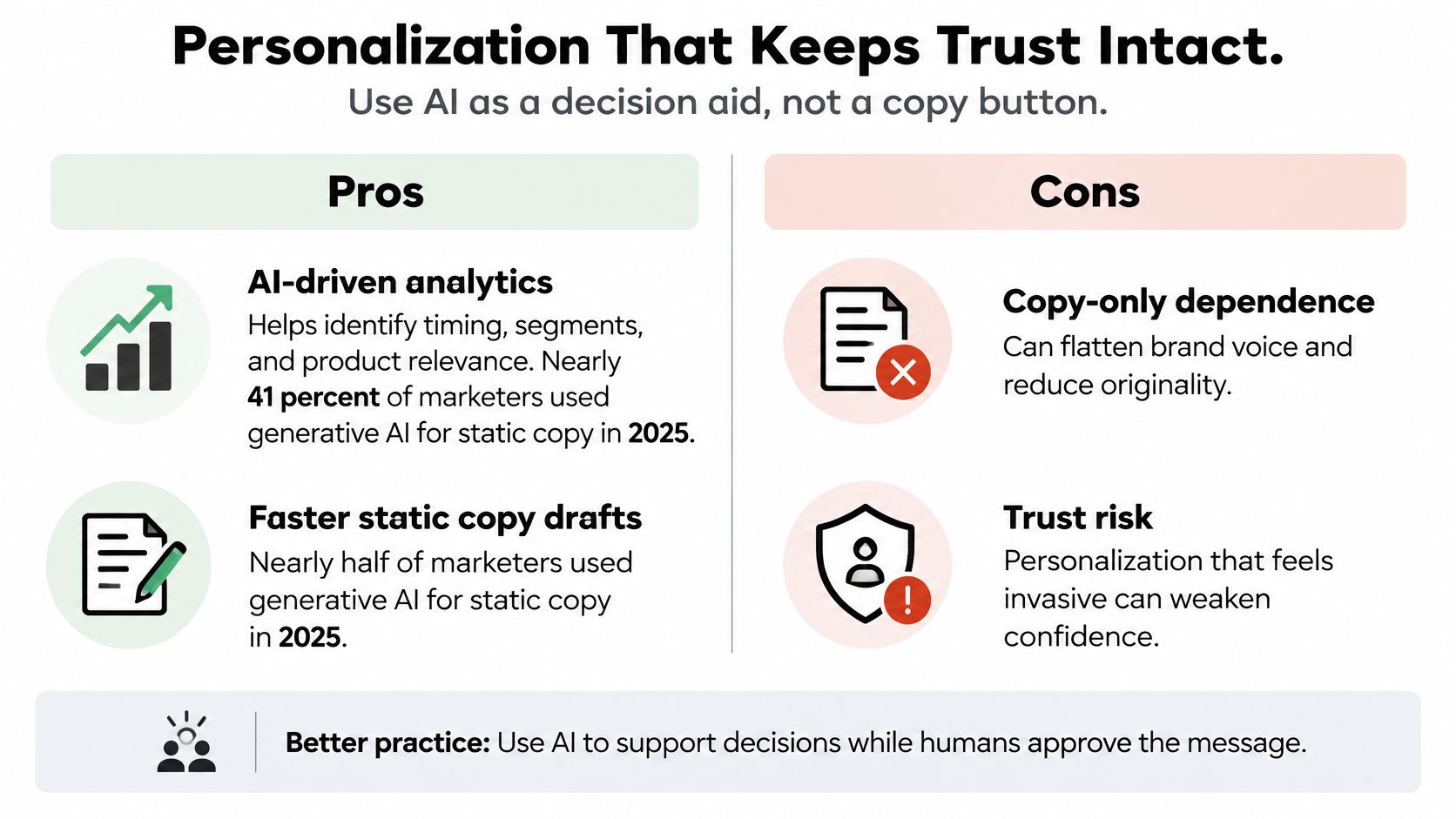
A predictive model might rank an item highly while ignoring reasons not to promote it. Add explicit checks so a recommendation can't feature a sold-out variant, conflict with an active promotion, or duplicate a message already assigned to SMS.
Human review should ask a customer-facing question: would the recipient understand why they received this? If the explanation requires describing a hidden inference they never expected, use a simpler signal.
More personalization isn't automatically better. Compare an AI-driven treatment with a transparent preference-based alternative and a suitable holdout before calling the trigger a win. Evaluate profitable repeat behavior, not whether the recommendation looks impressive.
Two failures make the problem concrete. Recommending a durable product the customer just bought feels careless, even if the model correctly predicts strong interest in that category. Sending a use-up reminder before the customer needs it, especially when a subscription already covers the next delivery, feels pushy.
Accurate prediction doesn't excuse an inappropriate message. Customer context and permission should remain harder constraints than a model's purchase score.
Choose a specific operational gap, not a broad ambition to improve retention. A useful monthly deliverable is a working flow with verified events, appropriate content, tested exits, and an agreed success measure.
Use the core-flow map as a planning prompt, then make the decision in your actual account.
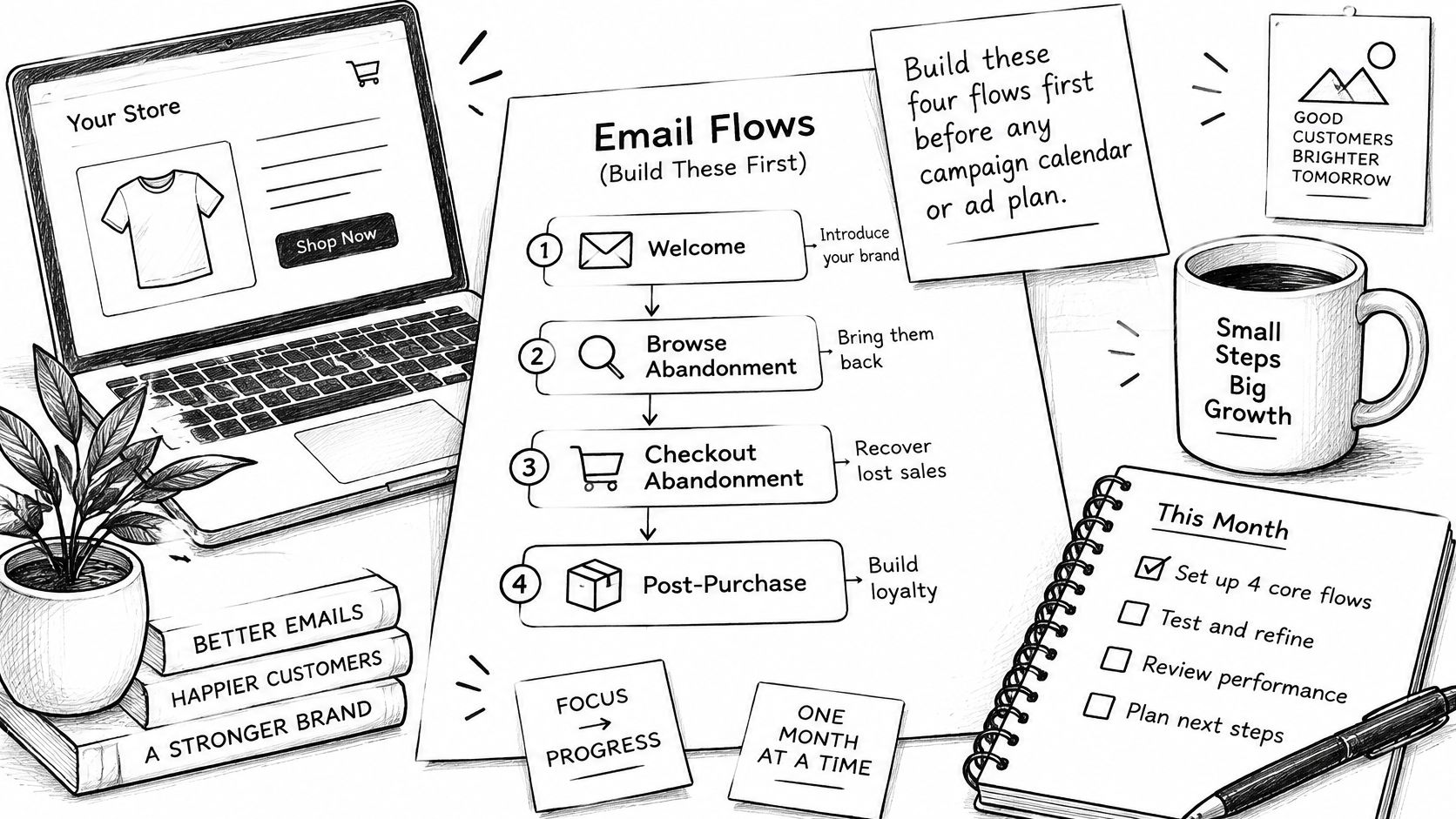
Inspect the foundation. Check welcome, browse abandonment, checkout abandonment, and post-purchase. If any are missing or still reach customers who should have exited, prioritize that gap over another campaign-calendar project.
Rank existing opportunities. Compare revenue per recipient and repeat-purchase rate across relevant flows. Look at customer eligibility and discount use before assuming the highest attributed revenue identifies the best next investment.
Reserve a randomized holdout. Set it up before expanding the chosen flow, and let the declared conversion window finish. Keep the assignment stable so the comparison remains interpretable.
Choose the content path. Use education for high-consideration goods, depletion timing for consumables, and category affinity for fashion. Write the message around the decision the customer needs to make, not the layout your team already has.
Name the deliverable and deciding metric. Assign an owner and write a concrete brief, such as building a coffee replenishment flow judged by incremental contribution margin per eligible customer. Keep unsubscribe and complaint behavior as safeguards, even when a single commercial metric determines whether the flow stays.
If your team can't connect store events, suppression rules, and email design, a done-for-you build is an alternative to assigning more acquisition work. At Class A Media, we build custom Klaviyo email and SMS flows with segmentation and conversion-focused design.
Our email flows drove a 270% increase in revenue for GUIZIO. Our new email system drove a 90% increase in flow revenue for The M Jewelers, and our email strategy led to a 29% increase in sales for STEPR. Those are different business outcomes, not interchangeable benchmarks or guarantees for another store.
Judge external execution by the same standards you apply internally: correct triggers, reliable exclusions, clear commercial definitions, and evidence of additional repeat business. Don't accept attractive creative as a replacement for a working system.
Open your automation account and select the flow to ship this month. Write its entry event, exit conditions, customer promise, and deciding metric into a brief before commissioning the emails.
Class A Media offers custom Klaviyo email and SMS automation built around customer behavior, segmentation, and conversion-focused design. Visit Class A Media to discuss the lifecycle gap you've identified and turn it into a done-for-you flow with a clear repeat-purchase objective.
Let's build retention system that drive predictable, scalable revenue - without ad spend, without retainers, without guesswork.


The Ultimate Ecommerce Email Marketing Agency
Get in touch: hello@classamedia.com