Blog post
Insights
Customer Lifecycle Phases Explained: Stages and Messages
A customer who just placed a first order doesn't need the same message as a regular who buys every month, and neither of them needs what a lapsed buyer needs. Customer lifecycle phases give you a simple way to see where each person sits, what they need next, and when the most helpful move is to pause instead of sending more.
In 2025, Shopify reported a 59% increase in returning shoppers over the previous two years. That's a useful reminder that repeat purchasing isn't an afterthought. It's a growing part of how Shopify stores make money.
Customer lifecycle phases are the stages a shopper moves through from first visit to lapse. Each phase asks your brand a different question. A prospect asks, is this worth trying. A first-time buyer asks, did I choose well. A loyal customer asks, do you recognize me.
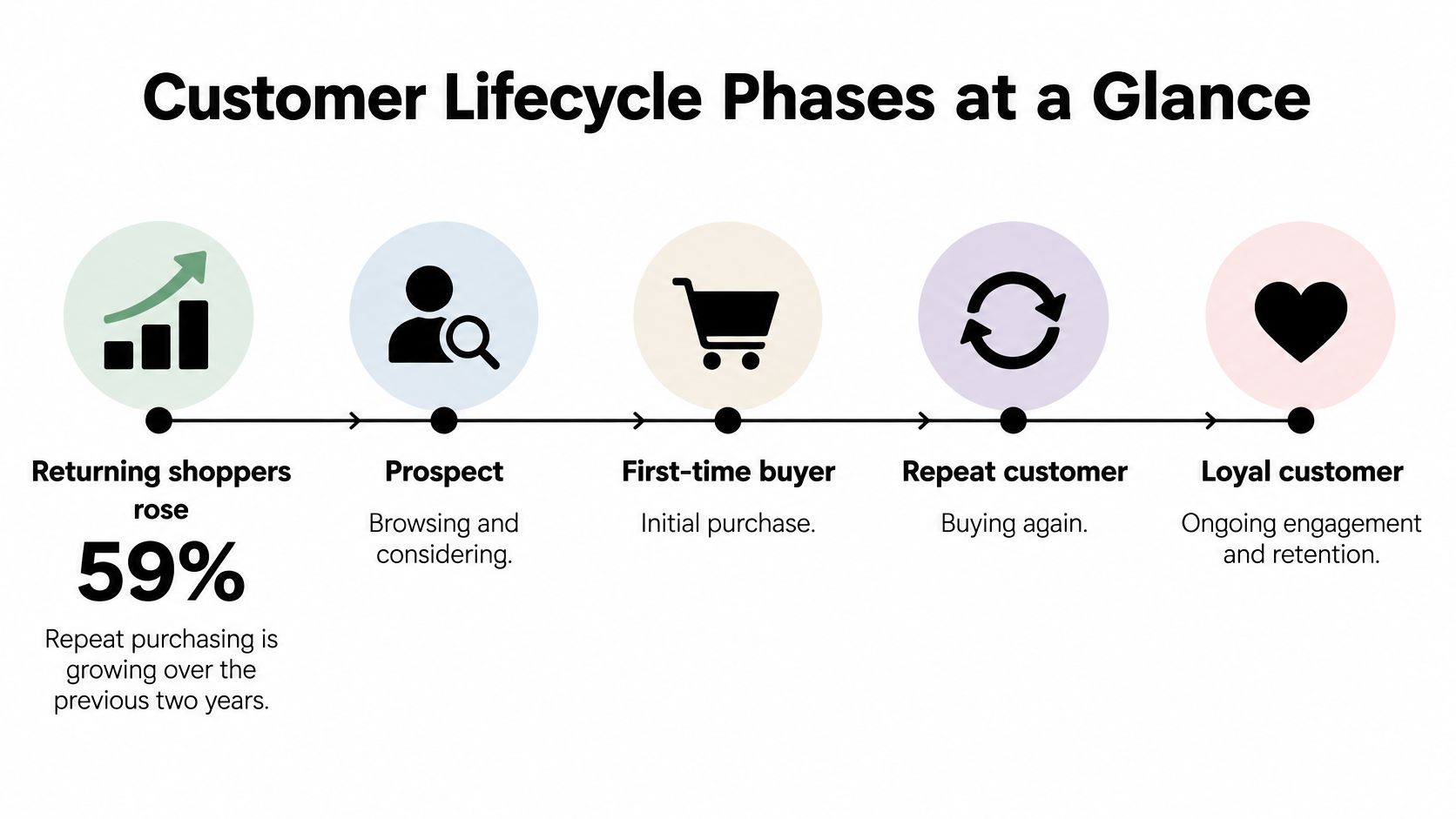
| Phase | Customer state | Main goal | Key signal |
|---|---|---|---|
| Prospect | Has visited but not yet bought | Turn the visit into a first order | Visited or added to cart |
| First purchase | Has placed one order | Activate and set expectations | One order, no reorder yet |
| Post-purchase adoption | Is using the product | Build confidence and reduce returns | Product in use in the first 30 days |
| Repeat purchase | Has placed two or more orders | Reinforce the buying habit | Second order placed |
| Loyalty | Buys regularly and may refer others | Deepen the relationship | Frequent buyer or referrer |
| Lapse and win-back | Has stopped buying | Re-engage or let the relationship go | No order past the expected interval |
These phases aren't a one-way conveyor belt. A loyal buyer can go quiet, move into lapse, then return after a seasonal launch and become a repeat buyer again. Your job is to notice the move, not force everyone through the same sequence.
Think of a café. A stranger peers at the menu. Someone orders a first coffee. A regular has a usual order and brings friends. You wouldn't greet all three the same way, and lifecycle messaging works the same way. If you want to connect journey mapping with live analytics as you build this view, you can connect journey mapping with live analytics to see phase changes as they happen rather than weeks later.
A new customer is often your most expensive customer. You've paid for the ad, the discount, the shipping offer, and the support time that comes with a first order. If that person never buys again, you may not recover what you spent to win them.
That math changes as the relationship continues. Newly acquired customers can be unprofitable early on because acquisition costs are high, while service costs often decline and purchase volume rises over time. Bain & Company's research puts a figure on the upside: a 5% increase in customer retention can raise profits by 25% to 95%, with the result varying by industry and business model.
Acquiring a new customer is widely understood to cost considerably more than retaining an existing one, which is why the second and third orders carry so much of the financial weight.
Say a loyal buyer who has ordered eight times receives your first-purchase welcome discount. You've treated a regular as a stranger and trained them to wait for a code they didn't need. Now reverse it. A first-time buyer receives a VIP invitation before their product arrives. They don't feel like a VIP yet. They feel confused about a relationship that hasn't started.
Each phase needs its own message because each phase solves a different problem.
Matching the message to the phase also means knowing when to hold back. A loyal buyer doesn't need another discount, and a contact who has ignored several win-back emails may need silence rather than one more. Relevance includes restraint. Every send asks for attention the customer hasn't promised to keep giving, and the best-matched message is sometimes no message at all.
Lifecycle programs are not simply communication sequences. They're how you extend customer tenure, increase transaction frequency, and spread the original acquisition cost across more orders.
Treat the Bain figure as directional rather than a forecast. The research spans different industries and service contexts, so it won't predict your store's numbers exactly. It does give you a clear case for a budget owner: if retaining a customer costs far less than replacing them, phase-specific post-purchase and repeat-purchase flows deserve funding before you buy more traffic to fill a leaky first-order experience.
You don't need a complex model to start. You need order history, a usual reorder interval, and rules your team applies the same way every month. The Optimizely Data Platform guidance on analyzing customer lifecycles separates customers by purchase progression, such as one-time purchaser, repeat purchaser, and loyal customer, and calculates stage conversion from those groups.
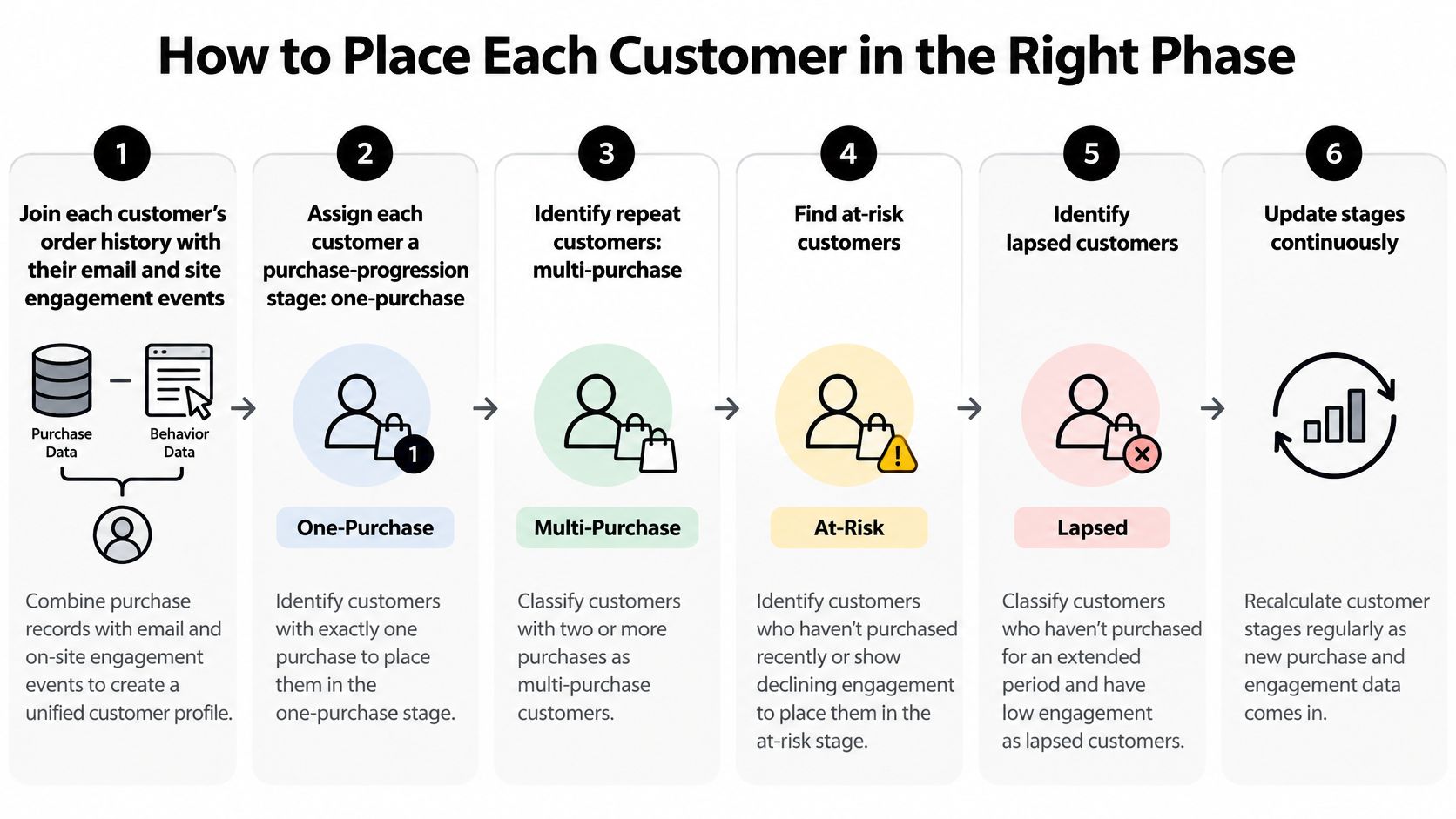
Say you have 600 one-purchase customers, 250 repeat customers, and 150 loyal customers. Your one-purchase conversion is (250 + 150) ÷ 1,000, which is 40%. In plain language, 40% of buyers who reached at least one purchase made it beyond that first order.
That single number is more useful than a blended retention figure because it points to a fix. If one-purchase conversion is weak, improve onboarding and reorder timing. If repeat buyers don't become loyal, look at recognition and product range.
For a broader view of grouping buyers by behavior and value, customer segmentation insights from ELECTE can help you separate simple phase rules from deeper segments. You can also build on these rules with practical ecommerce customer segmentation once your phase counts are stable.
Map the six phases directly from the signals. A prospect has visited or added to cart with no order. First purchase means one order and no reorder yet. Post-purchase adoption means the product is in use in the first 30 days. Repeat means a second order. Loyalty means three or more orders, frequent buying, or a referral. Lapse means a recency ratio above 1.
Keep open and click rates as diagnostic tools. They tell you whether a message got attention, but they don't tell you whether a customer moved to the next phase. Stage conversion, time between orders, revenue per customer, and cohort retention are the measures that show real progress.
Good lifecycle messaging follows what the customer just did. It doesn't blast the same campaign at everyone and hope timing works out.
A prospect who browses a product or abandons a cart needs a timely reminder tied to that exact product. Send email first. Use SMS only when the person has clearly opted in to texts. Answer the obvious objection in the reminder, such as sizing, ingredients, shipping time, or returns, rather than repeating a generic discount.
After a first purchase, slow down and orient the buyer. Confirm the order, explain when it will arrive, and tell them what to do when it lands. A customer who knows what to expect is less likely to contact support in a panic or return a product they never learned to use.
During the first 30 days, teach before you sell. Send usage tips, care instructions, or a short routine that helps the customer get a result. Ask for a review only after they've had time to use the product properly.
Cross-sells belong after use is confirmed. If someone bought a serum, a matching moisturizer makes sense once they're using the serum. Sent on day one, the same suggestion feels like a cash grab.
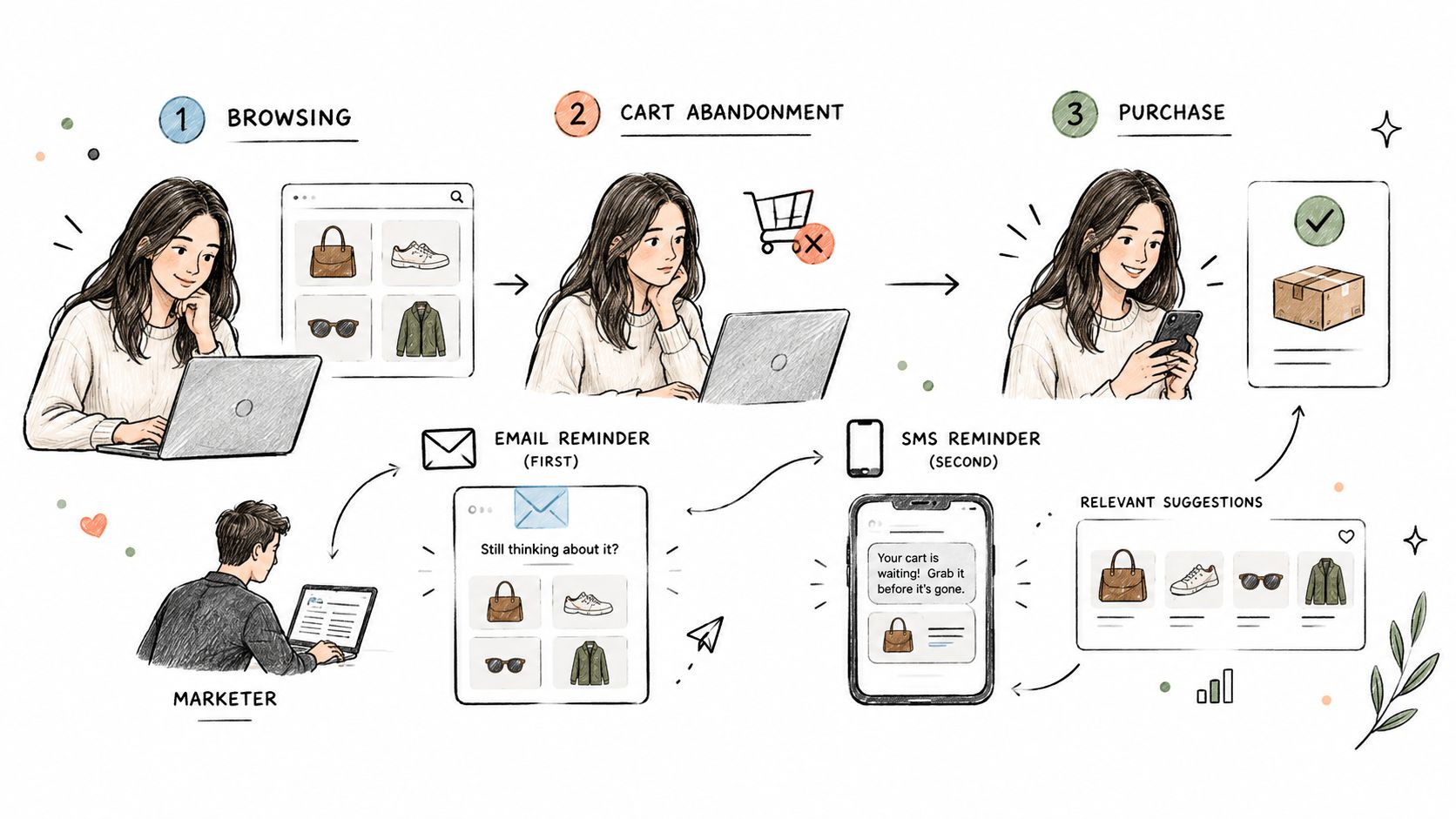
Time replenishment reminders to the expected reorder interval. Email can carry the explanation and product choice. Reserve SMS for time-sensitive restock or delivery updates, where speed matters.
Loyal customers usually respond better to recognition than to another discount. Give early access to a launch, a tier that names their status, or a referral invitation they can share without awkwardness. You're rewarding a habit, not bribing someone to form one.
Start win-back only after the expected purchase interval has passed. Offer a new reason to return, such as a product improvement or a category they haven't tried, and ask them to update preferences. A lapsed customer who tells you they only want seasonal launches is still reachable. A lapsed customer who unsubscribes is not.
A structured sequence like this is easier to manage when you treat it as a drip email campaign built around behavior rather than a fixed blast calendar.
Say a skincare brand sells a product with a 45-day usage cycle. Day 0 is a thank-you and delivery note. Day 5 is a routine guide. Day 40 is a reorder email before the bottle runs out. Day 45 is a short SMS if no order has arrived and the customer opted in. Day 60 is a win-back with a preference update, because the normal interval has now passed.
A commonly cited Marketing Metrics benchmark in Omniconvert's summary of retention benchmarks places the probability of selling to an existing customer at 60% to 70%, compared with 5% to 20% for a prospect. That's a gap of 40 to 65 percentage points, and it's why phase progress matters more than raw list growth.
Don't use one metric for every phase. Retention rate tracks whether customers remain active over a defined period. Repeat-customer rate tracks whether buyers make another purchase. Those numbers can move in different directions when your time window doesn't match your purchase cycle.
Define three things before you judge any result. Name the observation window, the cohort, and the event that counts as progress. A food brand may judge replenishment within weeks. A fashion brand may need a season, because a customer who buys a coat in October may not need another major piece until spring.
| Metric | Phase measured | What it shows | Common pitfall |
|---|---|---|---|
| First-to-second order conversion | First purchase to repeat | Share of first-time buyers who return | Measured too early in long purchase cycles |
| Time to second purchase | First purchase to repeat | Speed at which the buying habit forms | Median skewed by a few very late buyers |
| Retention rate by cohort | All phases | Share of a cohort still active in a set window | Window does not match the purchase cycle |
| Repeat-customer rate | Repeat purchase | Share of buyers who purchase again | Ignores how much each repeat order is worth |
| Revenue per retained customer | Loyalty | Value of customers the brand has kept | Hides margin differences between products |
| Customer lifetime value | Loyalty and lapse | Total value across the relationship | Needs gross margin and acquisition cost to be meaningful |
| Open and click rate | Diagnostic only | Engagement with individual messages | Mistaken for customer value |
Read the table as a chain. First-to-second order conversion tells you whether new buyers come back at all. Time to second purchase tells you whether your timing is early, late, or about right. Cohort retention tells you whether a specific month of buyers behaved better or worse than the buyers before them.
Customer lifetime value needs context before it means anything. Compare it with gross margin and acquisition cost, as explained in this guide to customer lifetime value in ecommerce. A high lifetime value built on heavy discounting can still lose money.
Practical rule: Opens and clicks describe a message. Stage movement describes a customer. Judge your lifecycle program on the customer.
One universal sequence will mistime almost everyone. Shopify's benchmark summary reports repeat-customer rates of roughly 22% to 44% for consumables, 10% to 17% for fashion, and 7% to 18% for durable and home-goods categories.
The reason is simple replenishment. Consumables run out and create a natural next purchase. Fashion purchases follow seasons, events, and taste. Durable goods can last for years, so the next opportunity may be an accessory or upgrade, not a replacement.
| Category | Repeat-customer rate | Replenishment pattern | Lifecycle emphasis |
|---|---|---|---|
| Consumables (food, beverage, health) | 22% to 44% | Predictable depletion | Depletion-timed reminders and subscription prompts |
| Fashion | 10% to 17% | Seasonal or irregular | Styling advice, complementary products and seasonal launches |
| Durable and home goods | 7% to 18% | Long replacement cycles | Warranty education, accessories and upgrade offers |
Food, beverage, and health brands should build around predicted depletion windows. If a supplement lasts 30 days, your reminder belongs shortly before day 30, with a subscription prompt for customers who reorder on time. Cross-sells work when they fit the same routine.
Fashion brands need a different rhythm. Post-purchase styling advice helps the first item earn its place in the wardrobe. Complementary products, seasonal launches, and event-based reactivation give customers a reason to return when there's no depletion date pushing them.
Durable-goods brands should think in a longer horizon. Warranty education builds confidence after purchase. Accessories extend the product's usefulness. Upgrade offers belong much later, when wear, new features, or a changed household makes replacement sensible.
Build cohorts by first-order month so you compare like with like. Track subsequent orders, spend, average order value, acquisition channel, geography, and subscription status for each cohort. A cohort bought through a deep-discount campaign may repeat at a lower rate than a cohort that arrived through search, and you won't see that in a blended average.
Don't chase the industry range for its own sake. The actionable benchmark is whether each cohort moves from first purchase to second purchase within the window that your gross margin and acquisition cost make economically viable. Check these published ranges against your own cohort data before you reset targets, because your product price, usage cycle, and discount policy can move the right window by weeks or months.
More messages don't automatically mean a healthier lifecycle. In The 2025 Digital Commerce Imperative from Publicis Sapient, 84% of shoppers across Australia, France, Germany, the U.K., and the U.S. want to customize the types of brand messages they receive by channel, while 16% abandon a brand after one irrelevant message and 29% do so after two or three.
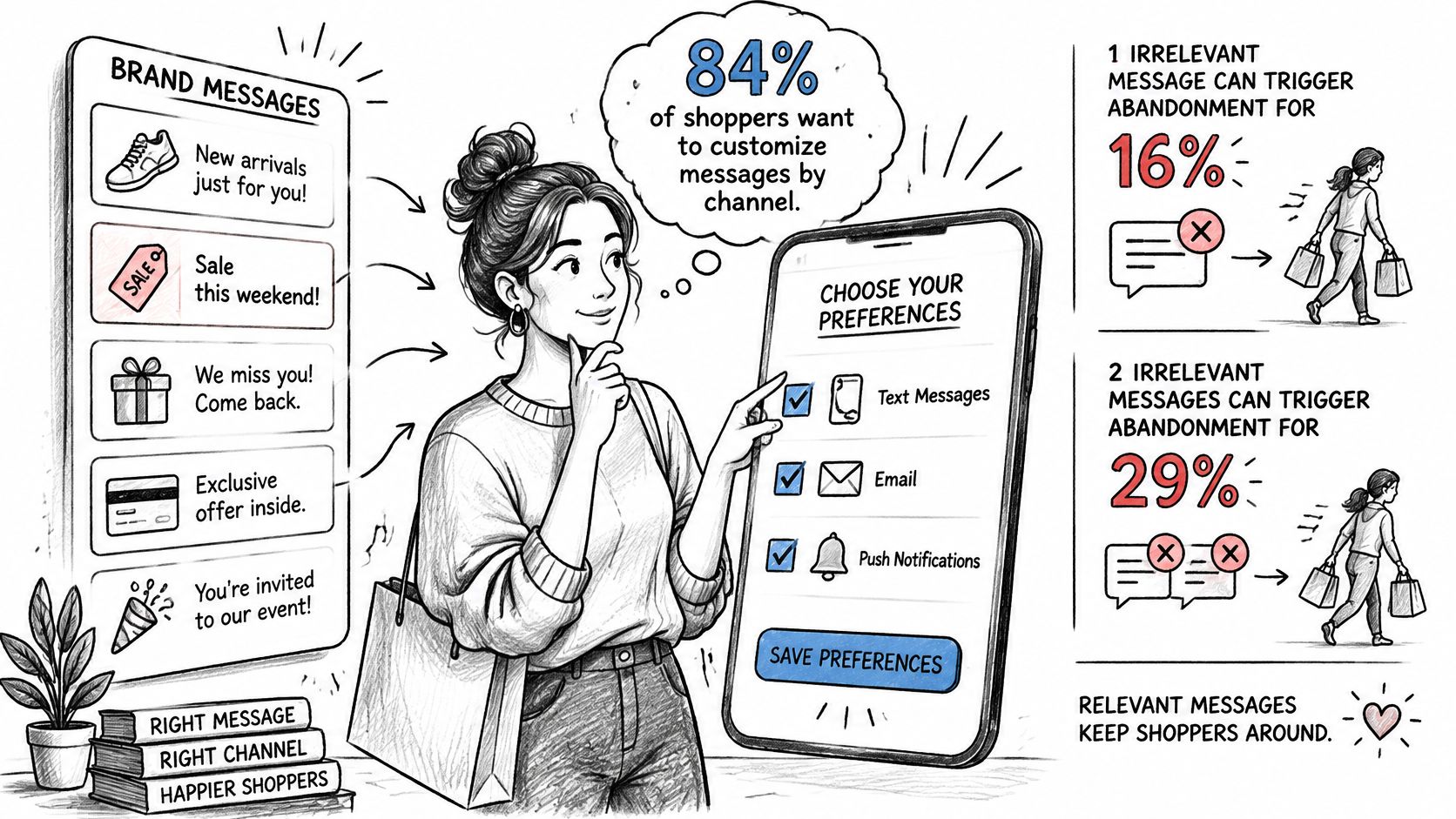
Treat relevance as a phase of its own. Alongside purchase status, track communication health through recent complaints, skipped sends, channel preference, inactivity, and message fatigue.
Trust decides whether customers accept this automation at all. Adobe's 2025 AI and Digital Trends retail report found that 87% of consumers expect retailers to protect personal data, but only 46% believe brands do so, and 74% want clear disclosure when AI is used in content, recommendations, or imagery.
The video below walks through preference and timing choices you can apply before your next automated send.
Make every automated message explainable and reversible. A customer should understand why they received it and be able to opt down or delete their data without hunting. Don't let AI act on its own for sensitive health products, unusual order patterns, or low-confidence predictions. In those cases, restraint protects both the customer and your sender reputation.
Start where customers stop moving. Compare each stage conversion rate with the benchmark your own cohorts have set, then repair the weakest handoff first. Fixing a later phase won't help if most buyers never reach it.
If first-time buyers rarely reach a second order inside your category window, fix first-purchase onboarding and post-purchase adoption before anything else. Check delivery expectations, product education, and reorder timing. Those early flows decide whether acquisition spending ever gets repaid.
If repeat buyers convert well but loyalty stalls, your problem is recognition, not reminders. Add early access, meaningful tiers, and referral invitations for customers who already buy without heavy discounts. If lapse counts grow faster than repeat counts, rebuild win-back timing around the recency ratio and suppress sends to people who have stopped engaging across orders, visits, and messages. You can use data insights to prevent churn when you need to separate slow buyers from customers who have clearly left.
Rebuild the whole sequence only when several phases fail the same window test. A full rebuild resets what you've learned in every flow.
Before you change anything, confirm that stage counts are stable for at least one monthly review cycle. A sale week or stock shortage can distort movement for a few days. Once the pattern holds, choose one path. Fix the first weak phase now, or schedule a full rebuild after the next review if the failure is spread across the lifecycle. Clients start by scheduling a call to get a custom plan.
If your Shopify brand has basic welcome and cart flows but weak movement from first purchase to repeat purchase, Class A Media builds custom email and SMS lifecycle systems around your product timing, segments, and reorder windows. Start with a focused plan for the phase that's leaking customers, then expand the flows that earn their place. Visit Class A Media to schedule a call and map your next repair.
Let's build retention system that drive predictable, scalable revenue - without ad spend, without retainers, without guesswork.


The Ultimate Ecommerce Email Marketing Agency
Get in touch: hello@classamedia.com