Blog post
Insights
Customer Segmentation Ecommerce: Methods for Shopify
78% of consumers said personalized content made them more likely to repurchase, according to McKinsey's consumer research. That's a reason to make your messages relevant, not a reason to send more of them. For a Shopify merchant, customer segmentation should answer a harder question: which message will create a profitable purchase that wouldn't otherwise happen?
A corner-shop owner remembers the regular who buys oat milk every Thursday. They greet a first-time visitor differently from someone who's shopped there for years, and they don't recommend something the customer just bought.
An online store can't recognize faces across the counter. Instead, you use order history, stated preferences, and permitted behavioral signals to remember what matters.
The everyday-shop analogy captures the idea:
Customer segmentation in ecommerce means dividing customers into groups with shared characteristics or behaviors so you can change their messages, offers, or timing. A recent buyer might need product-care instructions. Someone approaching a refill date might need a reorder reminder.
A segment isn't the same as a persona. A persona describes a type of shopper; a segment contains identifiable customers who meet an observable rule. Reddog Consulting Group's guide to understanding customer segmentation provides useful context for that distinction.
Practical rule: If a segment doesn't change a decision, it's a reporting label, not a retention strategy.
Say you sell coffee through Shopify. A customer who bought a grinder needs different guidance from someone who regularly orders beans, even if both live in the same city.
You can translate that difference into action by:
Segmentation organizes your decisions. It can't fix a poor product experience, an irrelevant recommendation, or an offer that costs more than the additional purchases earn.
The methods below differ in what you need to collect, what decision they support, and how much maintenance they require. Use this comparison to choose a starting point, not to build every audience immediately.
Segmentation methods by data, retention use and effort
| Method | Data it needs | Retention use | Setup effort |
|---|---|---|---|
| Demographic | Age, gender, location from sign-up forms | Tailoring creative, sizing and product lines | Low |
| Geographic | Shipping address and time zone | Send timing, regional offers and shipping cutoffs | Low |
| Lifecycle stage | First order date, last order date, order count | Welcome, post-purchase and win-back flows | Low |
| RFM | Order date, order count, order value | Ranking customers by value and urgency | Low to medium |
| Purchase behavior | Product and category history | Cross-sell and replenishment messages | Medium |
| Engagement | Opens, clicks, site sessions | Suppressing inactive contacts and setting cadence | Medium |
| Preference (zero-party) | Quiz answers and preference center choices | Matching product lines and content topics | Medium |
| Predictive clustering (k-means) | RFM plus order value, interval and category data | Grouping customers for purchase forecasting and budget allocation | High |
Lifecycle stage and RFM use information you already hold in your order records. Geographic rules are also straightforward, especially when delivery availability or seasonal merchandising genuinely changes the offer.
Demographic fields can help with creative, but they don't tell you whether someone needs another product. Don't infer a customer's gender, household, or interests from a gift purchase.
A 2023 review of 105 academic publications published between 2000 and 2022 identified manual feature selection and RFM as the most common customer representations, with k-means the most frequently used analytical method. Popularity doesn't make clustering the right first investment for your store.
Purchase behavior becomes useful when you can connect products to a plausible next need. Preference data offers a more direct instruction: if someone asks for running content, don't substitute a guess based on their postcode.
Treat engagement records as supporting evidence, not a ranking of customer worth. An absent open or session isn't proof that someone has lost interest.
Silver Spoon Agency's email segmentation tactics for growth can help translate audience choices into campaign ideas. Start with order-based groups, then add a signal only when it changes the message.
RFM stands for recency, frequency, and monetary value. A Shopify order export gives you the foundation, and a spreadsheet is enough to create an initial working model.
The ecommerce segmentation review published in Information Systems and e-Business Management identifies RFM-based customer representation followed by clustering as a recurring approach. You don't need clustering software to begin: transparent rules are easier to inspect while you're learning your customers' patterns.
This process turns order records into usable measures:
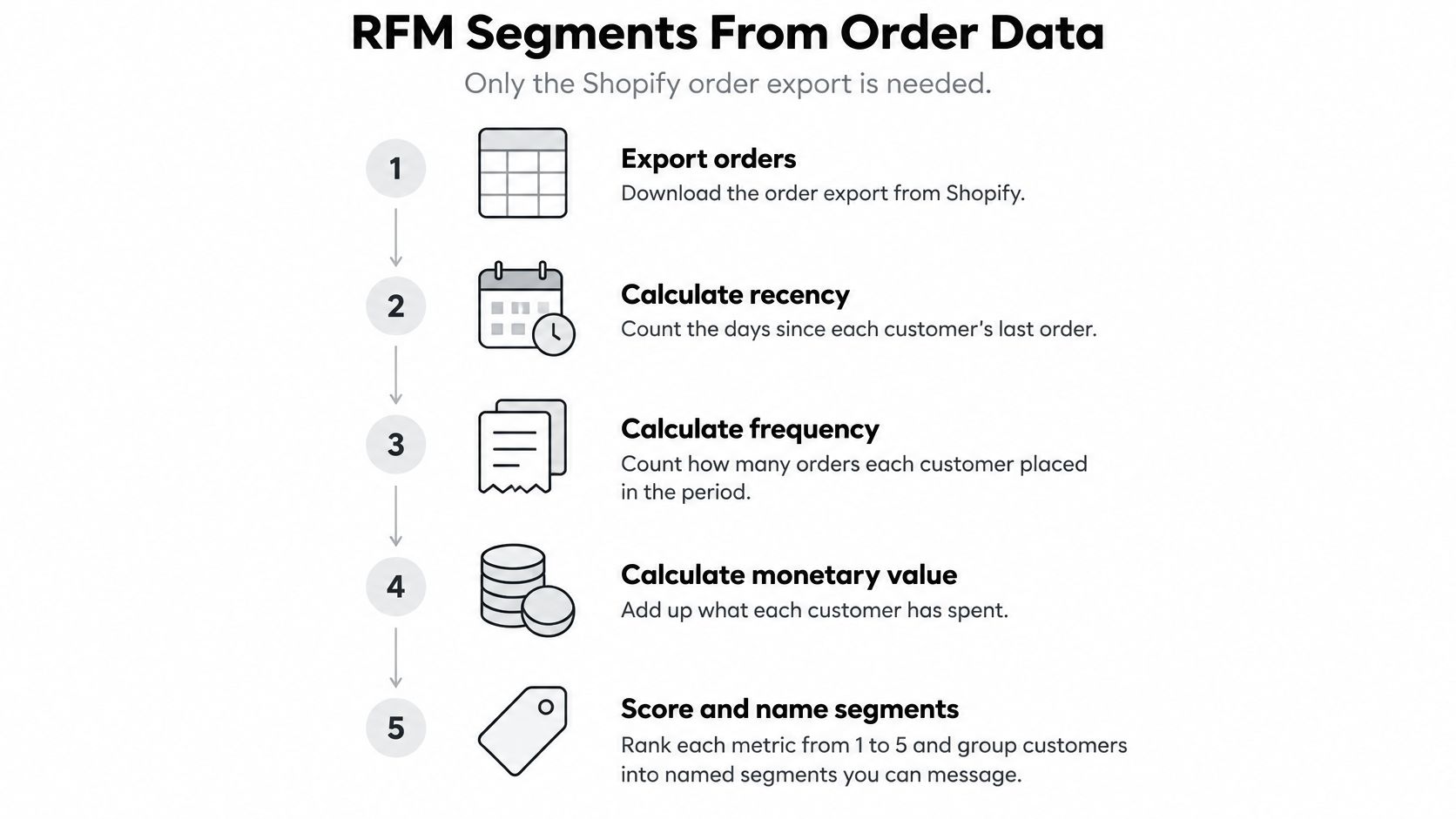
Export qualifying orders. Include customer ID, order ID, order date, order status, and order value. Choose a history window that includes your normal buying cycle, remove test and canceled orders, and account consistently for refunds.
Create a customer-level summary. Calculate days since the latest qualifying order, the count of distinct orders, and total net spend. Don't count Shopify line-item rows as separate purchases.
Rank each measure. Give more recent customers a higher recency rank, more frequent purchasers a higher frequency rank, and higher spenders a higher monetary rank. For example, you could use a hypothetical five-point scale, with five representing the strongest result.
Watch for tied scores. If most customers have only purchased once, equal-sized scoring bands can split identical buyers arbitrarily. Keep ties together or use explicit rules based on qualifying order counts instead.
Translate scores into actions. Use names such as Champions, Loyal, New Buyers, At Risk, and Hibernating. Define New Buyers directly from order history, since relative frequency rankings alone won't reliably identify them.
Inspect actual customer records. Check whether the names fit, whether the audience is reachable, and whether each group needs a distinct intervention. Merge groups that would receive the same treatment.
Schedule refreshes and exits. Recalculate scores on a documented schedule, while removing purchasers promptly from messages that no longer fit. A completed order should stop an inappropriate win-back reminder.
Monetary value is historical spend, not future profit. Your model won't account for product costs, returns, or likely future purchases unless you add them. A separate customer lifetime value calculation helps distinguish what someone has spent from what retaining them may be worth.
For a visual companion to the spreadsheet workflow, use this walkthrough:
Before activating a group, write its inclusion rule, exclusion rule, intended message, and exit condition. That short specification prevents a useful spreadsheet from becoming a collection of stale mailing lists.
RFM describes what a customer did. A predictive model estimates what they might do next. Adding more fields doesn't automatically create a prediction, and creating clusters doesn't automatically forecast a purchase.
The useful question is whether an added signal changes timing, product selection, channel, or expected profitability.
Behavioral signals and what each reveals
| Signal | Where to get it | Segment it reveals |
|---|---|---|
| Average order value | Shopify order totals | Candidates for bundle and higher-price collection tests |
| Interpurchase interval | Gaps between consecutive orders | Customers approaching a likely replenishment window |
| Discount dependence | Share of orders placed with discount codes | Promotion-sensitive candidates to evaluate before SMS |
| Product category | Order line items and collections | Cross-sell paths and category-specific flows |
| Time since last session | Site analytics, where permitted | Customers whose observed browsing has declined |
| Channel engagement | Email and SMS clicks and replies | Customers showing a preference for a channel |
An online-retail study on extended RFM segmentation adds repurchase time, average order value, and interpurchase time, using clustering and a subsequent prediction stage to distinguish regular, occasional, and high-frequency purchasing groups.
For your store, calculate features across recent, medium-term, and longer-term windows. Otherwise, an old expensive purchase can dominate the profile of someone whose current activity has declined.
Then estimate the likelihood of a purchase during the relevant replenishment window. Pair that estimate with contribution margin and expected incentive cost, rather than selecting recipients on purchase probability alone.
A large average basket doesn't prove someone likes bundles. A discounted order doesn't prove the customer needed a discount. Treat those interpretations as hypotheses to test.
Your ecommerce CRM setup should preserve timestamps and distinguish observed events from calculated scores. That makes it possible to explain why someone entered a flow and identify whether missing events affected the decision.
Compare predictions with simple rules using future purchases, not the transactions used to build the model. Check ranking quality, calibration, incremental repeat revenue, and cost per retained customer. Keep the model only if the operational improvement justifies its complexity.
What do I send each group? Start with the customer's likely next need, then choose a message that helps with it. The rules below are templates to adapt to your catalogue's buying cycle, not universal deadlines.
Segment rules, messages and what to avoid
| Segment | Rule | Retention message | Avoid |
|---|---|---|---|
| New first-time buyers | A qualifying first order within the onboarding window | Second-purchase education and relevant cross-sell | Heavy discounts before establishing value |
| Loyal repeaters | Repeated orders and a recent purchase within their normal interval | Early access and loyalty recognition | Constant promotions |
| High-value lapsing | Highest spend band and overdue against their established purchase interval | Personal win-back with a service angle | Generic newsletters |
| Discount-driven one-timers | A discounted first order without a repeat after the expected return window | Full-price product stories | Repeated discount offers and SMS blasts |
| Dormant | No order beyond the store's defined inactivity window | Short sunset sequence, then suppression | Daily sends |
For new buyers, explain how to use, fit, maintain, or enjoy the purchase before recommending another item. A relevant accessory can follow naturally; an immediate coupon may only reduce the margin on an order they already intended to place.
Loyal repeaters can receive recognition or relevant early access. For a high-value lapsing customer, a restock check-in or help finding a replacement may be more useful than another broad newsletter.
Discounted first purchases require caution. You know a code was used, but you don't know whether it caused the sale. Test product benefits at full price before assuming the customer will only respond to promotions.
For Seat Cover Solutions, we segmented the audience into first-time purchasers, high-LTV customers, and dormant leads. Those categories distinguish different relationships with the business; they shouldn't be treated as interchangeable recipients.
A drip email campaign needs purchase exits, eligibility checks, and a clear end. Dormant customers shouldn't remain in an indefinite reactivation loop.
Set a customer-level contact cap across campaigns and flows, plus a priority order for overlapping messages. A helpful post-purchase email should take precedence over an outdated win-back offer.
A responsive segment can still lose money. Customers may redeem an offer they didn't need, purchase products with weak margins, or bring forward an order rather than create an additional one.
Shopify's guidance on direct-to-consumer retention recommends evaluating cohorts through repeat-purchase rate, customer lifetime value, contribution margin, acquisition-cost payback, revenue per recipient, unsubscribes, and complaints. Opens and clicks don't tell you whether the intervention was worthwhile.
Randomly divide eligible customers within a segment into a treatment group and a holdout. The treatment receives the lifecycle intervention; the holdout doesn't receive the messages under test.
Choose the holdout size and observation window before launch, based on audience size and purchase timing. Keep transactional communications unchanged and document which other marketing both groups can receive.
In an email or SMS platform, save group membership before sending. Later, join Shopify orders to those customer IDs and compare:
Account for fulfillment, payment fees, discounts, and returns without deducting the same cost twice. Measure everyone assigned to each group, not just people who opened or clicked.
A campaign earns its place when the additional contribution exceeds the cost of creating it.
Last-click attribution can't establish that result. Email, SMS, paid media, and organic visits may all touch the same customer, so keep the experimental comparison separate from platform-attributed revenue.
Use this checklist before accepting the result:
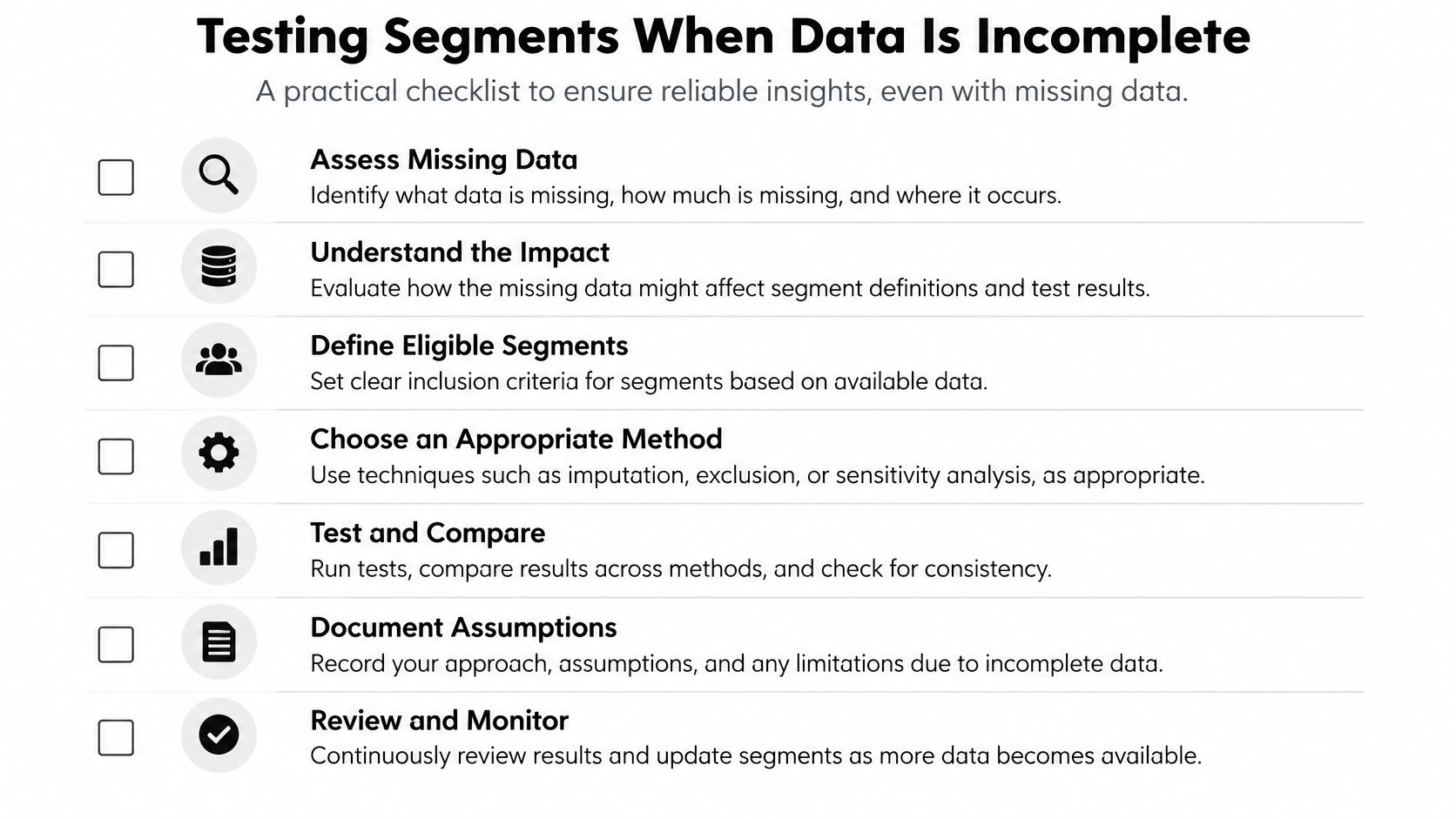
Shopify's explanation of customer reporting discrepancies notes that cookie banners and regional consent requirements can reduce recorded sessions and other analytics inputs. Browsing-based segments can therefore overrepresent customers whose activity you're permitted to observe.
No recorded session means unknown activity, not necessarily inactivity. Start with permitted purchase records and voluntarily supplied preferences, while preserving channel permissions, suppression rules, and deletion requests.
Compare treatment and holdout customers with similar data availability. Don't compare a highly observable personalized audience with an untracked audience and credit the difference to personalization.
Small groups can produce unstable results. Extend observation or merge groups with the same intended treatment rather than declaring success from a handful of purchases. A spreadsheet can support this test, but it can't make an undersized experiment conclusive.
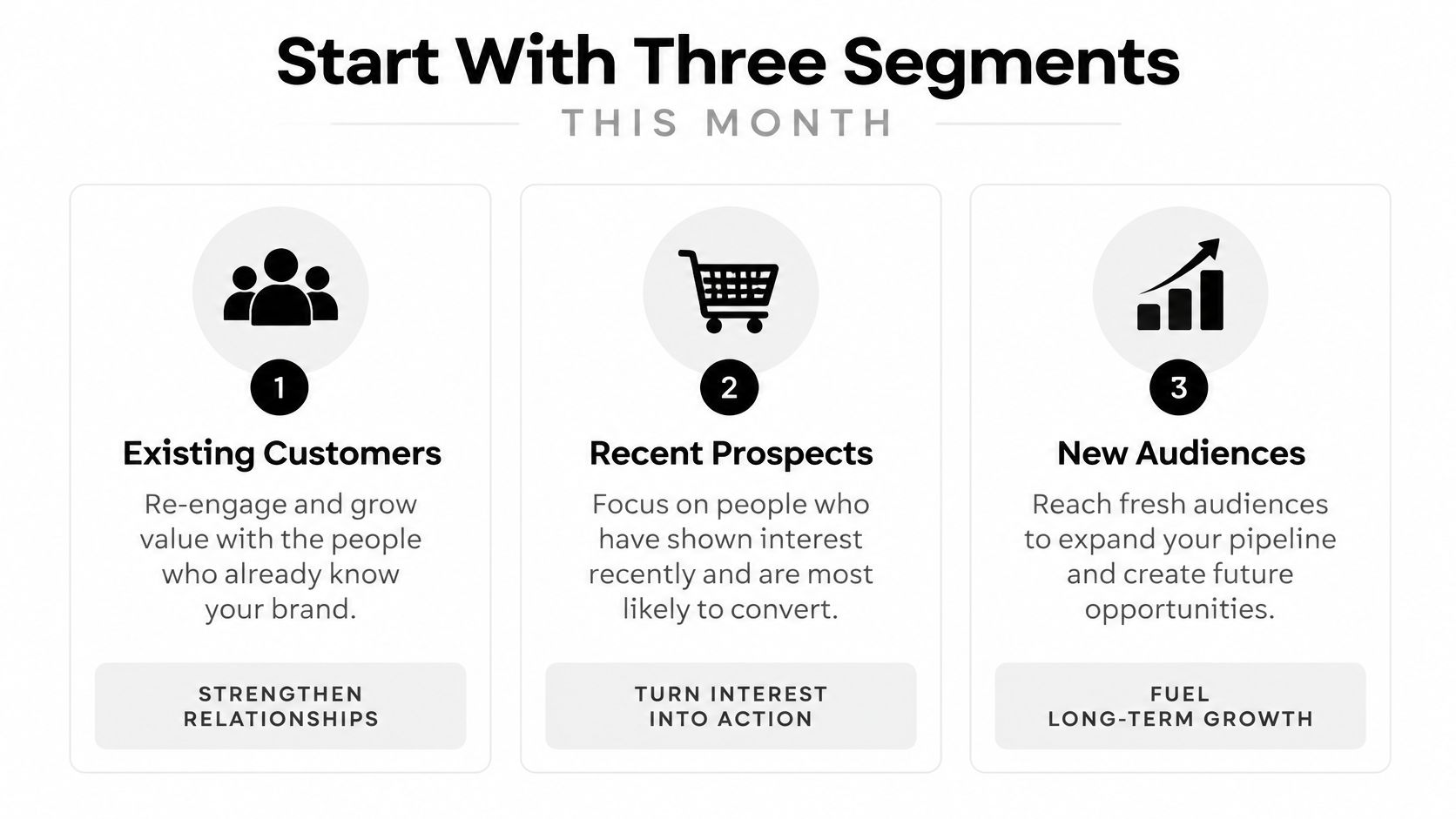
Start with new first-time buyers, high-value lapsing customers, and dormant customers. They give you distinct decisions to improve: the next purchase, the recovery of valuable relationships, and the removal of wasteful contact.
Don't build more audiences than your team can write for, maintain, and evaluate. A smaller system with clear ownership is more useful than an elaborate set of rules nobody checks.
Use this visual as a reminder to keep the initial audience structure manageable:
You can run this manually if someone owns the export, messaging rules, and evaluation. Outside help is an alternative when your team can't reliably complete those tasks, not a prerequisite for segmentation.
We've built retention systems for over 200 ecommerce brands, and our service is built for brands of all sizes and in every vertical. Our email and SMS flows have generated over $150 million in attributable revenue, but attributable revenue isn't the same as incremental profit. Keep that distinction in your reporting regardless of who builds the system.
Class A Media builds custom email and SMS retention flows around customer behavior, purchase history, and lifecycle needs. Visit Class A Media to discuss a scoped segmentation and automation project, including which customer groups to prioritize and how you'll evaluate their commercial results.
Let's build retention system that drive predictable, scalable revenue - without ad spend, without retainers, without guesswork.


The Ultimate Ecommerce Email Marketing Agency
Get in touch: hello@classamedia.com