Blog post
Insights
Ecommerce and CRM: How Customer Data Drives Repeat Sales
A shopper returns to your candle store a few weeks after buying a gift set. Your email greets her by name and makes it easy to find her favorite scent again. Meanwhile, another customer is still waiting for a delayed order, yet receives a cheerful promotion asking them to buy more.
Both experiences depend on how you connect ecommerce and CRM. The useful system isn't the one that sends the most messages. It's the one that knows enough to help, recognizes when to stay quiet, and lets you test whether its messages actually create additional sales.
An ecommerce CRM, short for customer relationship management system, brings customer information into a shared record. Its job is to connect orders, identifiable website activity, email and SMS engagement, permissions, and service conversations to the right person.
Think of a shop owner's regular-customer notebook. The owner remembers a shopper's preferred candle scent, knows which gift arrived damaged, and doesn't recommend something the shopper just returned. A CRM is that notebook with automatic updates and rules that can trigger, or prevent, a message.
The aim is one reliable profile per customer, not just a larger address book. That profile might live within a platform such as Klaviyo while receiving information from Shopify and a support tool. You don't necessarily need to replace every application, but you do need agreement about which system owns each field.
The commercial context is substantial: UNCTAD reports that businesses in 46 developed and developing economies recorded nearly $28 trillion in ecommerce sales in 2024. That's business ecommerce, not a retail-only estimate, but it establishes the scale of digitally recorded transactions.
For a retail-specific reference, the U.S. Census Bureau's ecommerce release estimated seasonally adjusted U.S. retail ecommerce sales at $310.3 billion in the third quarter of 2025, representing 16.4% of total retail sales. These market totals don't prove a CRM will improve your store's performance. They explain why managing the relationships created by online orders deserves operational attention.
Customer data types an ecommerce CRM holds
| Data type | Example records | Marketing use |
|---|---|---|
| Identity | Name, email, phone, shipping region | Personalized greetings and channel reach |
| Transactions | Order date, items, order value, discount used | Repeat-purchase timing and average order value |
| Behavior | Product views, cart adds, category browsing | Browse and cart abandonment triggers |
| Consent | Email and SMS opt-in, timestamp, opt-in source | Proof of permission and channel choice |
| Service | Returns, support tickets, late deliveries | Suppression rules and win-back timing |
Service records deserve particular attention. A complaint about a broken candle jar should change the next communication, not remain buried in a separate inbox. Bragly's guide to organizing feedback to improve conversions offers useful context for turning that feedback into actionable categories.
Practical rule: Store information because it changes a decision, not simply because an integration makes it available.
Keep raw events separate from interpretations. A product view is an event; an interest in home fragrance is an inference. Your team should be able to see which evidence produced a segment assignment and correct it when necessary.
Every usable record must answer:
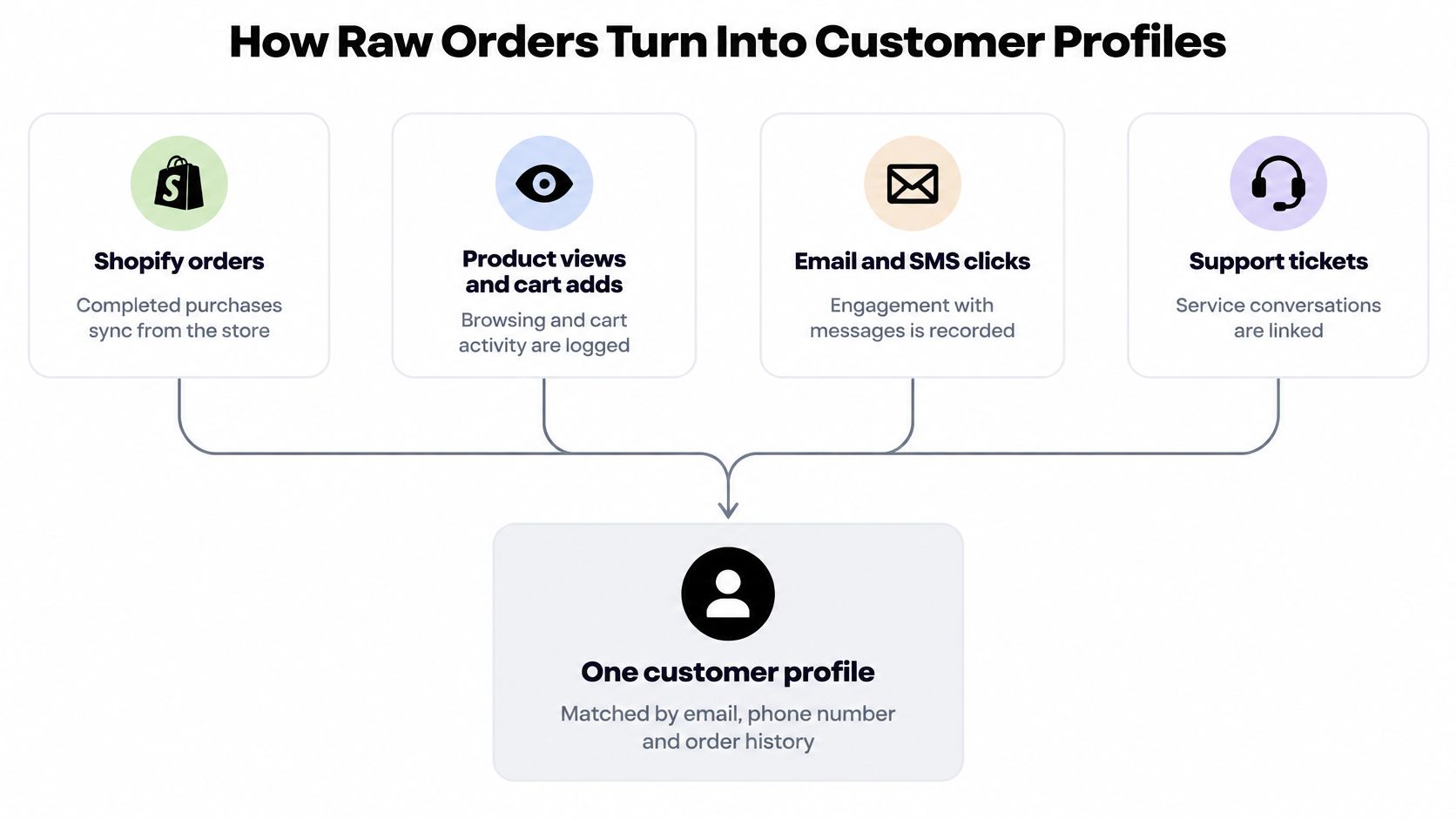
A Shopify purchase, a cart addition, an email click, and a support ticket arrive as separate events. The CRM connects them using reliable identifiers such as customer ID, email address, or phone number.
Matching needs care. A buyer who checks out with personal and work email addresses may appear to be different people. Don't merge profiles merely because their names match, and never assume that combining records extends marketing permission.
The diagram shows how those separate inputs feed a shared profile.
For disconnected tools, Grumspot's guide to middleware for ecommerce CRM connections explains the integration layer. Once events arrive reliably, customer segmentation models help translate purchase recency, category, frequency, discount use, and engagement into actionable groups.
Customer lifecycle states and their message rules
These are illustrative operating rules, not industry benchmarks. Set the timing and spending thresholds from your store's buying patterns.
| Lifecycle state | Entry rule | Message focus | Suppress when |
|---|---|---|---|
| First-time buyer | Initial order within the onboarding window | Care guide, delivery updates, review request | Customer has placed another order |
| Active repeat buyer | Multiple orders and a recent purchase | Cross-sell, loyalty perks, new arrivals | Purchase falls inside the recent-buyer exclusion window |
| Replenishment due | Predicted reorder date from past order intervals | Easy reorder reminder | Customer already reordered |
| Lapsed buyer | No order after twice their usual purchase interval | Win-back offer or preference check | Customer unsubscribed or asked to stop |
| High-value customer | Spending exceeds the store's chosen value threshold | Early access and VIP messages | Customer recently received another promotion |
Say a candle buyer places an initial order, browses another scent, then purchases again. She moves from first-time to active repeat buyer; if her usual buying interval passes without another purchase, she becomes eligible for a lapse rule.
A replenishment prediction should likewise follow observed order intervals, not a universal calendar. McKinsey reports that personalization most often produces a 10–15% revenue lift, with observed results ranging from 5–25% depending on sector and execution capability. That range isn't a forecast for your flows.
Name the person responsible for holdout settings, the person responsible for integration failures, and the person who supplies margin information. These jobs may sit across marketing, operations, and finance, but they can't remain implicit.
A flow that passes a design review can still fail a data review.
Test with controlled profiles representing a new subscriber, a repeat buyer, an unsubscribed contact, and someone with an unresolved delivery problem. Check both who enters a flow and who is prevented from entering it.
The checklist applies across platforms, although our implementation scope is specific: we focus only on Klaviyo email and SMS flows. Our Flow Essentials service requires Klaviyo, supports migration for customers open to it, and is built inside the customer's account with full access to the flows, logic, and templates.
That account access matters operationally. Your team should be able to inspect the rules, understand exclusions, and identify what needs changing without relying on a black-box setup.
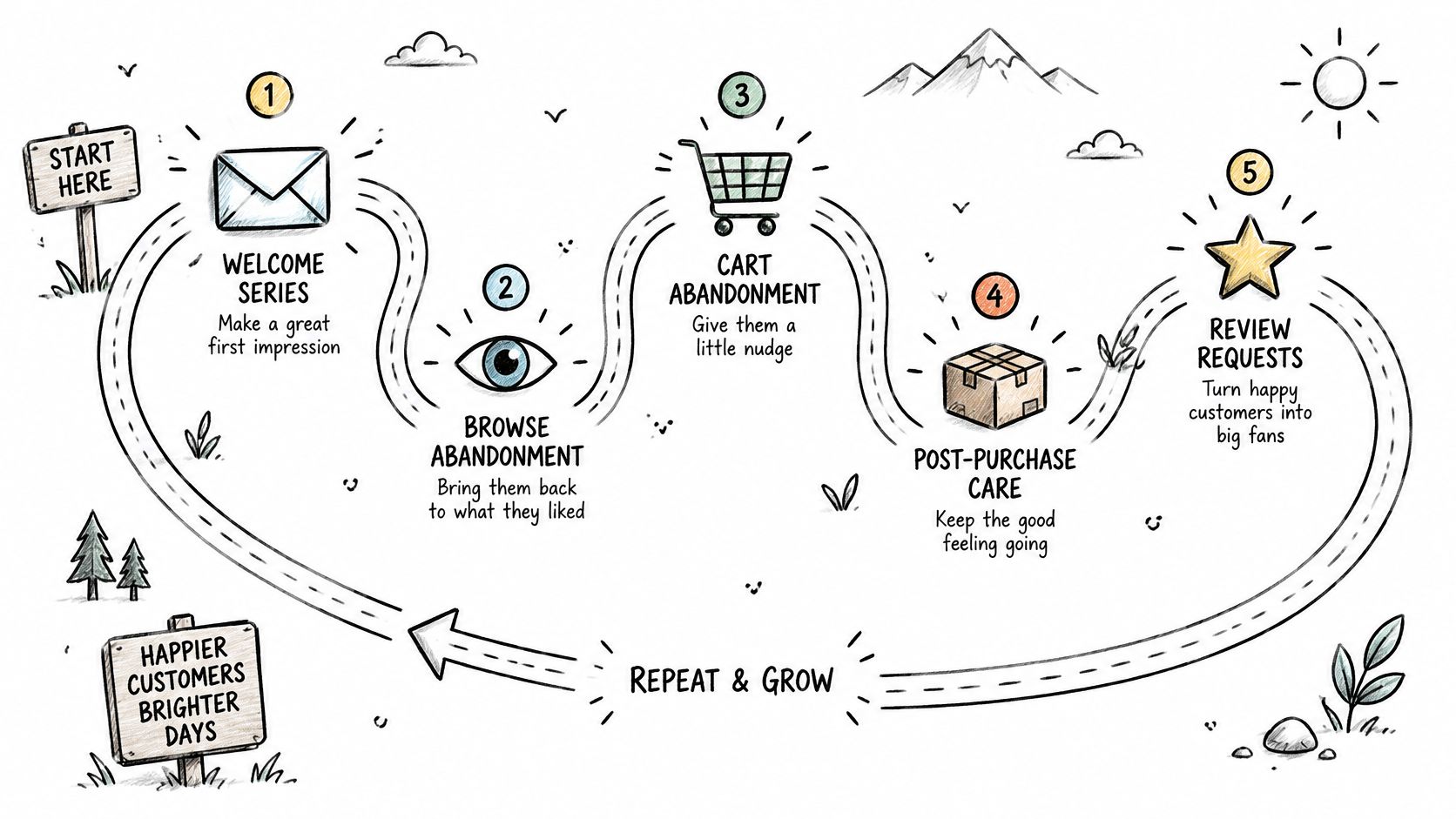
Customers should receive messages that match what they just did. A welcome flow begins with permission to communicate and explains the store's value; browse abandonment follows identifiable product interest without a purchase; cart abandonment follows an unfinished buying attempt.
A drip email campaign can organize those communications, but each message still needs an exit rule. Someone who buys shouldn't continue receiving a first-order incentive.
This journey illustration shows how communications can follow the customer rather than repeat the same sales prompt.
Baymard's checkout usability research places average global cart abandonment at 70.19% and identifies excessive additional costs, forced account creation, slow delivery, and checkout complexity among abandonment drivers.
Those barriers call for different responses:
Preserve the last-known cart, device, locale, inventory status, delivery promise, and consent state. Don't claim you know the shopper's objection unless you have evidence; test plausible explanations instead.
After purchase, send care instructions when they're useful and request a review after delivery, not merely after order placement. Replenishment messages follow likely product usage; win-back messages address a genuinely overdue relationship.
Use SMS for consented, high-intent situations, and email where product detail, delivery information, or reassurance needs more room. Test timing against the category's buying cycle, and stop recovery messages immediately when the customer completes the purchase.
A bigger list isn't automatically a more valuable list. A discount-driven sign-up from someone who doesn't understand what they've accepted is different from a customer who actively wants replenishment reminders.
Think of the difference between a guest list and a mailing list. Having someone's details because they attended an event doesn't tell you what they want to hear afterward. An ecommerce order similarly provides transaction context, not a complete communication preference.
The Dataships 2025 consent benchmark analyzed more than 15 million Shopify Plus checkout sessions and 100 A/B tests conducted from January through August 2025, examining how consent-collection design affects marketing permissions and revenue. The practical implication is to evaluate permission collection alongside checkout performance, not separately.
An opt-in asks the customer to accept an ongoing relationship. Make the benefit concrete and distinguish email from SMS rather than treating either channel as a substitute for the other.
Useful experiments include:
Avoid preselected boxes as a design practice. Keep the permission statement, timestamp, collection source, and channel attached to the customer record, and preserve changes when information moves between systems.
Regional requirements need qualified review. Don't assume the same wording, collection method, or exception works across every market, particularly when your store serves customers internationally.
A wellness buyer may welcome product-use guidance but dislike messages that appear to infer sensitive health information. A fashion customer may prefer new arrivals, while a food customer may want a reminder tied to consumption. Ask for preferences instead of assuming them from a broad category label.
Consider a hypothetical wellness-store experiment. The store compares an SMS invitation at checkout with one on the thank-you page, where it can explain the reminder service without interrupting payment. It then follows each group through the same observation period.
The comparison should include:
Fewer sign-ups can be the better result if the store preserves checkout completion and gains customers who genuinely want the messages.
That outcome must be measured, not assumed. A post-purchase invitation could attract better-qualified subscribers, or it could miss interested shoppers entirely. Keep the offer and audience comparable where possible, and don't declare a winner from sign-up count alone.
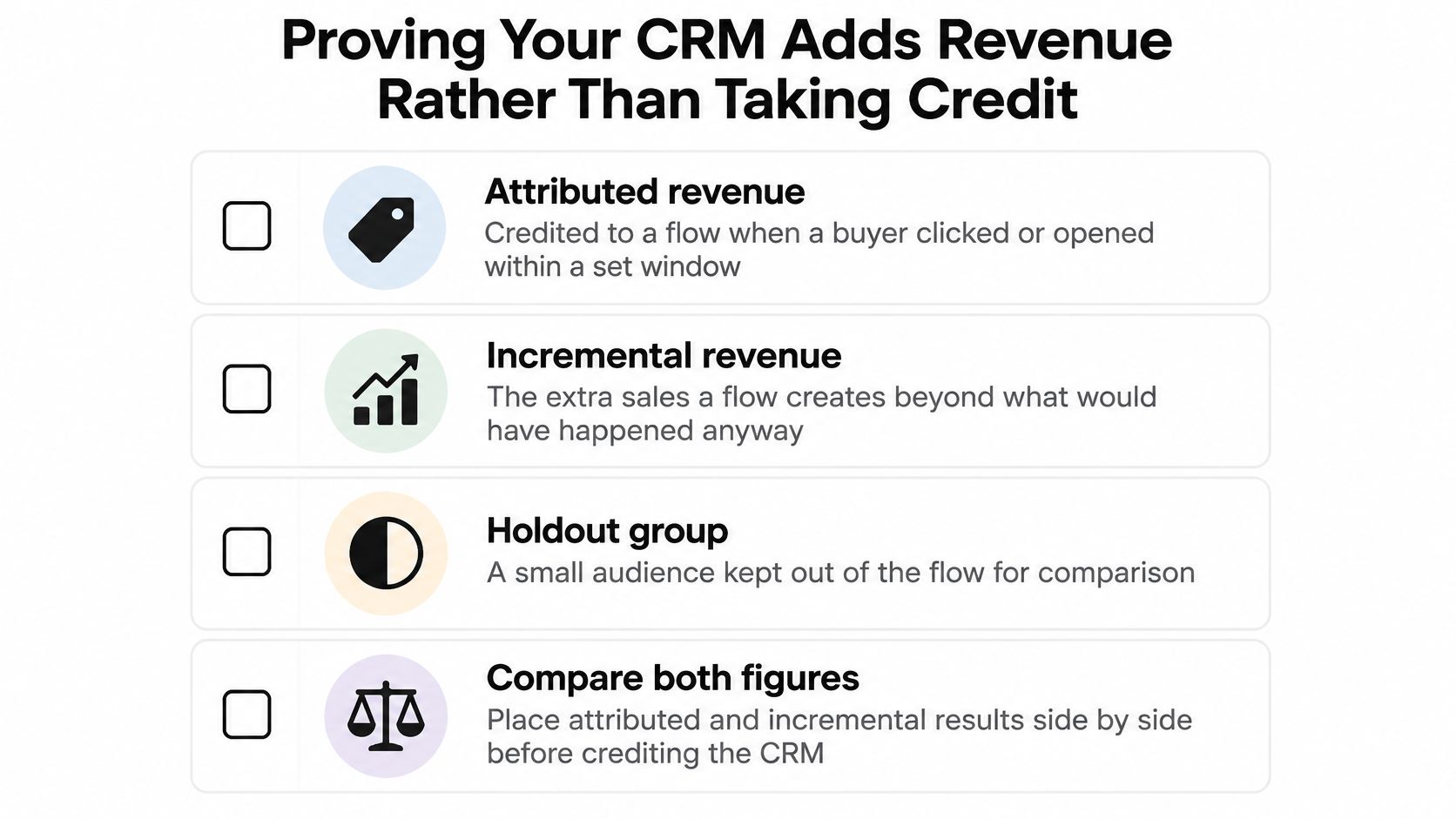
Attributed revenue is revenue a platform credits to a message under its attribution rules, often following an open or click within a chosen window. Incremental revenue is the additional revenue caused by sending the message.
The distinction matters because a customer may already have planned to reorder. A reminder can receive credit for that purchase without changing the customer's behavior.
Adobe's 2025 retail research found that 42% of organizations prioritized unified customer data across channels, while 43% prioritized advanced segmentation or real-time data processing. Connected records make measurement possible, but having them doesn't establish causation.
Use this comparison to keep platform credit separate from evidence of additional sales.
Randomly assign eligible customers to an exposed group and a holdout group that doesn't receive the flow being tested. Keep required transactional communications intact. Select the holdout size and test duration based on audience size, purchase frequency, and the effect you need to detect.
Compare revenue and repeat purchasing across all assigned customers, not just people who clicked. Normalize results for group size, use the same observation period, and record exposure to other promotions.
Subtract the holdout's revenue per eligible customer from the exposed group's equivalent figure to estimate incremental revenue per eligible customer. If the observed difference is small or uncertain, report that uncertainty rather than announcing a lift.
The embedded video provides another format for considering CRM measurement.
CRM metrics compared on what they prove
| Metric | What it reveals | Common trap |
|---|---|---|
| Attributed revenue | Revenue credited within the platform's attribution window | Credits purchases from customers already likely to buy |
| Incremental revenue | Normalized difference between exposed and holdout groups | Needs random assignment and enough observations to detect a meaningful gap |
| Repeat-purchase rate | Share of customers ordering again within the chosen window | Short windows favor fast-reorder products |
| Revenue per recipient | Flow revenue divided by recipients | Discounts can increase revenue while reducing margin |
| Unsubscribe rate | Share of recipients who opt out | Excluding suppressed contacts can obscure wider audience loss |
| Contribution margin | Net revenue after relevant variable costs | Requires finance inputs that marketing dashboards may omit |
| Open rate | Emails recorded as opened | Image preloading can make recorded opens misleading |
Suppress promotions for a recent purchaser when the offer would merely discount an order they were likely to place anyway. Pause sales messages during unresolved delivery problems, and prevent overlapping flows from sending competing offers.
Treat contribution margin consistently. If revenue is already net of discounts, don't subtract those discounts again; include relevant product, fulfillment, and other variable costs. Product Metrics' explanation of why ROAS can hide profit differences provides useful context for this distinction.
For a longer view, evaluate ecommerce customer lifetime value alongside the immediate outcome. A promotion that accelerates an order may not improve the relationship's total value.
Before accepting a result, confirm:
Consider a hypothetical fashion store reviewing its CRM over 90 days. The timeline is a worked example, not a benchmark or a reported client result. Its purpose is to show how a team makes decisions without inventing performance figures.
The store has an established email audience and past buyers, but its existing automations mostly repeat a first-order discount. Marketing wants more repeat sales; support wants fewer messages reaching customers who are waiting for exchanges.
The calendar illustrates the review sequence.

At launch, the welcome flow explains fit, links to a size guide, and introduces the first-order offer. Customers who purchase leave the prospect sequence. Those browsing unavailable sizes don't receive a recovery message promising that item.
During the early review, the team notices shoppers leaving after shipping charges appear. That observation doesn't prove cost caused every abandonment, so the team tests a clear shipping-threshold explanation rather than automatically adding another discount.
It also adds an arrival-date message for shoppers evaluating delivery. The operational decision is to answer the unresolved question, while checking that the checkout itself displays the same information.
At the next checkpoint, post-purchase communications use confirmed delivery events to time care guidance and review requests. Buyers with open exchange tickets receive service help instead of a promotional cross-sell.
The team also examines the recent-buyer exclusion window. Rather than applying the same delay to everyone, it distinguishes shoppers buying complementary accessories from customers who have just purchased another version of the same garment.
At the interim review, the holdout remains in place. The team can inspect early differences, but it can't yet claim a completed longer-term repeat-purchase result for customers who haven't had the full observation period.
Suppose one segment shows more unsubscribes after clustered promotions. The team reduces promotional frequency for that segment and records the change, recognizing that it has altered the treatment being tested.
At the final review, each flow's report places contribution margin beside revenue, with repeat-purchase outcomes separated by comparable enrollment cohorts. If the audience is too small to support a confident conclusion, the test continues.
The review changes three operating rules:
We build custom Klaviyo email and SMS flows that connect customer behavior, segmentation, and lifecycle messaging. Visit Class A Media to discuss a retention system built inside your account, with full access to the logic, flows, and templates your team will use.
Let's build retention system that drive predictable, scalable revenue - without ad spend, without retainers, without guesswork.


The Ultimate Ecommerce Email Marketing Agency
Get in touch: hello@classamedia.com