Blog post
Insights
8 Customer Segmentation Models for Better Retention
Many marketers say they segment, then send nearly everyone the same campaign with a different subject line. An industry analysis reports that approximately 70% of global marketers use segmentation, yet 42% do not segment customers at all and only 4% combine multiple data types, figures that should be treated as directional rather than definitive in the Martech Pulse industry analysis of data-driven segmentation. About 28% integrate segmentation with predictive analytics in that same reporting, which helps explain why so many programs stop at labels like past purchasers or VIPs.
That's the wrong starting point for customer segmentation models. A segment earns its place only when it changes a message, offer, timing, or channel for a specific group. If it doesn't change what you send, it adds reporting complexity without improving a retention decision.
For Shopify brands, the eight models below work best as complementary layers, not interchangeable choices. Lifecycle stage can organize the journey, RFM can rank value inside each stage, and product affinity can decide what to recommend next. Used that way, segmentation supports repeat purchases, customer lifetime value, and margin without relying on broad discounting or more traffic.
Build RFM first if you've got nothing more than order history. Score each customer on how recently they bought, how often they buy, and how much they've spent, typically from 1 to 5 per dimension. A customer scored 555 looks nothing like one scored 111, and your flows shouldn't treat them as if they do.
The infographic below summarizes how those three scores combine into actionable groups.
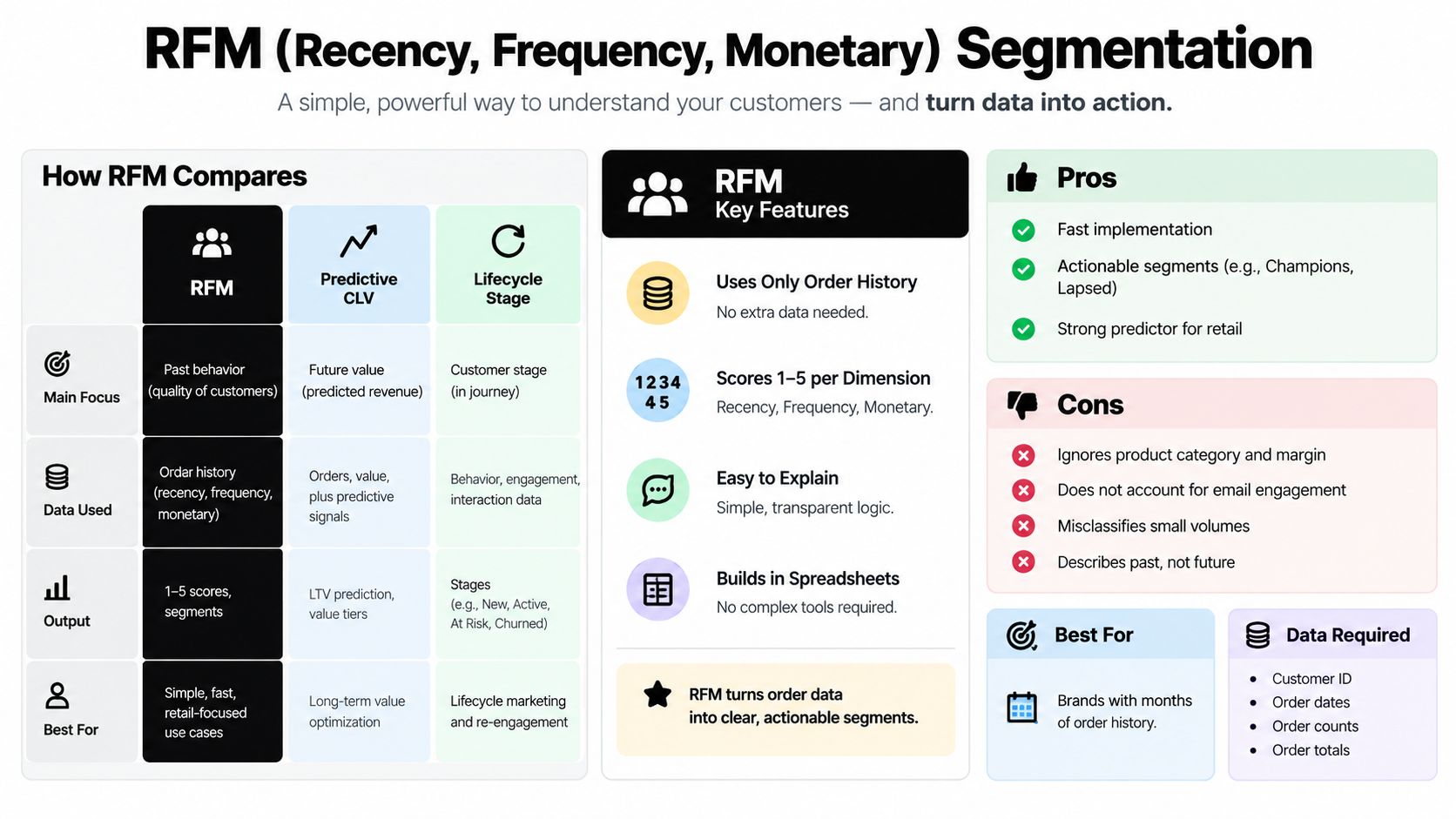
Group the combinations into plain-language cohorts such as Champions, Loyal, At Risk, and Lapsed, then map each one to a distinct flow. A fashion brand might give high recency and frequency customers VIP early access, while low recency customers enter a win-back sequence with a limited incentive. A supplement brand with a regular replenishment cycle can time reminders to the interval implied by recency and frequency, rather than guessing.
That transaction-only foundation scales better than many teams expect. One reported retail study used 522,268 cleaned transaction records covering 84,531 customers over 24 months and produced five cohorts through RFM and K-means clustering in the IJRASET predictive modeling and segmentation study.
Recalculate on a regular schedule and watch migration between groups, because movement often matters more than a static label. RFM works well inside broader effective retention marketing strategies when each score triggers a clear action. Before you scale it, find customer segment analysis pitfalls that can distort otherwise sound cohorts.
RFM tells you what a customer has done. Predictive CLV estimates what they're likely to be worth next, and that changes how much retention effort you can justify spending today.
Common probabilistic approaches pair the BG/NBD model, which estimates future purchase count and whether a customer is still active, with the Gamma-Gamma model for average order value. Email platforms such as Klaviyo also expose predictive fields, including predicted lifetime value and predicted next order date, that you can use directly as flow conditions. The video below walks through the underlying idea before you apply those fields to your own list.
Use predicted value bands to separate high-potential second-purchase customers from customers who are already proven. The first group may need curated recommendations and reassurance, while proven high-value buyers don't need a deep discount to return. If you give both groups the same incentive, you'll erode margin on people who would've bought anyway.
Segmentation can also improve the predictors themselves. In a 2025 study of 50,000 customer records, random-forest accuracy rose from 80% globally to 84% within clusters, while a reported CMT model rose from 76% to 89% after segmentation in the 2025 clustering and predictive modeling study. Those results are dataset-specific, so reproduce them on your own Shopify and messaging data before you trust them.
Set a minimum order count before you act on a prediction and keep first-time buyers in a separate flow. Compare predicted value with realized value over time to check calibration. For a Shopify-specific walkthrough, see RecurX's CLV guide for Shopify.
Start here if your flows feel tangled. Lifecycle segmentation groups customers by where they are in their relationship with your brand, from prospect or subscriber to first-time buyer, repeat customer, VIP, at risk, and lapsed. Each stage has one main job, and that clarity is what makes the model so useful as an organizing layer.
First-time buyers need product education and reassurance, not the same promotional push you'd send a loyal customer. Second-time buyers need a timely reason to make the habit stick. Lapsed customers need reactivation, often with something new to reintroduce the brand rather than a simple reminder.
The illustration below shows that progression from first browse through to a satisfied repeat relationship.

A practical setup pairs a first-purchase welcome flow that explains proper use with a second-purchase flow timed to the expected usage window. A wellness brand might define lapsed as an extended gap since the last order based on its actual consumable cycle, then trigger reactivation with new product education and a targeted offer.
Treat lifecycle stage as the outer layer and add RFM, CLV, or product affinity inside it where a decision needs more detail. That structure is central to building customer loyalty because it keeps every flow tied to a stage-specific purpose instead of a calendar.
Purchase models can't tell you who's still paying attention. Engagement segmentation groups contacts by email clicks, SMS replies, site visits, product views, and cart activity, which makes it essential for deliverability, frequency control, and spotting buyers who are close but haven't converted.
Prioritize clicks and site behavior over opens. Opens have become a weaker signal, and teams that build suppression rules on opens alone risk removing quiet buyers who purchase without much email interaction. A fashion brand, for example, might build an engaged non-buyer group from contacts who clicked product emails recently but didn't buy, then send social proof or a targeted incentive rather than another generic campaign.
Practical rule: Don't treat engagement as purchase intent. A contact who clicks often and never buys needs a different test than a contact who rarely clicks and buys every cycle.
Set a clear re-engagement window before you suppress inactive contacts from regular campaigns, and keep them in a re-permission sequence instead of deleting them outright. Build SMS engagement separately from email engagement, because responsiveness on one channel doesn't predict the other. Product view and cart behavior deserve faster triggers, since intent signals decay quickly after the visit.
Review suppression rules regularly. If your best replenishment buyers only engage around purchase time, an aggressive inactivity rule will silence exactly the people your flows should reach. Validate these groups on repeat purchases and unsubscribes, not opens alone.
What someone buys often predicts what they'll want next better than how much they spent. Product affinity segmentation groups customers by the products, categories, or collections they buy or browse, which drives replenishment, cross-sell, and more relevant launches.
A skincare brand can time a serum replenishment reminder to typical usage and cross-sell a complementary moisturizer. A food and beverage brand can segment by flavor preference and send a new flavor only to customers who've bought similar flavors, instead of training everyone else to ignore launches. The basket illustration below captures that category-first view of the customer.
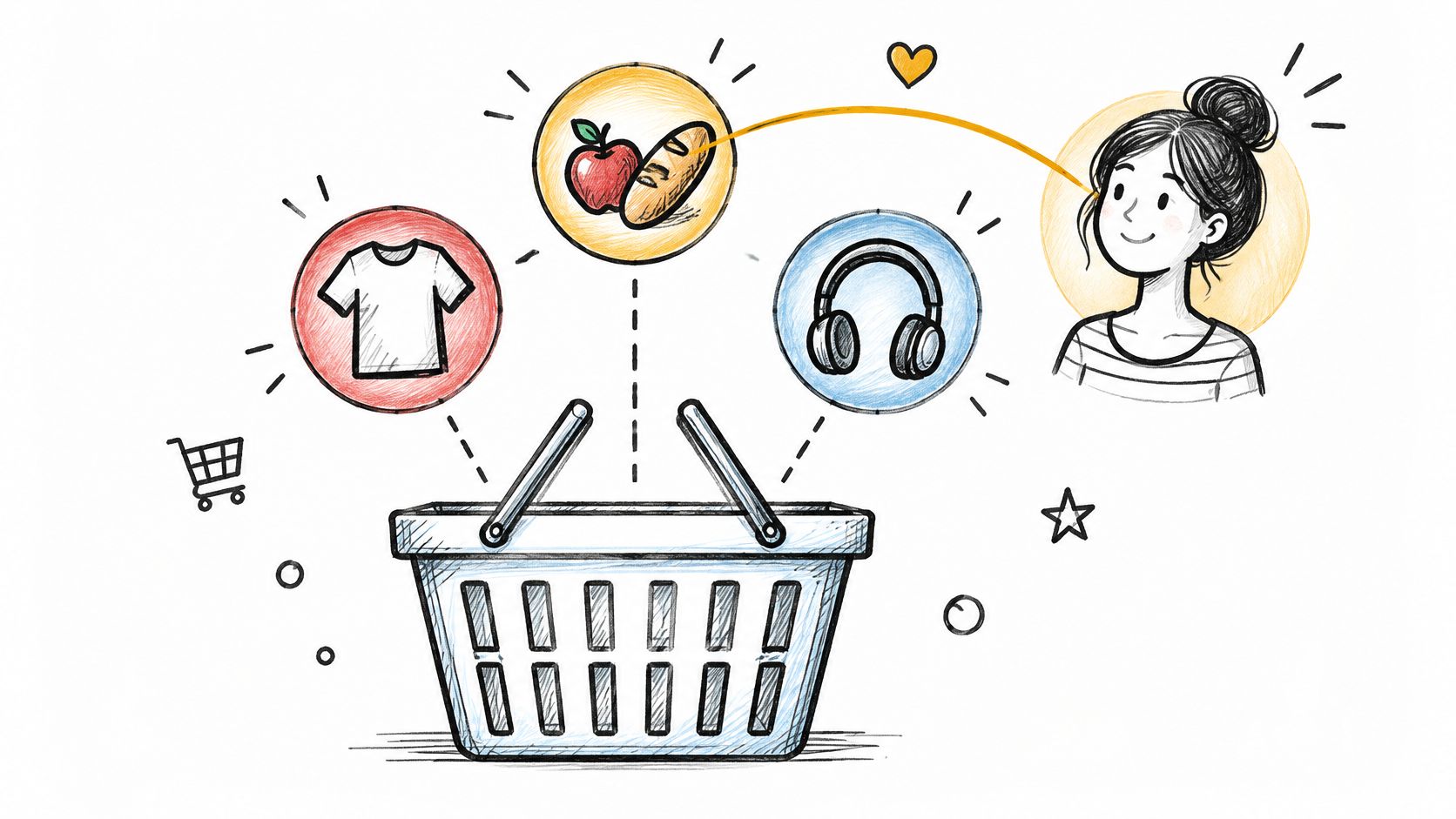
Resist building SKU-level segments on day one. Start with a small set of categories or collections, find which first-purchase products produce the strongest second purchases, and build flows around those entry products first.
Affinity is where personalization becomes visibly useful to the customer. It's also where over-granularity hurts fastest, because thin SKU segments produce tiny audiences and tests that never reach a clear answer.
Averages hide whether retention is getting better or worse. Cohort segmentation groups customers by month of first purchase, acquisition campaign, channel, or entry product, then tracks each group forward so you can compare them fairly.
The illustration below shows different entry routes leading to very different downstream outcomes.
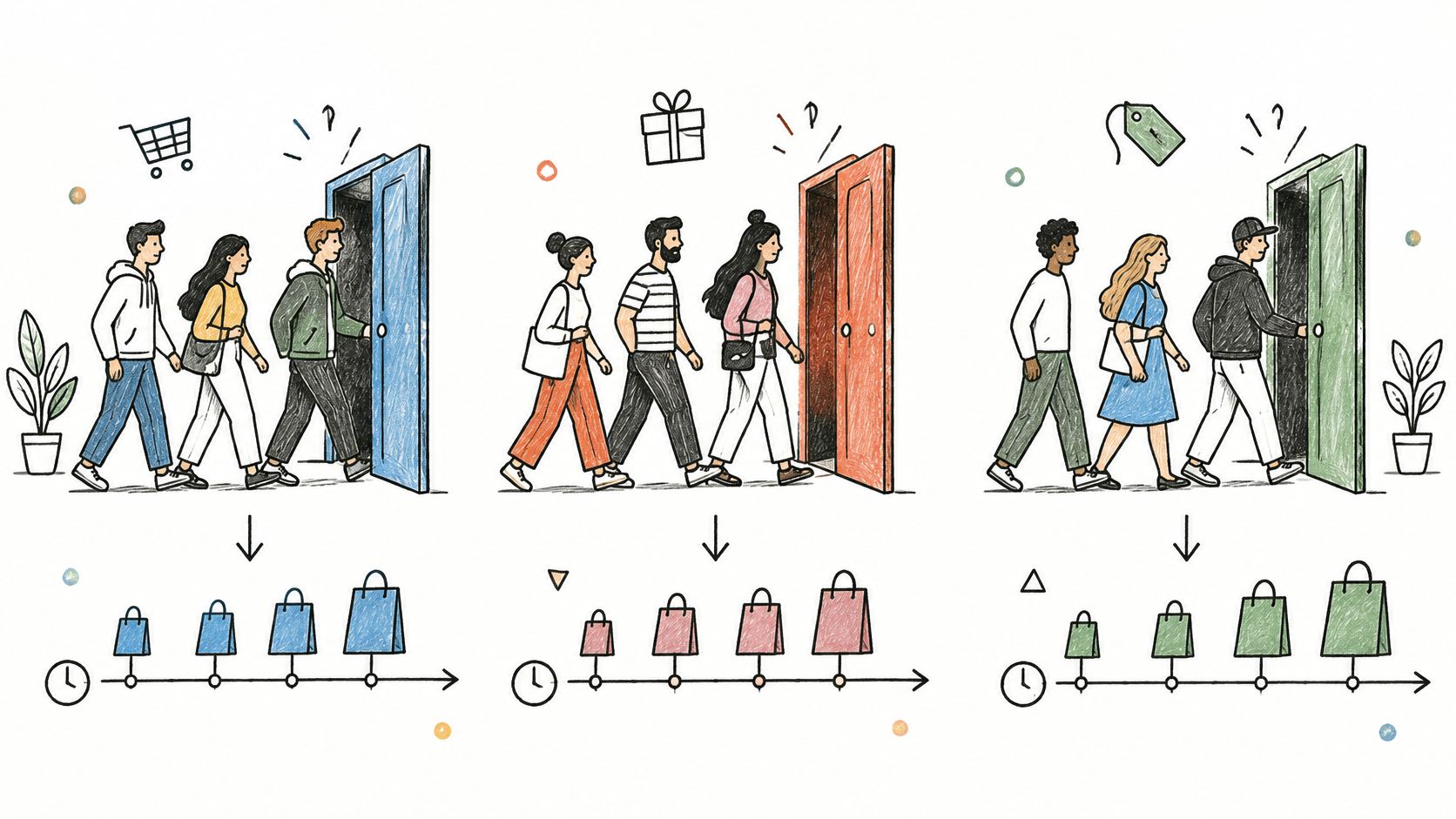
Compare cohorts at the same age after first purchase, such as their first month, second month, and third month. A brand might find that customers acquired through a quiz landing page repeat more reliably than customers from a broad discount campaign, then shift welcome flow emphasis and budget accordingly. The same method lets you measure whether a new post-purchase flow changed repeat behavior.
Tag acquisition source and entry product at the moment of first purchase, because reconstructing that data later is unreliable. Set a minimum cohort size before you draw conclusions, especially if you're a smaller merchant with sparse data. That caution matters because fewer than half of store owners in a Shopify merchant survey tracked core metrics such as profit margin, traffic, average order value, or conversion rate, as discussed in Shopify guidance on choosing a customer data platform.
A smaller number of robust cohorts you can explain will outperform clever segments built on data you can't trust.
Pair cohort results with predicted CLV to estimate long-term value by channel. You'll stop judging acquisition on first-order revenue alone.
This is the oldest layer, and the easiest to misuse. Customer segmentation became a formal concept in 1956, when Wendell Smith published his foundational work in the Journal of Marketing, described in Harvard Business School's history of marketing milestones. Smith argued for treating a heterogeneous market as smaller homogeneous markets rather than assuming one mass offer serves everyone.
Early models leaned on observable traits such as age, sex, education, and income. By 1964 Daniel Yankelovich was arguing for values, tastes, and preferences, and psychographic and geodemographic methods expanded from there. Geodemographic systems such as Claritas PRIZM and Experian Mosaic classify households using neighborhood-level data combined with consumer behavior.
For ecommerce retention, use these models to shape creative, tone, and positioning, not to override behavioral triggers. A wellness brand might send more educational welcome copy to one interest group and performance-focused copy to another. A fashion brand might adjust seasonal messaging by region and weather.
Prefer first-party data from quizzes, preference centers, and checkout forms over purchased third-party data. A systematic review of 41 peer-reviewed studies published from 2018 through 2025 found personalization generally linked to relevance and loyalty, while fairness and algorithmic opacity were only sporadically examined, in the systematic review indexed on RePEc. Separate observed behavior from sensitive inferences, document why someone entered a segment, and validate assumptions against behavior. These segments work best when they enrich a comprehensive customer profile rather than replacing purchase data.
Some customers only buy on sale. Others happily pay full price, and discounting them anyway is pure margin loss. Promotion sensitivity segmentation separates those groups by how much purchasing depends on coupons, sales, and promotional events.
Start with two simple measures per customer, average discount depth and share of orders placed with a discount. That gives you full-price buyers, consistently discount-driven buyers, and a middle group whose behavior varies by product. Don't label anyone permanently, because sensitivity can shift after a strong full-price experience or a long run of sales.
A brand might exclude proven full-price buyers from sitewide sale emails and reserve those promotions for discount-driven customers, then measure whether revenue holds while margin improves. Another might test free shipping, bundles, or gift with purchase for price-sensitive customers who respond to an incentive but don't need a deep percentage cut.
This model pairs naturally with predicted CLV, which can cap how much discount depth a segment justifies. It's less glamorous than predictive personalization, but for promotion-heavy brands it's often where the fastest profit improvement sits.
| Segmentation Method | 🔄 Implementation Complexity | ⚡ Data / Resource Requirements | 📊 Expected Outcome | ⭐ Key Advantage | 💡 Ideal Use Case |
|---|---|---|---|---|---|
| RFM (Recency, Frequency, Monetary) | Low; rules-based scoring | Customer IDs, order dates, order counts, and totals | Clear behavioral groups for targeted retention flows | Fast to build and easy to explain | Brands with several months of order history seeking actionable lifecycle segments |
| Predictive Customer Lifetime Value (CLV) | High; statistical modeling or platform analytics | Repeat-purchase history and transaction values; ideally 12+ months | Forecasts future customer value to guide retention investment | Allocates incentives and budget by expected future revenue | Repeat-purchase brands optimizing retention spend and discount depth |
| Customer Lifecycle Stage | Low to medium; stage rules and flow mapping | Order counts, first and last order dates, and account status | Journey-based messaging from first purchase through reactivation | Organizes automation around customer needs at each stage | Brands building or improving full lifecycle automation |
| Engagement-Based Behavioral | Medium; event tracking and engagement rules | Email, SMS, website, and cart events | Identifies engaged prospects and inactive contacts | Supports deliverability and reduces irrelevant messaging | Brands managing list health or targeting high-intent non-buyers |
| Product Affinity and Purchase-Category | Medium; product taxonomy and category rules | Order line items with SKU or category IDs; browse data optional | More relevant replenishment, cross-sell, and recommendations | Connects messaging to customer product interests | Multi-category and consumable-product brands |
| Acquisition Cohort | Medium; consistent source tagging and reporting | First purchase date, acquisition source, and subsequent orders | Retention and revenue comparisons across customer groups | Shows which channels or changes drive lasting value | Brands evaluating retention programs and acquisition quality |
| Psychographic and Demographic | Medium to high; profiling or data enrichment | Profile attributes, preference data, and optionally third-party data | Informs creative, tone, and audience targeting | Adds customer context beyond transactions | Brands refining messaging or acquisition targeting, especially with limited behavioral data |
| Promotion Sensitivity | Medium; discount analysis and segment rules | Discount amounts, order totals, and ideally product margins | More targeted offers and improved incentive efficiency | Helps protect margins by limiting unnecessary discounts | Brands seeking to reduce broad discounting without losing price-sensitive buyers |
Don't choose between these models as if only one can win. The strongest retention programs use lifecycle stage as the organizing framework, then layer RFM for value, engagement for frequency and suppression, product affinity for what to recommend, predicted CLV for how much to invest, and promotion sensitivity for how much incentive to offer. Cohort analysis sits across the whole system and tells you whether any of it is improving retention over time.
Start with the business question, not the available tool. If the question is who's drifting away, lifecycle and RFM will get you further than psychographics. If the question is why margin keeps shrinking during sale periods, promotion sensitivity matters more than another engagement segment. A segment that doesn't change a decision shouldn't survive your next audit, no matter how precise it looks in a dashboard.
Data quality decides how ambitious you should be. Confirm that order history, identity matching, and acquisition tags are reliable before you add predictive scores or fine-grained affinity groups. Smaller merchants with low volume usually get better results from a small number of reliable lifecycle and RFM cohorts than from highly individualized segments built on sparse signals. As volume grows, you can add predictive layers and test them against holdouts instead of assuming they work.
Governance belongs in the system too. Keep observed behavior separate from inferred traits, avoid sensitive proxies, give customers preference and suppression controls, and document why each segment exists. Relevance that customers can't understand or control erodes trust, especially in fashion, health, and food categories where purchase patterns can reveal private interests.
Measure success with cohort retention, repeat-purchase rate, incremental revenue per recipient, and contribution margin, alongside unsubscribe and complaint rates. Open rates alone will reward segments that look busy but don't create value. Review migration between segments, retire groups that no longer change a flow, and rebuild thresholds when your repurchase cycle or product range changes.
For ecommerce brands that want custom email and SMS retention infrastructure without a recurring agency retainer, Class A Media is one relevant project-based option. It builds systems combining audience segmentation, lifecycle communication, predictive triggers, and revenue attribution around existing customer relationships. Whether you build internally or with a partner, hold the work to the same standard, every segment must earn its place by changing what a customer receives and improving a result you can measure.
If your segments aren't changing what customers receive, Class A Media can build custom email and SMS flows for your Shopify brand using behavioral segmentation, lifecycle timing, and predictive triggers tied to repeat purchases and lifetime value. The work is structured as a one-time project rather than a recurring retainer, so you own retention infrastructure built around your existing customers. Visit Class A Media to see how that system could fit your store.
Let's build retention system that drive predictable, scalable revenue - without ad spend, without retainers, without guesswork.


The Ultimate Ecommerce Email Marketing Agency
Get in touch: hello@classamedia.com