Blog post
Insights
Customer Lifecycle Management Explained for Ecommerce
You can see it in the dashboard. The welcome flow converts, the abandoned-cart sequence recovers a steady trickle of orders, and every automated message reports revenue next to it. Then you check repeat purchase rate for the last two quarters and it hasn't moved.
That gap is where customer lifecycle management lives. Most Shopify stores have automation. Fewer have a system that decides, customer by customer, what should happen next, on which channel, and how to prove the message earned the order rather than merely arriving before it.
A shopper finds your store through a paid search ad and buys two pairs of running socks. Three months later she comes back for a waterproof jacket. Then she goes quiet for a year. What should your store say to her at each of those moments, and what should it deliberately not say?
Customer lifecycle management is the practice of answering that question systematically. It means deciding what each customer should hear next based on where they are in the relationship: first contact, first order, repeat order, a service need, or a lapse. It's less about writing emails and more about holding an accurate picture of a person long enough to be useful to them.
Think of the owner of a neighborhood running shop. She remembers your name, that you pronate slightly, and that you bought socks in March. She mentions the new trail shoes when they arrive because she knows you've been training on gravel. She says nothing in the week your order was late. That judgment, applied at scale and written into software, is the discipline.
The analogy breaks in one useful place: the shop owner has a memory. Your store needs a record.
Modern email and SMS flows are descendants of database marketing, which emerged in the 1970s and 1980s as businesses started organizing customer information for analysis and targeted communication. Before that, the tools were literal: the Rolodex arrived in 1956, ACT! launched in 1987, and GoldMine followed in 1989. Sales-force automation in the 1990s turned those contact cards into systems for leads, opportunities and customer histories, with Siebel Systems founded in 1993 and Salesforce arriving in 1999. The history of the CRM industry traces that shift from storing contacts to managing relationships across acquisition, conversion, retention, service and reactivation.
The foundational change was from treating customers as anonymous transactions to maintaining an evolving record of individual relationships. Each message today is chosen from a record that includes purchase history, browsing, product interest, channel consent and recent contact.
That record pays when it's used properly. McKinsey reports that companies excelling at personalization generate 40% more revenue from personalization activities than average companies, and its research found that personalized communications influenced brand consideration for 76% of respondents and increased repurchase likelihood for 78%, according to McKinsey's personalization research.
The journey is easier to see than to describe.
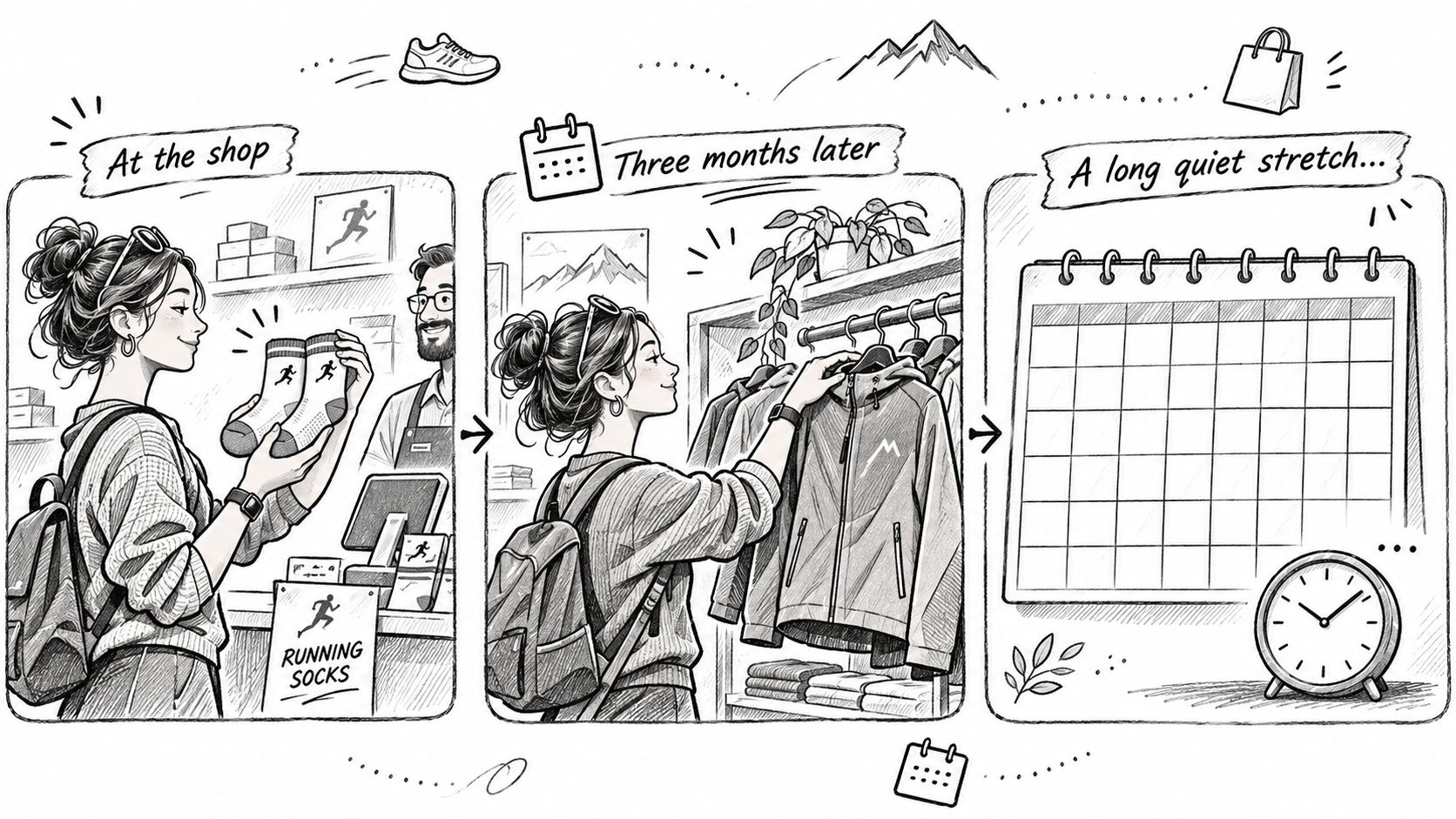
The core idea: lifecycle management chooses the next message from a record of the relationship, not from a calendar of campaigns.
Three questions organize everything that follows. Which stages exist and how do you recognize them? Why does retention deserve money that would otherwise go to acquisition? And how do you tell whether the messages are working, as opposed to merely being sent?
| Stage | Customer state | Lifecycle goal | Example trigger |
|---|---|---|---|
| Acquisition | New visitor or subscriber, no purchase yet | Earn the first contact and permission to message | Signup form submitted |
| Conversion | Browser or cart abandoner close to a first order | Turn intent into a first purchase | Cart abandoned for 1 hour |
| Retention | Recent buyer | Earn a second order | Delivery confirmed, then a set window after purchase |
| Service | Customer with a delivery, sizing or order question | Protect trust after the sale | Shipping update or support ticket opened |
| Reactivation | Lapsed buyer | Win back lost demand | No purchase for 90 days |
Read the table as a map, not a ladder. Customers move between stages based on behavior, which means the same person can sit in retention in March and reactivation in July without anything dramatic happening. A jacket buyer who returns an item for a different size is in service while still being a retention candidate.
Acquisition covers everyone who has raised a hand but not opened a wallet: newsletter signups, popup subscribers, quiz takers. The goal is permission, not a discount. A first-purchase education email that explains sizing, shipping times and how to care for the product does more for a cold subscriber than a 15% code, because it answers the question that's blocking them.
Conversion is the narrow window where intent is visible. A cart abandoned for an hour is a strong signal; a single product page view is a weaker one. The classic message here is the cart reminder, and it works best when it removes friction (returns policy, delivery timing, a sizing chart) rather than repeating the product name.
Retention starts the moment the parcel lands. Delivery confirmed, then a set window after purchase, is the trigger most stores never build. The message is a replenishment prompt for consumables, a styling or usage idea for durable goods, or a review request timed to when the customer has used the thing.
Service messages protect the relationship. A shipping update or an opened support ticket should suppress promotional sends immediately, not compete with them. Customers who receive a promotion while waiting on a late delivery remember both.
Reactivation is the last honest attempt. Ninety days without a purchase is a common window, adjusted to your repurchase cycle. A win-back offer works better when it names what the customer bought before and what's changed since.
Before you build anything, list the five stages on paper and mark which ones your store already covers with a live flow. Most brands find at least one stage with nothing at all, and often it's retention or service.
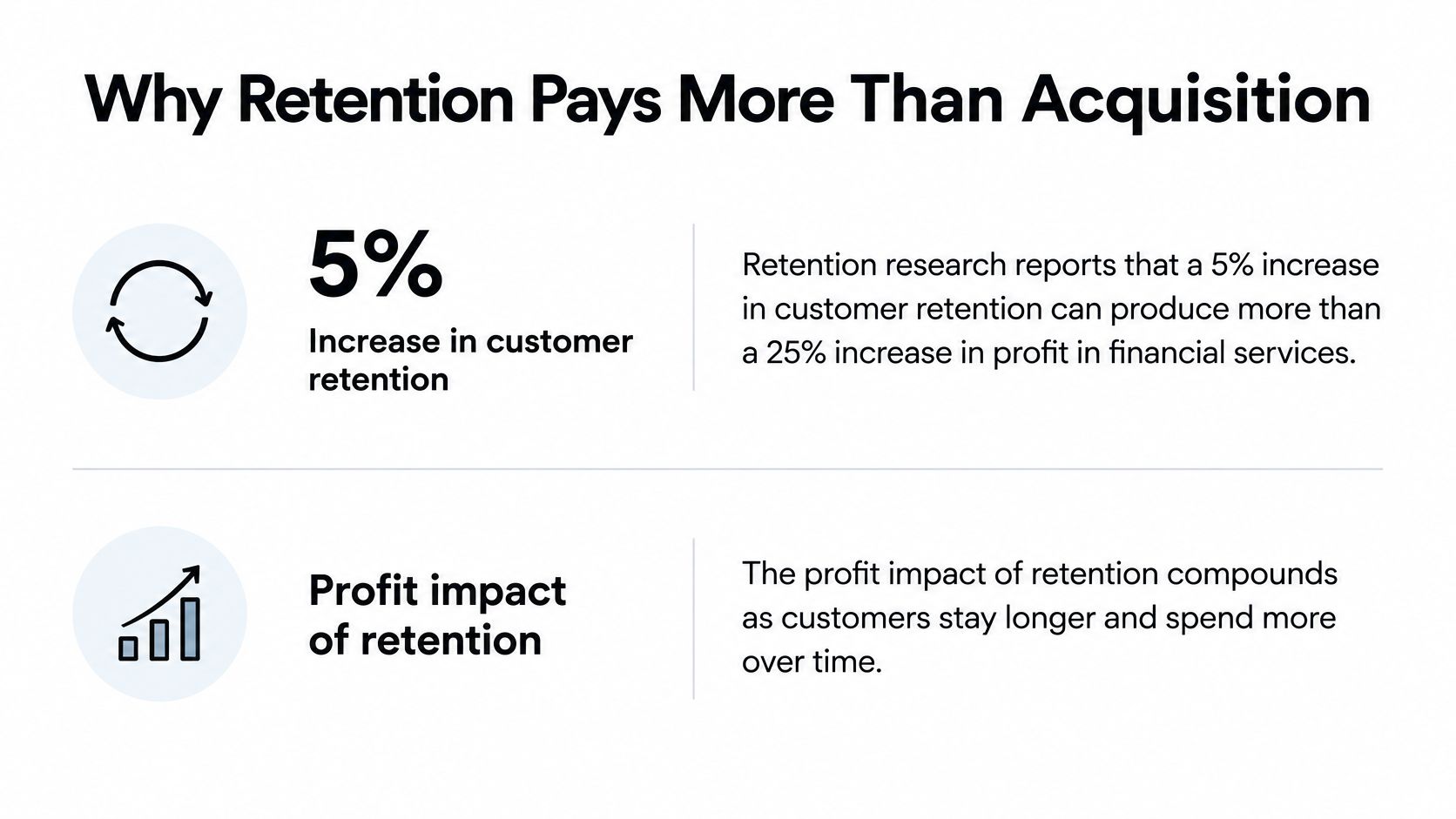
A store spending $40 to acquire a customer who buys once is working harder than a store that gets a second order from the same buyer for the cost of one email. That gap is the economic case for lifecycle management, and it shows up clearly in the research. Bain analysis, as reported in the compiled customer retention statistics, found that in financial services a 5% increase in customer retention can produce more than a 25% increase in profit. The wider body of Bain and Harvard Business Review research puts the profit impact of improving retention at 25% to 95% depending on the industry, and is commonly summarized as finding that acquiring a new customer costs roughly 5 to 25 times more than keeping an existing one.
The finding most relevant to ecommerce comes from apparel: repeat customers tend to spend more per order the longer the relationship runs, with the gap widening meaningfully when you compare their third year with their first few months. The relationship compounds, and it compounds slowly.
A second order from an existing buyer is usually cheaper to win than a first order from a stranger. You already paid for the click, the creative and the trust, so a post-purchase sequence that prompts a repeat order competes against your paid acquisition cost rather than against another email. An analogy helps here: retention spend is closer to maintaining a machine you already own than to buying a new one. The purchase price is sunk, and the running cost is small next to replacement.
The caution matters as much as the numbers. These findings come from financial services and apparel, not from your catalog, your return rate or your discount habits. A store with a 30% return rate and a permanent sitewide sale has different retention math than the studies describe, so treat the figures as a reason to test rather than a result to report. Teams often trip up right here: they quote the industry benchmark in a budget meeting, then discover twelve months later that their own repeat curve looks nothing like it.
Set a fair comparison before you invest. Write down the fixed and variable cost of building and running one flow. Estimate the repeat orders it could plausibly produce, using your own historic second-order rate as the baseline rather than a target. Multiply by contribution per order, not revenue per order. Then compare that figure with what paid acquisition would charge for the same number of orders. If the flow is cheaper per contribution dollar, it earns the budget.
Where to invest first, in order: the stage with no flow at all, then the stage holding the largest customer count, then the stage where the message is currently generic. Retention usually wins on the second criterion because the audience is already large and already paid for. One honest caveat applies to all of this: a flow that sends a discount to customers who would have reordered anyway looks profitable in a dashboard while adding nothing. The measurement question, how to separate caused purchases from captured ones, is what turns retention economics from a slogan into a number you can defend.
The same message doesn't belong in the same channel for every customer. That sounds obvious, and yet most lifecycle programs are built as a sequence problem: add more steps, add more channels, synchronize them so the customer gets everything everywhere.
More automation can reduce retention when it ignores preferences. In a 2025 UK survey reported by Attentive's SMS and email marketing research, 84% of respondents wanted to customize the types of brand messages they receive by channel. Preferences also split by use case: 55% preferred email for brand news and 56% for product previews, while shipping updates and order confirmations were more naturally associated with SMS.
| Message type | Best-fit channel | Survey evidence |
|---|---|---|
| Brand news | 55% preferred email for brand news | |
| Product previews | 56% preferred email for product previews | |
| Shipping updates | SMS | Shipping updates and order confirmations were more naturally associated with SMS in the 2025 UK survey |
| Order confirmations | SMS or email | Transactional confirmations suit SMS for speed, with an email copy kept for the customer's records |
| Abandoned-cart reminders | Email first, SMS only with opt-in | 44% not interested in SMS abandoned-cart reminders |
SMS is commercially strong. 73% of surveyed consumers reported purchasing after receiving a brand text. That's an argument for using the channel with consent, not an argument for moving every flow into it. The same survey found 44% were not interested in abandoned-cart reminders by SMS, which is the clearest signal in the data: a message can be welcome in one channel and intrusive in another.
Classify every message before you assign a channel. Transactional messages (order confirmation, shipping, refund) go where the customer will see them fastest and where they'll have a record. Service messages follow the support conversation, not the marketing calendar. Promotional and replenishment messages are the ones that need explicit consent per channel.
Then apply four rules.
None of this works without clean segments underneath it, which means starting from a customer segmentation analysis built on purchase behavior and channel consent rather than demographics alone.
Pick one stage from the table and build it properly rather than building five badly. The sequence below works for any stage, and the common mistake at each step is where most programs fail.
Name the customer state in one sentence. Write "subscribed to the newsletter, never purchased, opened at least one email" rather than "new subscriber." The tighter the state, the easier the trigger and the exit rule become. The usual mistake is a state so broad that half the audience doesn't belong in it.
Choose one goal metric. Second-order rate for retention, cart recovery rate for conversion, reactivation rate for win-back. One metric, chosen before launch. Teams that list four goals end up optimizing for opens because opens move first.
Define the trigger and the exit rule together. A cart abandoned for one hour starts the flow; a completed order ends it immediately. The mistake here is the most expensive one in lifecycle marketing: no exit rule, so buyers keep receiving cart reminders for a purchase they already made.
Write the first message around a single job. Education for a first-time buyer, friction removal for a cart abandoner, timing for a consumable. If the message tries to do two jobs, it does neither. Roughly 70% of ecommerce carts are abandoned globally, with Baymard's tracked average at 70.19%, and its checkout usability research identifies checkout design and flow as a frequent cause, sometimes the only one. That's why a cart message that addresses a checkout obstacle outperforms one that repeats the product name.
Set the timing pattern, then adjust it to your purchase cycle. A cart reminder at 1 hour, a second at 24 hours and a final one at 48 hours is a reasonable default for fast-moving categories. A store selling made-to-order furniture needs a longer window and fewer messages. Apply the channel rules from the preference map before you set the timing, so the first message goes out on the channel the customer chose.
Set a frequency cap across all flows. One customer should not receive several promotional messages in a single day just because she qualifies for several flows. Cap at the account level, not the flow level.
Hold back a randomized control group before launch. Withhold a share of eligible customers from the flow entirely, and keep that definition identical to the one you'll use when you read the results. Without it, the flow gets credit for orders that would have happened anyway.
Review at 30 days against the goal metric and the control. Then fix the weakest message before adding the next stage. Adding stages to a flow that isn't working multiplies the problem.
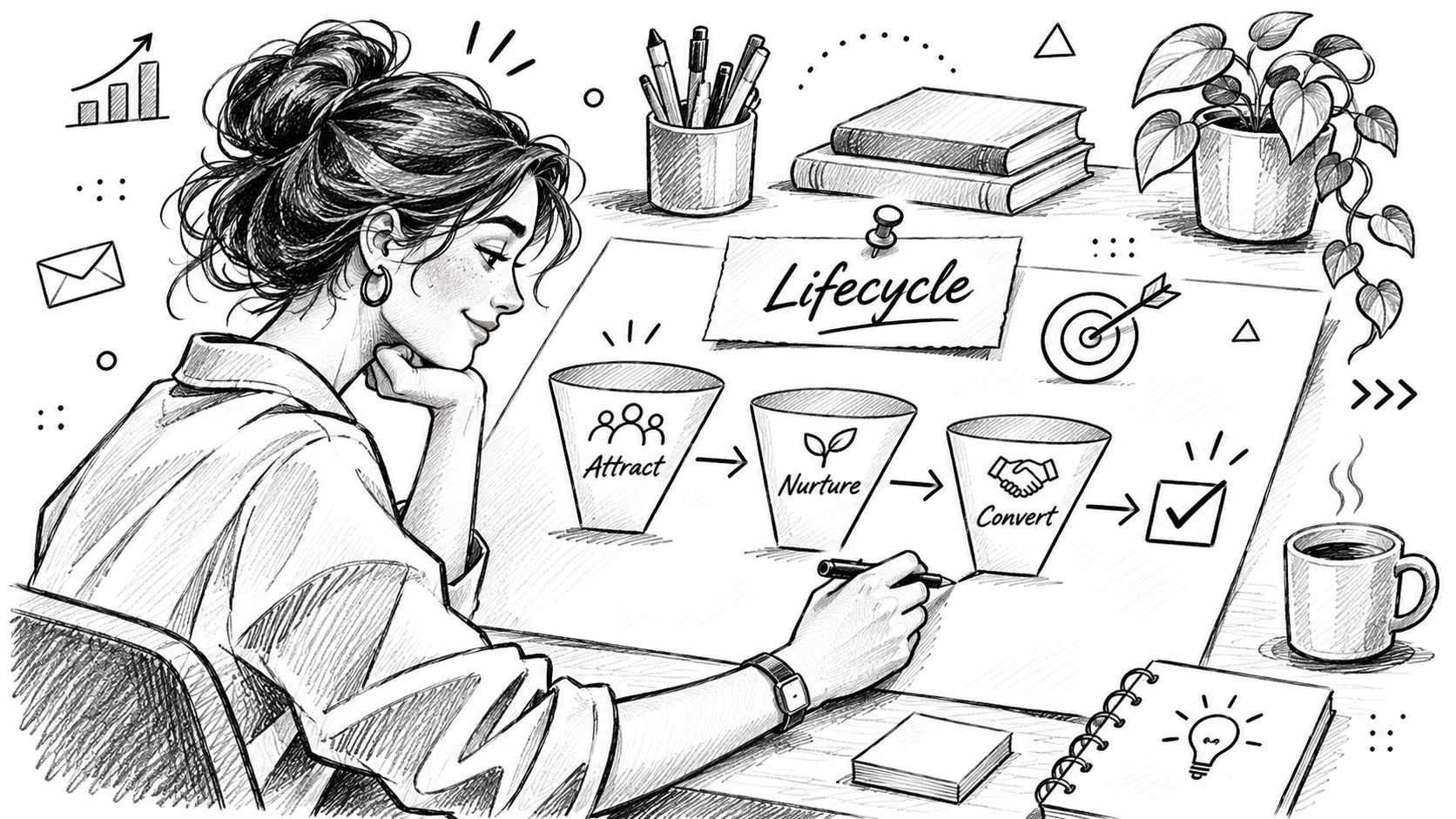
Treat each flow as part of your wider ecommerce and CRM setup rather than a standalone campaign. The customer record that triggers the flow should be the same record your support team reads from, or the service stage will contradict everything the marketing does.
Opens, clicks and attributed revenue can mislead, and they mislead most at scale. Automated flows tend to capture customers who were already close to buying, so their orders get credited to the flow that happened to arrive first.
The scale of automation makes this worse, not better. An analysis of 24 billion emails and 230 million SMS messages sent in 2024 found that automated messages produced substantially higher engagement than manual campaigns, while automated SMS represented 18% of orders despite only 9% of sends, according to Omnisend's ecommerce marketing report. Those figures show efficiency. They don't show that a single extra order was caused.
Withhold a share of eligible customers from a flow for a defined period. Compare repeat-purchase rate and contribution margin between the treated group and the held-back group. The difference is the incremental value, and it's the only number that survives scrutiny when someone asks whether the email program is worth its cost.
Keep the holdout honest. Randomize at the customer level, not the order level. Keep the withheld group eligible in every other respect, so they can still receive service messages and transactional mail. And size the group before launch based on your normal order volume, because a holdout too small to detect a difference just adds cost without adding knowledge.
| Metric | What it shows | Limitation |
|---|---|---|
| Opens and clicks | Message engagement | Does not show that a purchase was caused |
| Attributed revenue | Orders credited to a flow | Over-credits customers who would have bought anyway |
| Repeat-purchase rate | Share of customers who order again | Needs a comparison group to judge flow impact |
| Customer lifetime value | Discounted future contribution per customer | Depends on forecast assumptions |
| Contribution margin | Profit after product cost, refunds and messaging costs | Requires clean order and cost data |
| Holdout lift | Extra purchases against a randomized control group | Needs a withheld group of eligible customers |
Customer lifetime value is the metric that ties retention to finance. A practical model discounts expected future contribution from each customer or segment: expected order frequency multiplied by average contribution margin and expected retention duration, minus variable service and communication costs. Harvard Business School's customer lifetime value framework supports three operational decisions with it: how much to spend acquiring or retaining customers, which levers increase CLV, and which segments are profitable enough to prioritize.
The warning is that CLV depends entirely on its assumptions. A model built on a 24-month retention duration when your data shows a median of 7 months will justify spending you can't recover. Rebuild the inputs from order history, refunds, subscription status and acquisition source, then run a customer lifetime value analysis before you use CLV to set a budget.
Geography changes the numbers more than many teams expect. The same 2024 dataset reported a UK SMS click-to-conversion rate of 10.65% against a 2.18% global average. If you set targets from a global benchmark, your UK program looks like an underperformer and your other markets look like stars, when the difference may be market maturity, list quality or message mix.
Position lifecycle management as an experimentation discipline with four primary outcomes: incrementality, repeat-purchase rate, contribution margin and customer lifetime value. Everything else is a diagnostic.
Take the five stages from the map and compare them against the flows your store runs today. Most brands find the largest gap in one of three places: no welcome flow for new subscribers, no cart abandonment flow, or no post-purchase sequence that prompts a second order.
Pick the largest gap and make three decisions before launch. Name one goal metric, such as second-order rate for a post-purchase flow. Apply the channel rules so the first message lands where the customer prefers it and duplicates are suppressed elsewhere. Reserve a randomized holdout of eligible customers who receive nothing from the new flow, and keep that definition stable for 30 days.
Judge the result on contribution margin and repeat orders against the holdout. Not opens. Not clicks. Ambition isn't the bottleneck: in Customer.io's 2025 survey of more than 600 brands, 68% said they were likely or very likely to achieve their lifecycle marketing goals, as reported in these retention benchmarks. Measurement is.
We've built retention systems for over 200 ecommerce brands, and our email and SMS flows have generated over $150 million in attributable revenue. If you already use Klaviyo, a Klaviyo agency can build, test and report on these flows for you.
Your action this week: open your flow list, mark the largest missing stage, and write the goal metric and holdout size on one line.
Class A Media builds custom email and SMS lifecycle systems for Shopify brands, from welcome and cart recovery through post-purchase sequences designed to earn a second order and keep the relationship alive. If your flows are running but repeat purchase rate isn't moving, we can map the missing stages, apply channel-aware preference rules, and set up holdout testing so you can see what the messaging adds. Visit Class A Media to start the conversation.
Let's build retention system that drive predictable, scalable revenue - without ad spend, without retainers, without guesswork.


The Ultimate Ecommerce Email Marketing Agency
Get in touch: hello@classamedia.com