Blog post
Insights
Customer Segmentation Analysis: How to Group Shoppers
You send a campaign to your whole list, watch a few orders come in, and still can't tell who bought because of the message and who would've bought anyway. Meanwhile, unsubscribes tick up from people who clearly weren't the right audience. That's the gap customer segmentation analysis is meant to close. It doesn't start with a fancier chart. It starts with grouping shoppers who behave alike, treating each group differently, and checking whether that different treatment worked.
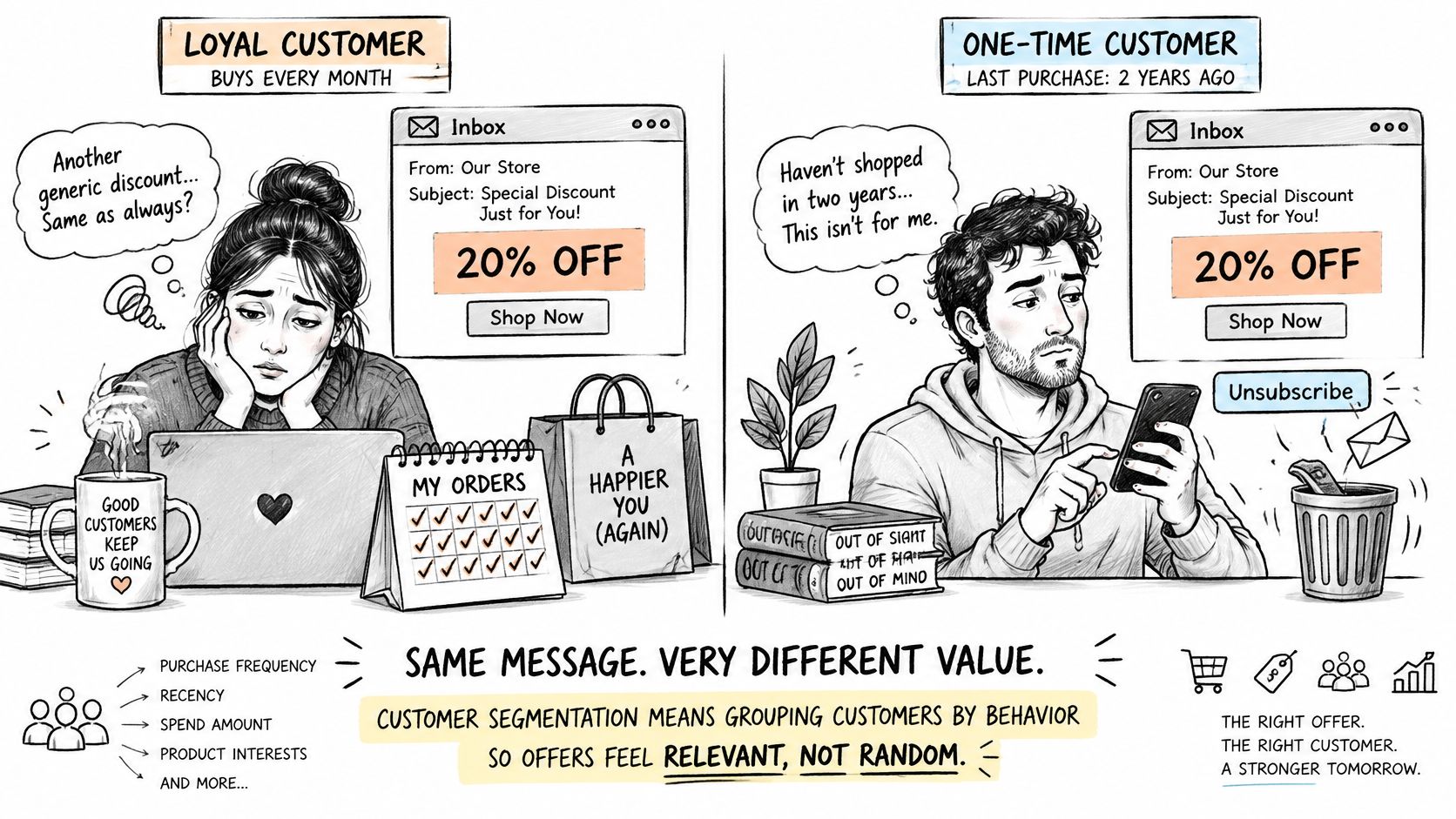
Say a store sends the same discount email to two people. One orders every month without a code. The other bought a gift once, two years ago, and hasn't returned. The loyal buyer learns to wait for discounts she never needed. The one-time buyer sees an offer for a product she doesn't use and unsubscribes. Same send, two bad outcomes, because the store treated different shoppers as if they were identical.
A good shopkeeper doesn't make that mistake. She knows which regulars buy bread every morning, which families stock up on Saturdays, and which visitors only appear at Christmas. She greets them differently, stocks for them differently, and doesn't offer the daily regular an introductory deal. Customer segmentation analysis is that instinct, written down and tested with order data instead of memory.
Filtering is mechanical. You pull everyone who bought shoes, or everyone in one state, and you send. Analysis asks a harder question before you send anything. Does this split predict something that matters, such as spending, reorder timing, or the risk of never coming back? If two groups behave the same way on every measure you care about, they're not two segments. They're one list with two labels.
The underlying idea, splitting a mixed market into smaller and more similar markets, has been a marketing principle since the 1950s. It still holds because the test hasn't changed. In the 2025 American Marketing Association and Kantar survey, 72% of marketers agreed that segmentation is key to understanding customers, in a survey that included 182 American Marketing Association members.
A segment you can't describe in one sentence, value in dollars, and treat differently isn't a segment yet. It's a spreadsheet tab.
Before you build anything, make every proposed group answer three questions. Who's in it, in terms a teammate could apply without you in the room? How valuable is it, in revenue, margin, or repeat orders? And what will you do differently for these shoppers that you won't do for everyone else? A group that fails the third question doesn't earn a campaign, no matter how clean it looks in a pivot table.
Most stores think they're data-rich because Shopify and Klaviyo dashboards are full of numbers. The 2024 Twilio study tells a different story. Only 16% of brands surveyed strongly agreed they had the customer data needed to understand their customers, and only 19% strongly agreed they had a full customer profile. The gap usually isn't missing software. It's that order, engagement, and consent records live in separate places and never get joined by customer.
You don't need a data warehouse to begin. Order history alone gives you the backbone. Recency shows how long it's been since the last order. Frequency counts orders placed. Monetary value captures total and average spend. Add repurchase count and the interpurchase interval, the typical gap between repeat orders, and you can already separate a steady repeater from a one-time big spender.
The interval does work the other variables can't. Say a skincare customer reorders every 45 days and has now been silent for 60 days. She's late, and a replenishment reminder fits. A customer with the same recency who only ever ordered once is a different case entirely. Same days-since-order number, opposite treatment.
| Variable | What it tells you | Source | Minimum history |
|---|---|---|---|
| Recency | Days since last order | Order records | Any order history |
| Frequency | Number of orders placed | Order records | 12 months |
| Monetary value | Total and average spend | Order records | 12 months |
| Repurchase count | Orders after the first purchase | Order records | 2 or more orders |
| Interpurchase interval | Typical days between repeat orders | Order records | 3 or more repeat orders |
| Product category | Categories purchased | Product catalog | Catalog mapping in place |
| Engagement | Opens, clicks and SMS replies | Email and SMS platform | 90 days |
| Zero-party preferences | Stated needs from quizzes or polls | Opt-in forms | Opt-in responses |
| Consent status | Marketing permission on record | Consent records | Current status |
Product category comes from your catalog, so map every SKU to a category before you analyze, or category segments will be unreliable. Engagement comes from your email and SMS platform, and stated preferences come from quizzes and polls customers chose to answer. If you're sorting out which of these signals you own and can use, it helps to put first-party data to work deliberately rather than collecting everything and sorting it out later. Joining these sources into one record per shopper is the same discipline behind building a comprehensive customer profile, and it's worth doing before you add more variables.
One caution. Don't build a segment on engagement alone. Opens are unreliable, since mail apps prefetch images and inflate them, so a so-called engaged segment may just be a segment of Apple Mail users. Clicks and SMS replies are sturdier. If your history is thin, start with simple recency and frequency bands, run them carefully, and add variables as orders accumulate.
There's no single best method, and anyone selling you one is selling software. The right choice depends on your goal, your catalog size, and how much history you have. A method that needs thousands of repeat buyers will starve in a store where most customers order once.
| Method | How groups form | Best for | Main limitation |
|---|---|---|---|
| Demographic or rule-based filters | Fixed attributes such as location or age | Early-stage targeting and gifting | Ignores what customers actually buy |
| RFM scoring | Recency, frequency and monetary bands | Most ecommerce retention programs | Cutoffs are arbitrary and need tuning |
| Lifecycle stages | New, active, lapsing and lapsed status | Welcome and win-back flows | Stage boundaries need careful setting |
| Clustering (such as k-means) | Algorithm finds similar groups across variables | Large catalogs with many variables | Clusters need naming and cleaning before use |
| Predictive churn or propensity model | Probability of the next order | Prioritizing budget and offers | Needs enough history and validation |
| Attitude-based segments | Survey answers on needs and concerns | Fashion, wellness and food brands | Needs opt-in data and regular updates |
RFM scoring is where most stores should start. It's transparent, you can explain it to your team in five minutes, and you can audit any customer's score by hand. Its weakness is honest, too. The bands are your invention, so a customer at day 31 isn't magically different from one at day 29 just because your cutoff sits at 30. Tune the cutoffs against real reorder behavior, not round numbers.
Lifecycle stages translate directly into flows. New, active, lapsing, and lapsed map cleanly onto welcome, replenishment, and win-back sequences. The same logic travels outside ecommerce, which is why teams in other industries work to identify inactive player segments before spending on reactivation. The hard part is setting stage boundaries from your own interpurchase intervals instead of copying another brand's 90-day rule.
Clustering earns its keep when you have many variables and a large catalog, because k-means can find groupings you'd never spot by eye. But the algorithm hands you unnamed clusters, sometimes split by a variable you don't care about, and a statistically tidy cluster nobody can name or act on is decoration. Predictive models go further and estimate the probability of a next order, which helps you spend win-back budget where it's likeliest to pay back. They need enough history and out-of-time validation, or they'll confidently predict last season's behavior.
Attitude-based segments capture what transactions can't, such as fit worry in fashion or ingredient concern in wellness and food. Two customers with identical spend may need sizing reassurance and safety education respectively, and no RFM score will tell you that.
Choosing rule: start with RFM plus lifecycle stages, prove one treatment works, and only then graduate to clustering or prediction.
The process below is deliberately plain. You can run the first version in a spreadsheet, and you should, because doing it by hand once teaches you what the automated tools are doing later.
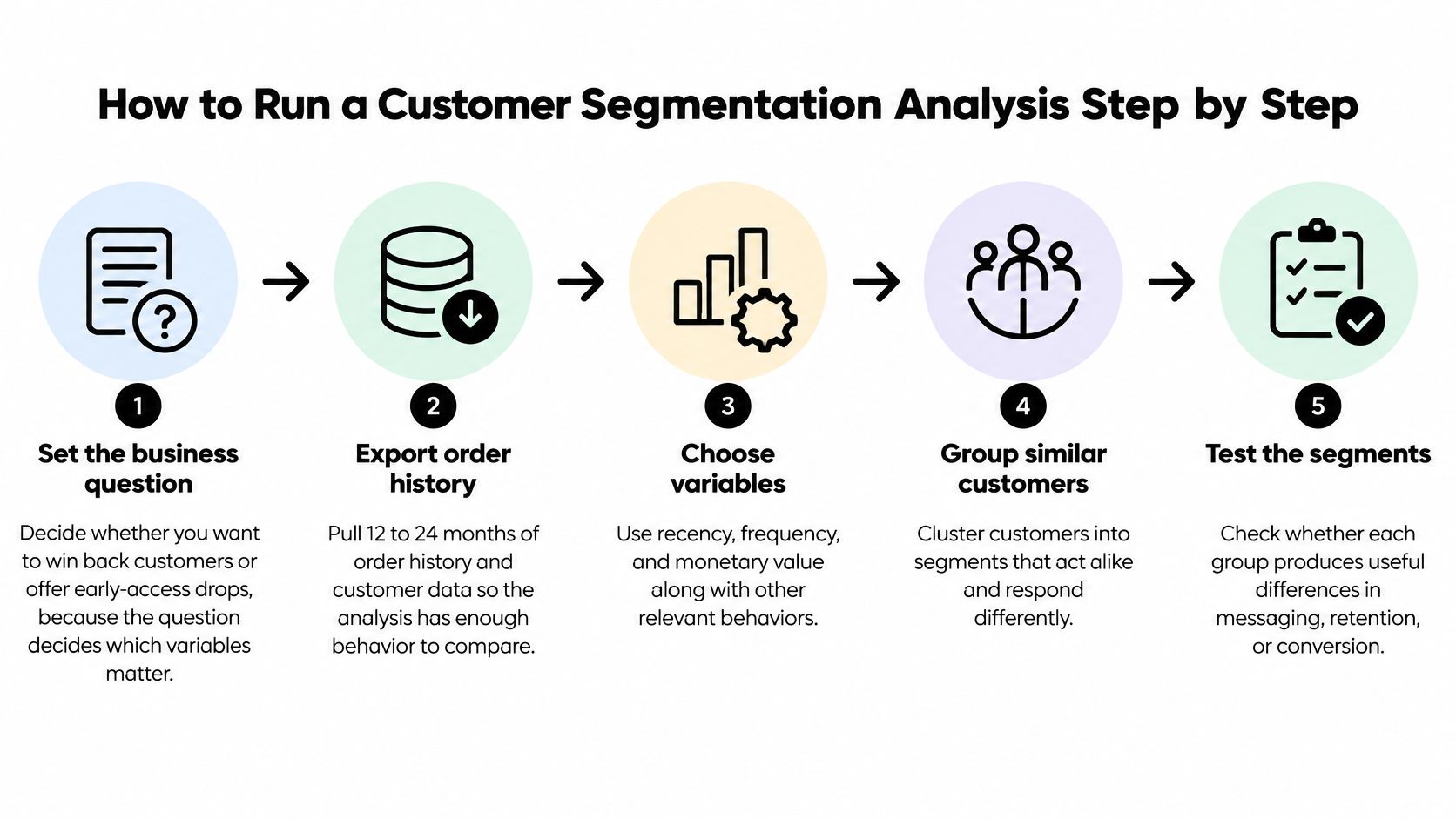
Set the business question first. Decide whether you're choosing whom to win back, whom to give early access to drops, or whom to stop discounting. The question decides which variables matter. The common slip is starting with the data export and hoping a question shows up.
Export 12 to 24 months of order history. Pull customer ID, order date, order value, product, and discount used. Shorter windows miss seasonal reorders, so a swimwear brand analyzing only winter data will misread its best customers as lapsed. The slip here is exporting orders without a stable customer ID, which makes repeat buyers invisible.
Choose the core variables. Calculate recency in days since last order, frequency as order count, and monetary value as total spend, then add repurchase count and average order value. Resist adding twelve more columns. Every extra variable is another chance for a join error, and five solid variables beat fifteen shaky ones.
Clean the data before you group anything. Merge duplicate customer records, delete test orders, and set aside extreme values such as bulk wholesale buys. One wholesale account can drag a whole cluster toward itself and invent a segment of one. Skipping this step is the fastest way to build segments around your own bookkeeping mistakes.
The short walkthrough below shows the grouping logic in action before you read the remaining steps.
Build the segments with explicit bands. As starting cutoffs, try recency at 0 to 30, 31 to 90, 91 to 180, and over 180 days, frequency at 1, 2, or 3 or more orders, and monetary value split at the median spend of repeat buyers. Use clustering instead only if your catalog and variable count demand it. These bands are hypotheses, not findings, so check each one against holdout results before locking anything in.
Profile every segment before naming it. Record its size, its share of revenue, its typical product category, and its average reorder interval. Profiling reveals a segment that's 2% of customers and 30% of revenue, or one that's huge and worth almost nothing. Naming segments before profiling them is how teams fall in love with groups that don't pay.
Attach one action to each segment and reserve a holdout. One treatment per segment, written down, plus a randomly chosen 5 to 10 percent who receive no message. The holdout feels like leaving money on the table. It isn't. It's the only way you'll know whether the treatment earned anything, and skipping it is the most expensive slip on this list.
Measure against the holdout after 30 to 90 days, then refresh. Compare repeat-purchase rate and revenue per customer between treated and holdout shoppers, on a fixed schedule, not whenever someone asks. Segments built once and never refreshed deteriorate as customers move, prices change, and your catalog turns over.
A segment earns its place only if it changes what you send or what you deliberately withhold. That standard sounds strict until you consider what shoppers now expect. McKinsey's personalization explainer reports that 71% of consumers expect companies to deliver personalized interactions, while 76% become frustrated when those interactions don't occur. You can't meet that expectation by mailing one undifferentiated audience, and you can't fake it with a first-name merge tag either.
| Segment | Typical signal | Treatment | Metric to judge |
|---|---|---|---|
| First-time buyers | One order in the last 30 days | Onboarding and care guide | Second-order rate against holdout |
| Repeat loyalists | Three or more orders at short intervals | Early access and cross-sell | Repeat rate and margin |
| Replenishment due | Days since last order near the usual interval | Replenishment reminder | Reorder rate against holdout |
| High-value lapsing | High spend, no order beyond twice the usual interval | Controlled win-back with holdout | Incremental revenue against holdout |
| Discount-dependent | Orders only when a code is used | Product education, fewer discounts | Margin per customer |
| Low engagement | No opens or clicks for 90 days | Reduced frequency or sunset | List health and complaint rate |
Take the repeat loyalist. She orders often, at short intervals, without needing a code. A discount doesn't motivate her, it just donates margin. Early access to a drop and a well-chosen cross-sell respect how she already behaves, and margin per customer tells you whether the restraint paid. This kind of stage-matched messaging is the practical core of working through the phases of the customer lifecycle instead of blasting one calendar at everyone.
Now take the high-value lapsing customer, the mirror image. His spend is high but he's silent beyond twice his usual interval, so something changed. He belongs in a controlled win-back sequence, capped in frequency, with a holdout beside it. Without the holdout, every customer who drifts back on his own gets credited to your emails, and you'll scale a flow that may be doing nothing.
The reverse case matters just as much. For discount-dependent shoppers, the right treatment is often fewer discounts and more product education, even if short-term clicks dip. Judge them on margin per customer, not conversion rate, or you'll conclude the education failed while profit improved.
That last point generalizes. Open rate and attributed revenue will mislead you if they're your only scoreboard, because attribution credits messages for purchases that would've happened anyway. Every row in the table carries a metric compared against a holdout or against margin for exactly that reason. If a treatment can't beat doing nothing, the segment hasn't earned its send.
A customer isn't a permanent label. Someone active in March can be at risk by June, because a subscription paused, a need changed, or a competitor intervened. Treat each segment as a state a customer moves through, not an identity you stamp once. Recent orders, purchase cadence, average order value, and days since the expected reorder can estimate the next state, whether that's active, needs-attention, or churn risk, and that movement is what should trigger your flows.
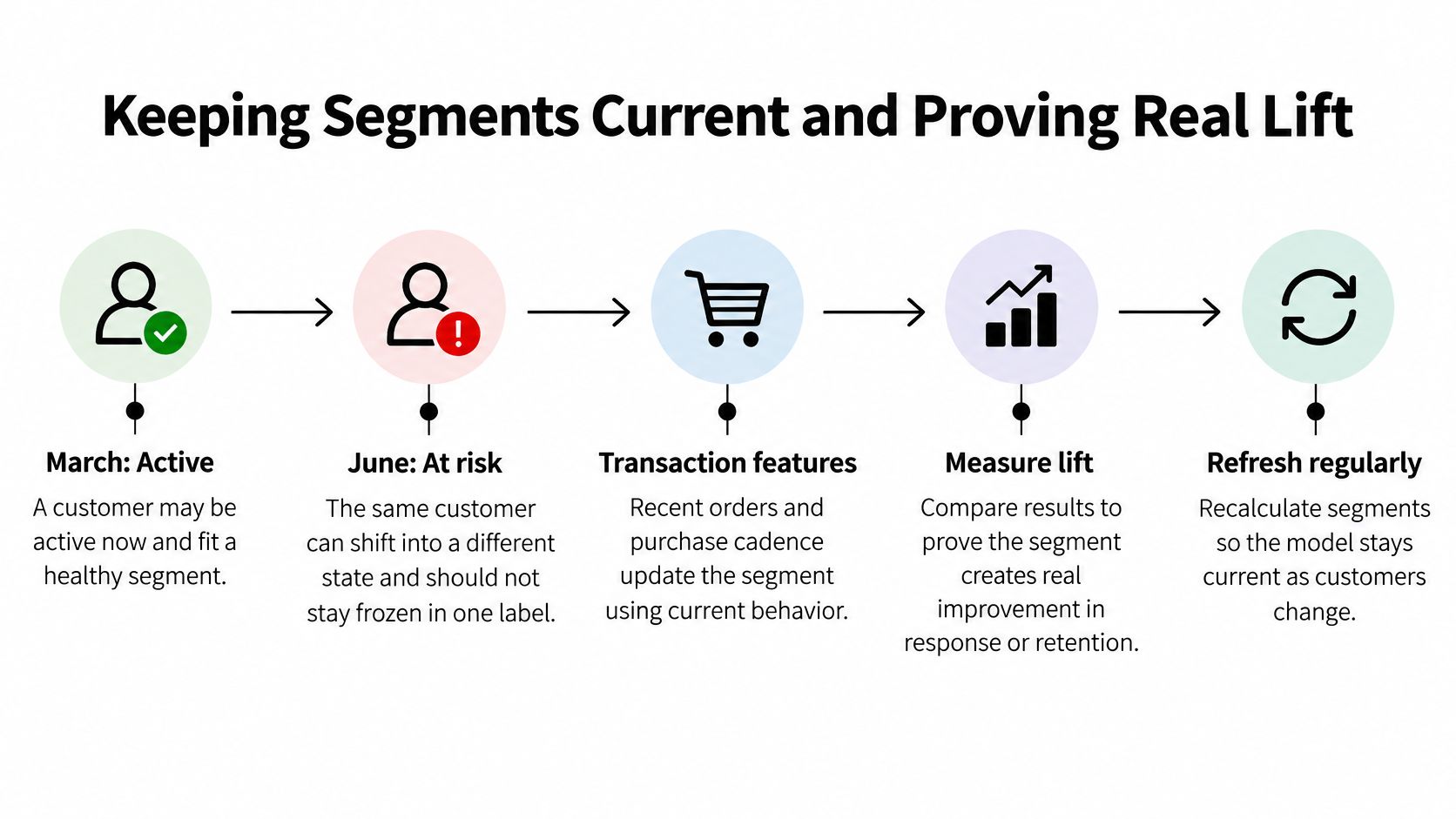
Consistency beats sophistication here. Set a monthly cycle and protect it.
Segment movement also feeds longer-horizon planning, since a customer sliding from active to needs-attention is a leading indicator for customer lifetime value in ecommerce long before the revenue line shows it. Catching the transition early is cheaper than winning the customer back later.
Keep two ideas separate, because teams constantly blur them. A model can be excellent at predicting who will buy next and still tell you nothing about whether your message caused the purchase. Predictive accuracy is not proof of cause. Only a randomized holdout, where treated and untreated customers were alike at the start, shows whether the treatment changed the outcome.
Report three numbers for each segment and skip the rest until these are stable. Precision at the intervention threshold tells you how many flagged customers needed the intervention. Retention lift against the holdout tells you whether the treatment moved behavior. Incremental profit per customer tells you whether the movement was worth the discount, the send cost, and the list fatigue.
If the treated group and the holdout show no gap after two full cycles, change the treatment or retire the segment. Don't run a third cycle hoping.
Opens and attributed revenue can't substitute for those three numbers. Both flatter the sender, opens because machines generate them, attribution because it claims credit for demand that already existed. The holdout comparison is less flattering and more useful, which is precisely why it's the standard your segmentation has to meet.
More granular isn't automatically better, and treating it as progress is how stores collect data they never use and can't defend. Every field you gather that doesn't change a treatment is pure liability. It erodes trust when customers wonder why you need it, and it adds regulatory and deliverability risk when consent records and sending lists drift apart.
Work from what's volunteered and what's transacted. Use zero-party data, such as quiz answers a customer chose to give you, for preferences instead of inferring sensitive traits from browsing. When someone withdraws consent, suppress them from every segment-driven message immediately, not at the next list clean. Document your segment logic in plain language, so a new hire can explain why any customer received any message.
Attitude-based groups need extra care. Labels like concerned skeptics or cautious evaluators describe real differences in how people shop, but you can't infer them from purchase frequency, and writing to a stereotype you invented will show. Validate them with randomized message tests, reassurance copy against standard copy, and keep the labels internal and descriptive. Watch fairness too. It's easy to celebrate relevance and loyalty gains while never checking whether a segment systematically gets worse prices, thinner offers, or manipulative urgency.
Outreach discipline belongs in the same conversation, since messaging people who never agreed to hear from you sits alongside the classic Cold Email Mistakes that damage sender reputation. Three operational mistakes undo otherwise sound work.
Start with one business question, not a segmentation program. Winning back high-value customers who've gone quiet is a good first one, because the customers are identifiable and the payoff is measurable. Pull your 12 to 24 months of order history, run the eight steps on that question alone, and build no more than three to five segments in the first round.
Attach one treatment to each and reserve your 5 to 10 percent holdout before anything sends. Write down, in advance, the metric that will prove the segment works, such as incremental revenue against the holdout, and set a review date 60 days out. Deciding the success test after seeing results isn't analysis. It's storytelling.
At the review, let the gap decide. A clear win justifies scaling the treatment and building the next segment. No gap means the treatment or the segment changes, and that's a useful answer, not a failure. Your first segment is a test, not a final system, and its holdout result tells you whether segment two is worth building. If your team lacks the time or analytics depth to run the build, you can outsource the execution, but keep the decision rules, the holdout, the metric, and the review date, inside your business where they belong.
Class A Media has built retention systems for over 200 eCommerce brands, turning segmentation like this into email and SMS flows that treat loyalists, first-time buyers, and lapsing customers differently on purpose. If you'd like that applied to your store, you can schedule a consultation and get a custom plan built around your business. Start at Class A Media and bring your first business question with you.
Let's build retention system that drive predictable, scalable revenue - without ad spend, without retainers, without guesswork.


The Ultimate Ecommerce Email Marketing Agency
Get in touch: hello@classamedia.com