Blog post
Insights
What Is a Retention Schedule? a Guide for Ecommerce Brands
A retention schedule is a formal control document that identifies categories of records, specifies how long each must be kept, and states whether it is destroyed or permanently preserved. The clock usually starts from a defined trigger event, not automatically from creation.
If you delete a customer's profile from your CRM, what happens to their information in your email platform, support exports, and backups?
That question exposes the difference between having a retention document and actually managing records. For a Shopify brand, a workable schedule needs to connect business decisions to the systems holding customer information, including the copies nobody checks during routine housekeeping.
A records retention schedule gives your team approved instructions for managing defined categories of information. Each entry identifies the record category, its retention period, and its final disposition, meaning what happens when retention ends.
A record category, sometimes called a record series, groups information by its content and business function. Customer-service case records belong together because they document support activity, whether the information appears in a ticketing platform, an email attachment, or a paper file.
The format doesn't determine the rule. The purpose of the record does.
A retention schedule isn't permission to delete whatever looks old. It's an approved explanation of what you keep, why you keep it, and what happens afterward.
This concept map shows how retention decisions connect operational needs with consistent disposal.
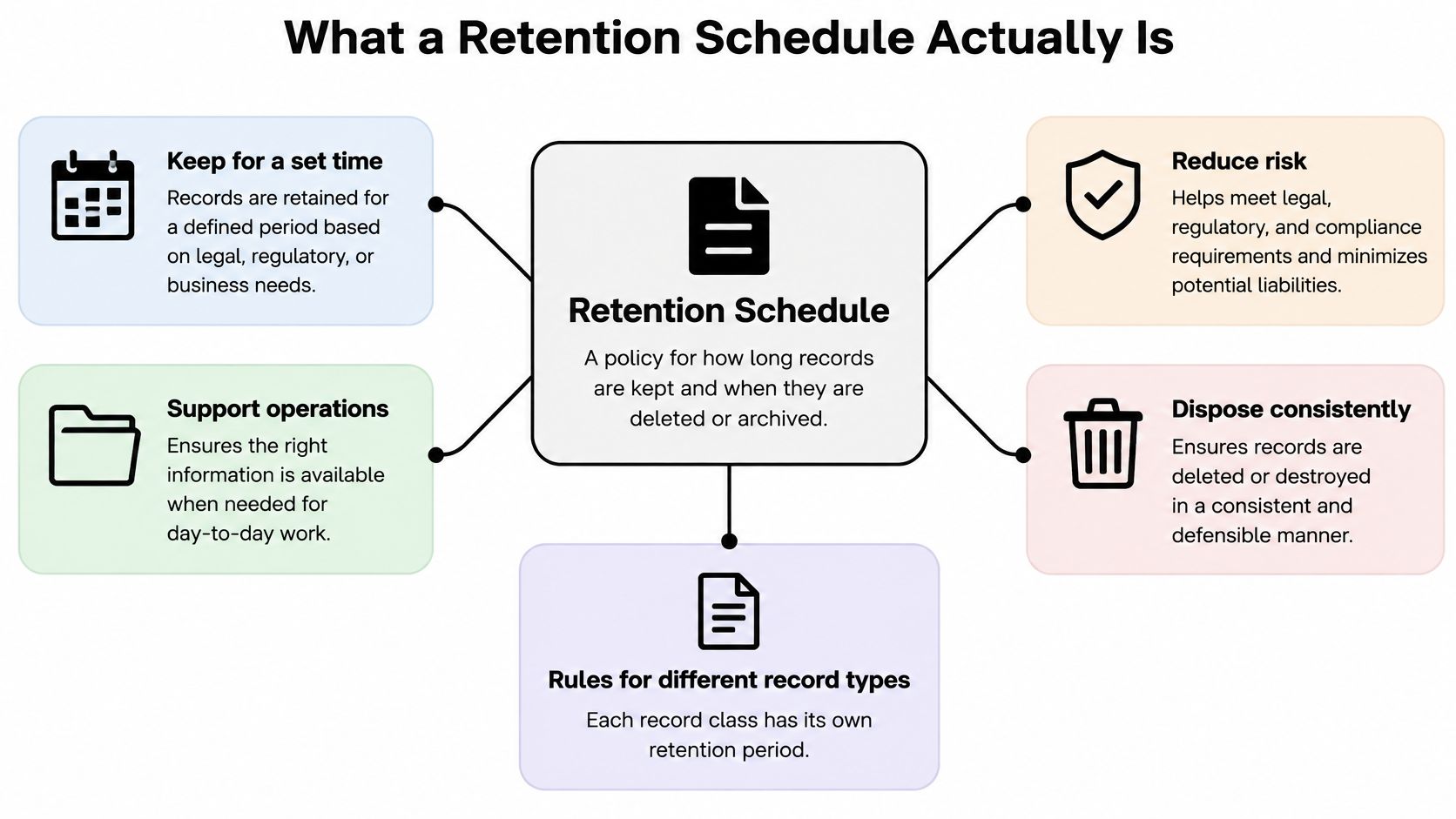
Temporary records can be essential evidence while your business needs them. Temporary means they have an authorized endpoint rather than a permanent preservation requirement.
Permanent records follow a different path. In the U.S. federal system, they ultimately transfer to the National Archives, while temporary records become eligible for authorized destruction. NARA's explanation of records schedules also makes clear that federal records must have an approved schedule before agencies can destroy them.
Those federal requirements aren't a ready-made compliance checklist for a Shopify merchant. They demonstrate the underlying discipline: decide the record's value and obligations before deciding its disposal.
A broad policy might say that your company keeps customer information only as long as necessary. Your schedule turns that intention into instructions an employee or system can follow.
For example, “keep support records as needed” leaves the decision to whoever happens to review them. A useful entry instead defines which support records are covered, which event starts retention, who approves the rule, and what disposal requires.
That's why the answer to “what is a retention schedule?” goes beyond a deletion calendar. It's a governance document that connects operational needs, legal obligations, risk management, and preservation. Without those connections, a tidy spreadsheet can still produce inconsistent decisions.
Consider a proposed entry for resolved customer-support tickets. Writing “delete old tickets” doesn't tell your support manager whether a reopened complaint qualifies, whether attachments count, or who can approve an exception.
A complete entry removes that ambiguity. The NARA records-management glossary defines retention around the period records must be kept for business, evidentiary, statutory, or other authorized reasons. Scheduling documents that period and the ultimate disposition.
Fields Every Retention Schedule Entry Needs
| Field | What It Answers |
|---|---|
| Record category | Which records belong under this rule? |
| Trigger event | What event starts the retention clock? |
| Retention period | How long must the records remain after that event? |
| Final disposition | Are they destroyed, transferred, or permanently preserved? |
| Record owner | Who is accountable for the decision and its implementation? |
| Approved authority | What legal, contractual, or business basis supports the rule? |
| System of record | Where is the authoritative version maintained? |
| Disposition method | How will the approved outcome be carried out? |
| Exception process | Who pauses, reviews, and releases an exception? |
| Version and approval | Which approved instructions currently apply? |
Creation, transaction closure, and fiscal-year cutoff are different starting points. Choosing between them changes when a record becomes eligible for disposition.
For the support-ticket example, a proposed trigger might be final case closure rather than the first customer message. Your team would still need to define what final closure means if a customer reopens the issue.
Avoid a field that depends on someone's interpretation, such as “when the customer relationship ends.” Describe the event your system can record and your staff can verify.
An arbitrary age rule can otherwise produce opposite mistakes: deleting evidence while it's still needed or retaining personal information long after its purpose has ended.
Treat the entry as a controlled instruction, not an editable note. Have the relevant business owner and qualified legal or compliance adviser validate the basis for the period before implementation.
Then document changes. A new market, product line, vendor, or application can change which records exist and how your team manages them.
If you replace your help desk, for example, check whether the migration preserves closure dates and category labels. Moving the message text without those fields could leave the team unable to apply the approved rule.
Suppose a shopper places an order, subscribes to email, contacts support about delivery, and later asks to stop receiving messages. Your team may see a customer profile, but the underlying information serves several distinct purposes.
The order documents a transaction. Consent evidence documents permission. The support ticket explains the delivery issue, while the suppression record helps prevent unwanted future contact.
Those records shouldn't automatically inherit the same retention rule just because they share a customer identifier.
The diagram below separates familiar ecommerce information into manageable groups.
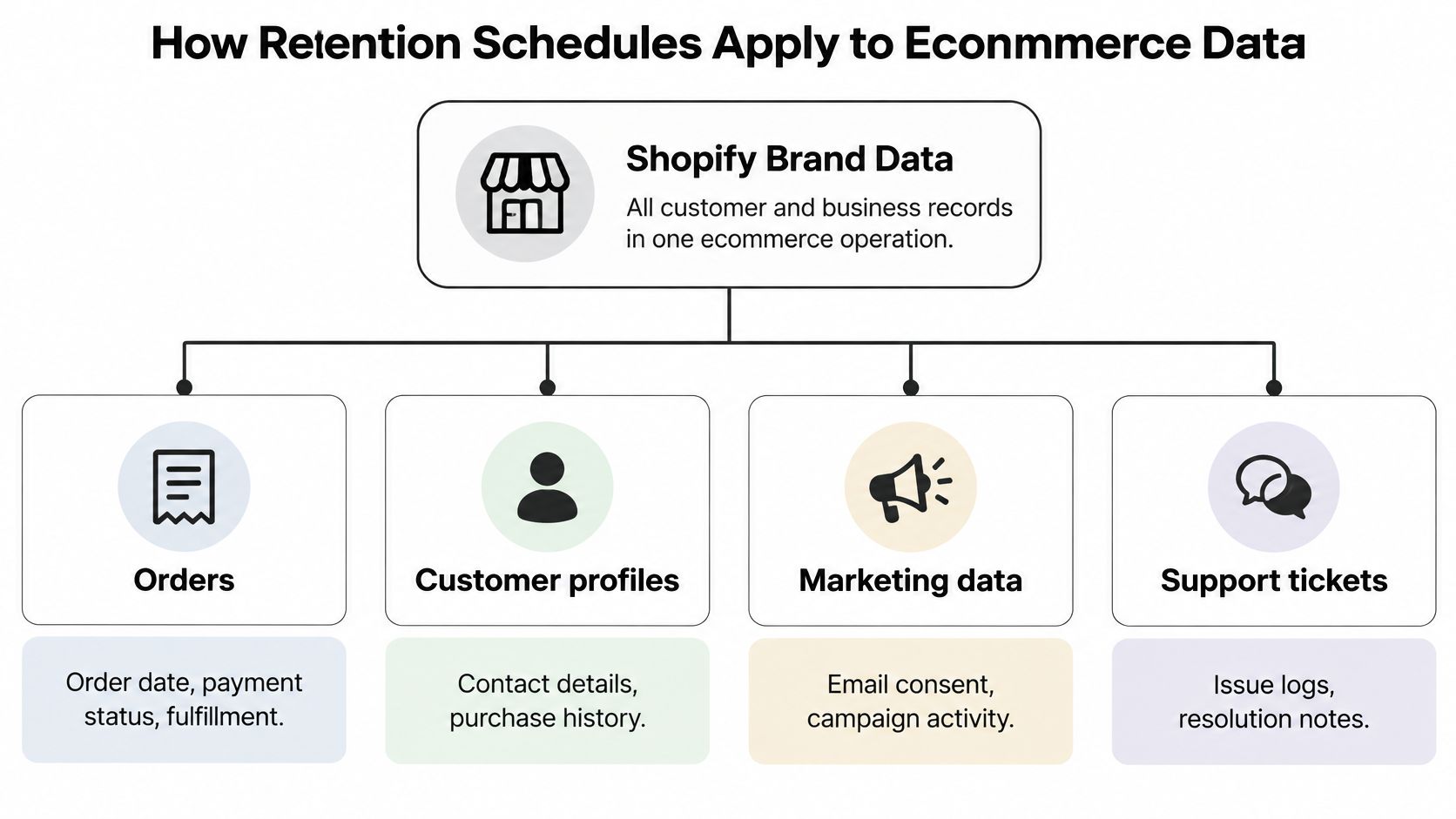
When drafting your inventory, distinguish between these practical classes:
A useful customer-profile planning guide can help you identify the information your team combines for marketing. For retention purposes, reverse that view: ask which components deserve separate lifecycle instructions.
Records-management guidance estimates that only about 3% to 5% of records created in a given year warrant permanent retention because of their enduring significance, as explained in this records-retention guidance hosted by the Maryland State Archives. That's a general records-management estimate, not a deletion target for your store.
The useful principle is that permanent retention should be a deliberate classification, not the accidental result of never making a decision.
For your Shopify operation, ask what evidence each class preserves and when its active purpose ends. A closed support case, expired supplier contract, and completed financial reporting period may point to different trigger events.
Your schedule should preserve what remains necessary without turning every historical click, export, and message into an indefinite customer dossier.
A spreadsheet can document an approved schedule. It can't, by itself, enforce that schedule inside Shopify, your CRM, or your email platform.
The practical choice is therefore about execution, not whether your policy lives in a spreadsheet or a dedicated application. Your team needs a reliable way to detect trigger events, check eligibility, carry out authorized actions, and record the outcome.
| Decision Criterion | Manual Approach | Automated Approach |
|---|---|---|
| Setup | Document rules and assign reviewers | Translate approved rules into system logic |
| Trigger handling | Staff review dates and statuses | Systems evaluate recorded events |
| Maintenance | People reconcile changes and exceptions | Administrators maintain integrations and rules |
| Auditability | Reviewers collect approvals and completion evidence | Systems generate logs that staff must validate |
| Failure handling | Follow up on unfinished tasks | Route errors and blocked actions for review |
The comparison below illustrates these operating models.
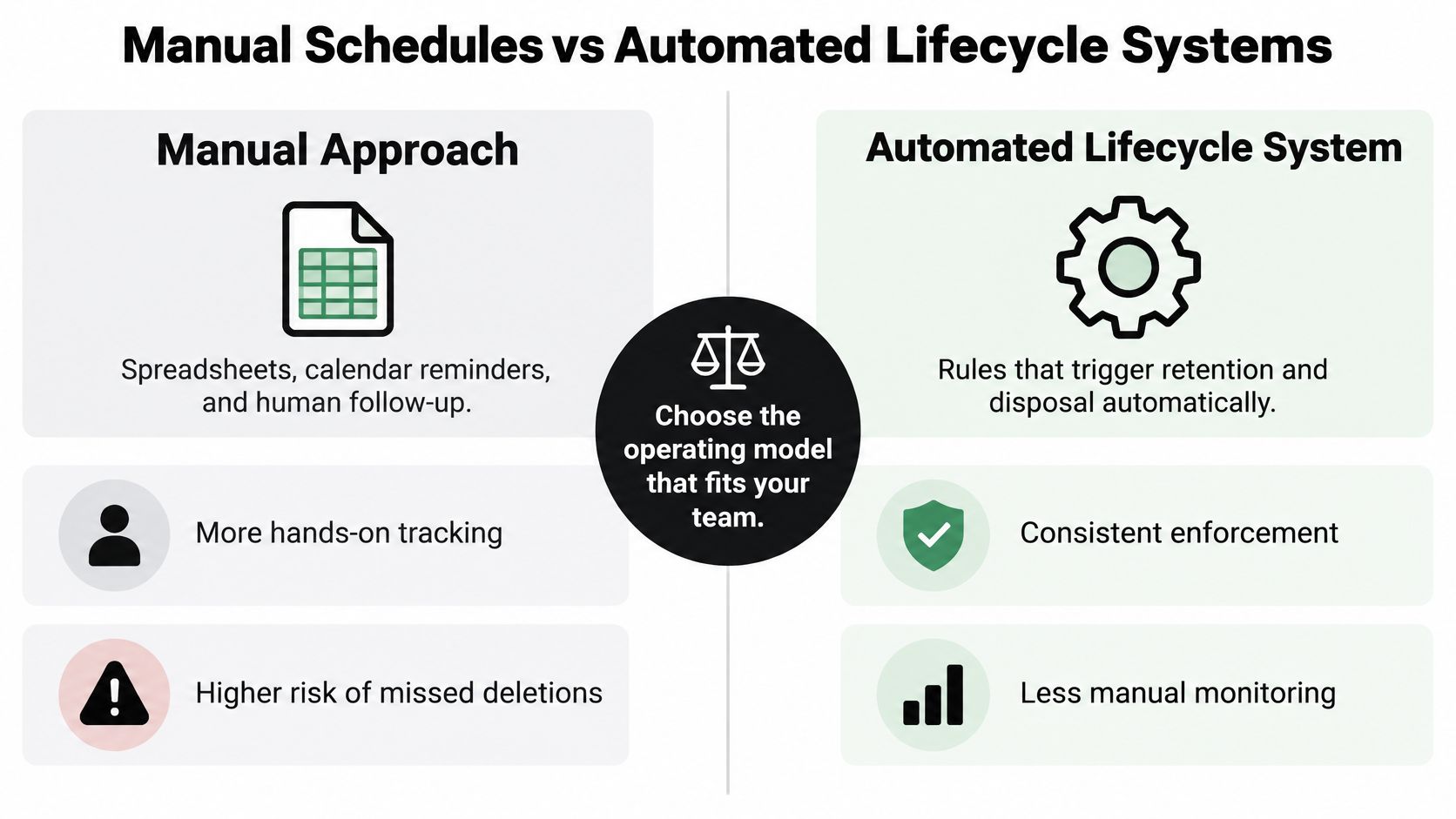
The HHS records-management policy provides a federal example of location-independent electronic records management and accurate, consistent metadata. For a merchant, the practical lesson is to preserve enough context to explain a record and the decision made about it.
For email and SMS events, a proposed implementation should connect the customer identifier, timestamp and timezone, channel, purpose, consent status, source system, retention class, and disposition status.
Sending automation isn't records-retention automation. A welcome flow can respond to a subscription event without controlling how long the underlying event history remains stored.
Similarly, customer segmentation models help organize audiences, but an audience segment isn't automatically a retention class. Purchase propensity and authorized storage duration answer different questions.
Manual review can be a reasonable starting point when your team can inspect the relevant records and document each decision. Automation becomes more useful when repeating that process across connected applications would leave staff reconciling separate task queues.
Before commissioning integrations, use Next Point Digital's resource to avoid common ecommerce automation pitfalls. Keep the implementation discussion concrete: ask what happens when a trigger is missing, an application rejects a request, or an exception blocks disposition.
Automating an unclear instruction won't resolve the ambiguity. It will repeat it.
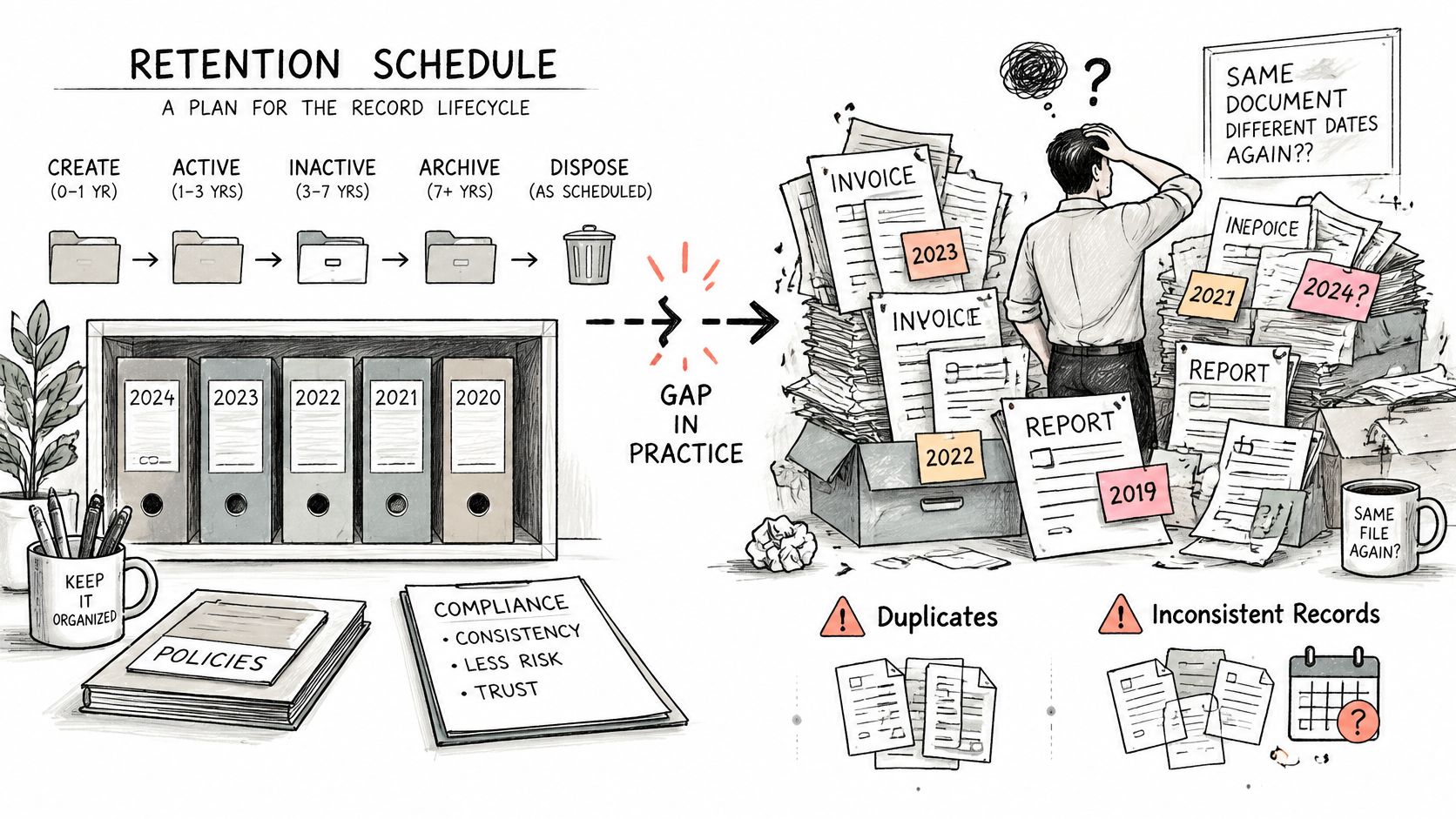
A customer record can disappear from the CRM while an exported copy remains on a shared drive. If your team checks only the CRM, it may mark the work complete without addressing the wider record inventory.
The contrast below captures the gap between documented order and operational confusion.
Use the record-series approach described in Oregon's retention-schedule basics as a starting point, then map the locations involved in your own operation. Include production applications, analytics warehouses, inbox attachments, vendor exports, replicas, and backups.
For backups, ask the provider what deletion means in its environment. Document whether the approved process involves selective removal, expiry through a backup cycle, or another supported method, and explain how restored data would be handled.
Don't describe deletion as complete if you've only submitted a request. A practical evidence log should distinguish requested, completed, blocked, and awaiting confirmation, with the responsible system and supporting response.
Practical rule: Record the boundary of your evidence. Confirmation from an email platform doesn't prove that a separate warehouse or downloaded export was cleared.
The video below offers an additional format for considering records-management processes.
A legal hold, investigation, audit, or dispute can require your team to pause ordinary disposition. That exception should have a defined scope and release process, not become a reason to preserve every customer attribute indefinitely.
Consider a deletion request involving an unresolved order dispute. Your legal adviser may identify transaction evidence that must remain, while unrelated marketing attributes can be evaluated separately. Proton's data-retention policy guidance discusses the interaction between retention, legal obligations, deletion, and accountability.
Document the basis for any exception, name its owner, and revisit it when the underlying issue ends.
Shorter isn't automatically safer. Uncontrolled deletion can remove necessary evidence; indefinite storage can create avoidable privacy, security, and discovery exposure. A defensible process requires a reason for either outcome.
The most useful mental model is a controlled decision process, not a countdown timer. Your team should be able to explain why a record is present, which instruction applies, and what prevents or permits the next action.
Use this checklist to test whether your schedule is operational rather than merely documented:
These checks belong alongside access controls, vendor oversight, and change management. MarTech Do's resource on building a stronger data governance framework offers a useful starting point for that broader discussion.
Marketing decisions still matter within those boundaries. For example, your approach to customer lifetime value in ecommerce can inform which analytical outputs you need, but commercial usefulness alone shouldn't become an open-ended justification for retaining identifiable history.
Keep the question precise: what information is necessary for this purpose, under this approved rule?
The practical next move isn't purchasing software. It's choosing a record class whose lifecycle your team can trace from collection through an evidenced final outcome.
Start with an inventory of the systems holding customer information. Include Shopify, your CRM, email and SMS platform, help desk, reporting environment, shared storage, and relevant service providers.
List the record classes inside each system, then choose a narrowly defined class to schedule first. Resolved support tickets can make a useful pilot if your team understands their closure process and can locate the related attachments and exports.
Write down the category, owner, source system, trigger, proposed retention period, authority, disposition method, and exception procedure. Have the period and its basis reviewed before anyone enables deletion.
Don't fill gaps with assumptions. If nobody knows where exported attachments go, record that as an unresolved implementation question.
Then test the proposed entry against a realistic scenario:
A failed test is useful if it exposes a missing owner or unsupported integration before live deletion begins. Revise the entry and repeat the test until staff can explain the outcome without relying on informal knowledge.
Bring in a records-management or legal specialist when the uncertainty concerns retention authority, competing obligations, or preservation requirements. Bring in a lifecycle-automation specialist when approved decisions need to be reflected in customer communications and connected workflows.
This week, produce a reviewed pilot entry and a documented test result. That's a more useful foundation than a detailed schedule nobody can execute.
Class A Media builds custom email and SMS automation for Shopify brands, using segmentation and predictive flow triggers through a one-time project model rather than ongoing retainers. Visit Class A Media to discuss how your approved data-retention boundaries, consent states, and exception requirements should inform your lifecycle communications.
Let's build retention system that drive predictable, scalable revenue - without ad spend, without retainers, without guesswork.


The Ultimate Ecommerce Email Marketing Agency
Get in touch: hello@classamedia.com