Blog post
Insights
Welcome Email Subject Line Ideas: 8 That Convert
Why do so many welcome email subject line lists treat a discount shopper, a skincare quiz subscriber, and a premium fashion customer as if they want the same greeting?
Your first line should reflect why someone subscribed, not just announce that they're on a list. Someone waiting for a code needs the code. Someone comparing unfamiliar products needs help choosing, while a subscriber drawn to your founder's story may welcome a more personal introduction.
Welcome messages deserve that attention. A GetResponse analysis cited in WriteMail's email benchmark reporting measured 83.63% opens for welcome messages, compared with 39.64% across its overall email benchmark, although neither figure should become a universal target for your store.
The strongest starting point is a recognizable promise, written in your brand's voice. These inbox-ready writing tips for marketers offer useful writing context, but choosing the right approach comes before polishing the wording.
Choose from the types below by audience situation and brand fit, then test whether the promise leads to clicks and purchases.
A first name works best when it introduces something useful. Without a benefit, personalization can look like a mail-merge trick rather than a thoughtful welcome.
This approach fits warm, service-oriented brands, including skincare businesses that help customers choose routines and fashion stores offering styling guidance. It's less convincing when the brand otherwise speaks in a restrained, impersonal voice.
An Experian benchmark covering participating brands in the United States and Canada found that personalized subject lines increased unique open rates by 29.3% overall, according to MarketingSherpa's coverage. That's a reason to test personalization, not a promise that adding a name will improve your welcome flow.
Try subject lines such as:
Say a skincare subscriber completed a routine quiz. Use their first name alongside the promised results, then send them directly to their recommendations rather than your general collection page.
In Klaviyo, preview the message with profiles that have missing or malformed name fields. Use conditional wording so an empty field produces a natural greeting, not an awkward replacement inside a sentence.
Keep the offer, sender name, and preview text unchanged when testing the name. Later messages can personalize around a selected category or stated preference instead of repeating the subscriber's name indefinitely.
A subscriber who joined through an offer popup shouldn't have to solve a riddle to claim the incentive. State the benefit directly, then make it easy to redeem.
Discount-led wording fits accessible, commercially direct brands whose signup proposition already includes a first-purchase perk. It's a weaker fit for a premium brand trying to introduce craftsmanship, unless the subscriber explicitly requested an offer.
In Experian CheetahMail's historical welcome-email study, real-time welcome messages containing an offer generated more than twice the transaction rate and revenue per email of real-time welcomes without one, according to Experian's published findings. The finding supports delivering a promised incentive, not adding discounts to every signup journey.
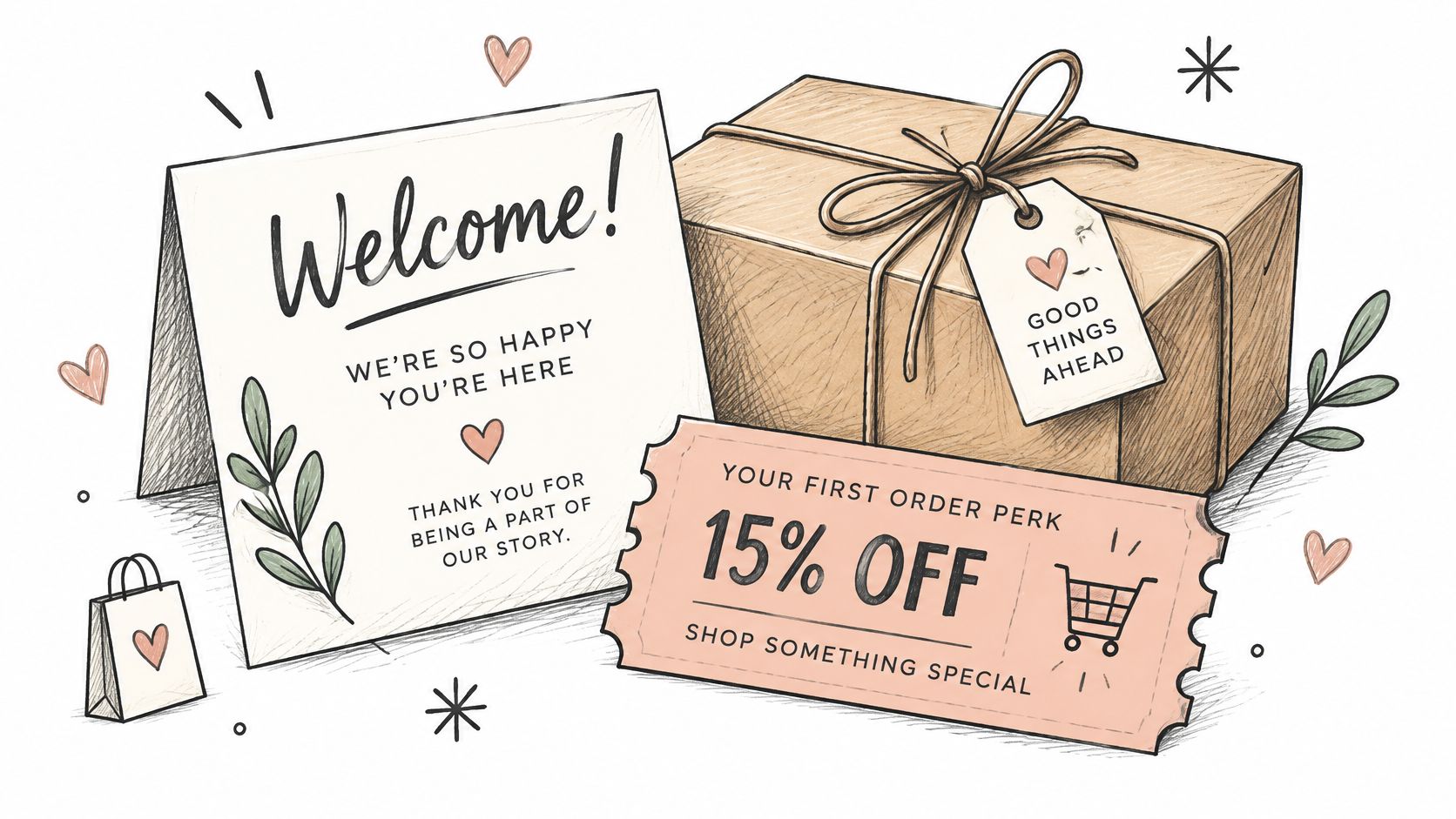
Useful options include Your welcome code is ready, Free shipping on your first order, inside, and Your first-order gift is waiting. Choose the wording that matches the actual signup promise.
For a food brand offering free shipping, show the shipping code near the top of the email and explain any exclusions before the shopping button. Don't bury the conditions beneath product recommendations.
Margin rule: Judge an incentive by the purchases it creates and the margin you keep, not just the number of codes redeemed.
Use a consistent email marketing conversion rate measurement method when comparing variants. Also track whether these customers return without another incentive, and move later welcome messages toward product usefulness, customer proof, and reasons to reorder.
Which routine fits you best? is useful when a subscriber needs help choosing. Want something amazing? asks for attention without offering much direction.
Question-based subject lines suit consultative brands with meaningful differences between products. Think skincare routines, coffee brewing preferences, or clothing collections with distinct fits, rather than a store selling a straightforward replacement item.
Use a question to name the decision the shopper is facing, not to manufacture mystery.
Say a coffee subscriber explored both espresso and filter collections without buying. A subject line such as Which coffee suits your brewer? can lead to a short selector that starts with their brewing method.
The email should answer the question within the opening content. Show clear options, explain the difference, and link each choice to an appropriate product or collection.
Don't label someone indecisive because they visited several pages. They may be comparing gifts or browsing for a household, so keep the question helpful rather than diagnostic.
If the email needs a long introduction before answering the subject line, the question is probably too broad.
Measure the next useful action, such as completing a product finder or visiting a recommended collection. An intriguing question that attracts opens but sends everyone to the homepage hasn't resolved the shopper's problem.
For a founder-led food brand, Why we started [Brand] in our kitchen can sound more natural than a generic promotional greeting. For an established technical supplier, the same intimate tone might feel forced.
Story-led subjects fit brands with a specific origin, sourcing practice, design philosophy, or production decision worth explaining. They don't work because the business has an About page.
Useful directions include Meet the team behind [Brand], Where your products actually come from, and Why we make it this way. Choose the story that helps someone understand the product, not just admire the founder.
Say a pantry brand makes sauces using a family recipe. The email could explain the flavor choices, show the people making the product, and link to the starter collection.
That's more useful than a long founder biography followed by an unrelated sale banner. Use authentic photographs and approved founder quotes, and avoid assigning a personal sender identity unless the message genuinely represents that person.
Keep any supporting video relevant to the same message, and introduce what the subscriber will learn before asking them to watch.
A founder story can introduce a purchase reason without leading with price. But if the subscriber is still waiting for a code, deliver that first.
Your welcome offer ends tonight is appropriate only when tonight is the actual deadline for that recipient. If the same code still works afterward, change the offer mechanics or remove the urgency.
This approach fits promotion-friendly brands and subscribers who've already received a genuine expiring incentive. It's a poor default for a quiet luxury brand, an education-first wellness purchase, or someone who just subscribed for a guide.
Trust matters beyond the immediate click. Validity's deliverability benchmark report recommends descriptive, conversational subject lines that make sense on their own, a useful standard when deadline copy starts becoming theatrical.
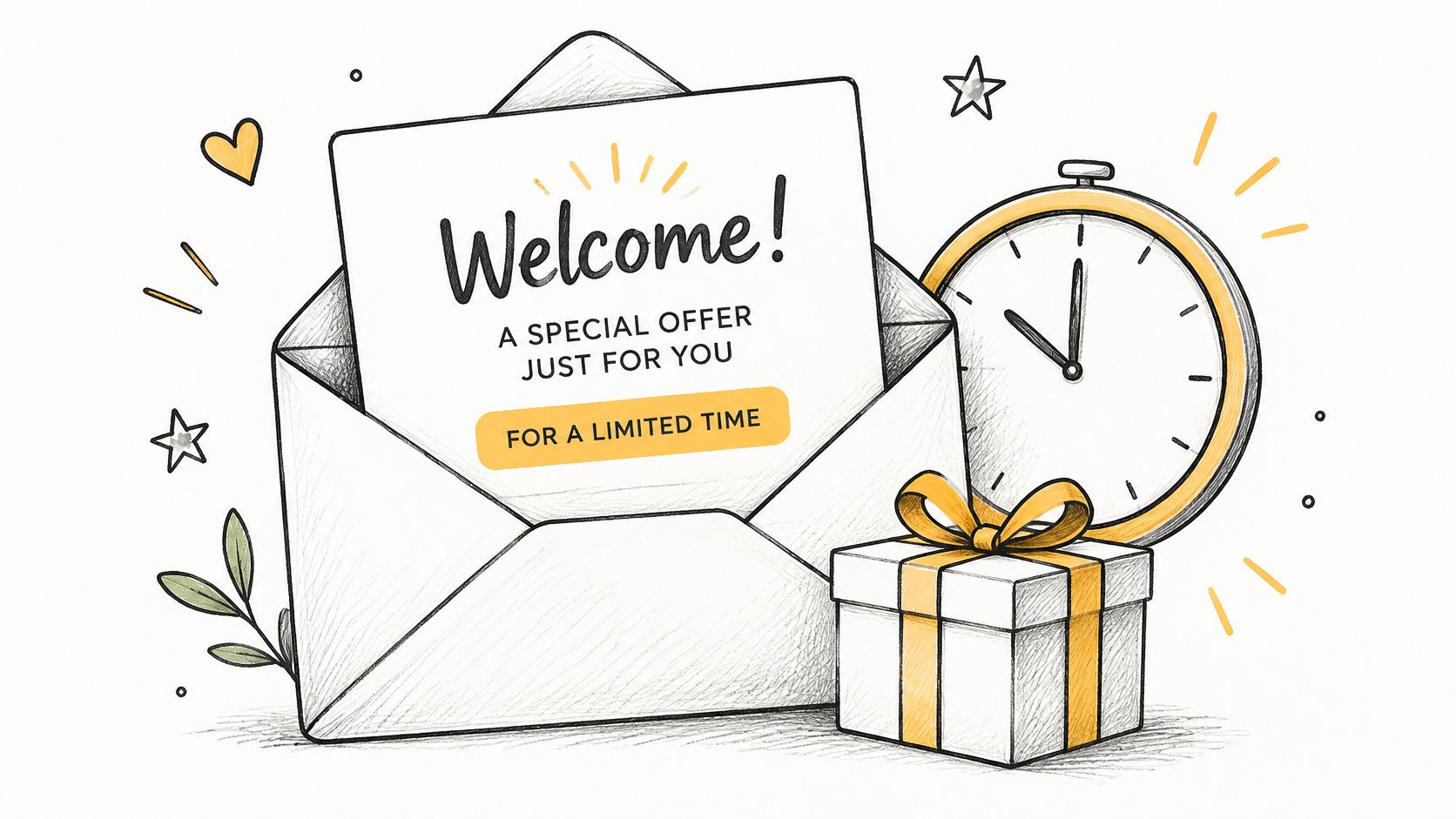
For a fashion store, Last chance to use your welcome code can fit a reminder sent before an enforced expiry. Check the recipient's offer status and suppress the message after purchase.
If you add an email countdown timer, make sure its expiry matches the discount settings and the wording. Don't let the subject say tonight while the email displays a different deadline.
Trust check: A deadline is a fact about the offer, not a tone of voice.
Use a deadline reminder selectively rather than making every message sound like a final warning. Monitor purchases alongside unsubscribes and spam complaints, and remove the pressure if it attracts short-term redemptions at the expense of the relationship.
When product selection is the obstacle, a guide can give shoppers a reason to continue without another discount. Your guide to choosing the right size addresses a concrete concern that Discover our collection leaves unresolved.
This style fits knowledgeable, reassuring brands, especially in fashion, skincare, supplements, and equipment categories. Keep the promise practical and avoid turning educational copy into unsupported health or performance claims.
Consider these directions:
Say a clothing store sells several denim cuts. The welcome email can explain how each cut fits, identify the relevant measurements, and link directly to the matching styles.
Use actual product specifications, verified reviews, and purchase information where relevant. Don't claim that customers reorder an item most often unless your store records support it.
Within a welcome series built around customer loyalty, guide-led messages can follow offer delivery and help subscribers understand what to buy. Keep the email focused on the decision named in the subject rather than squeezing in an entire buying manual.
After purchase, the information need changes. Your customer communication between checkout and fulfillment should reflect that change instead of continuing to push first-order selection advice.
Suppress or adapt welcome content after an order. A shopper who has already chosen their size needs confirmation and preparation, not another invitation to start shopping.
You're in! 👋 Here's what comes next feels at home beside an informal lifestyle brand. The same line may be wrong for a clinical-looking wellness business whose customers expect careful, restrained guidance.
Playful wording should sound like your existing product pages and social posts. An emoji can reinforce that voice, but it shouldn't become a substitute for explaining what's inside.
Possible subjects include Welcome to the family 🌿, Good taste. You're in., and Your first brew starts here ☕. Avoid Your cart is calling unless the recipient has a relevant cart event.
For a coffee subscription brand, the cup can support a welcome message about choosing a first blend. The words should still make sense if the symbol displays differently or a screen reader announces its name.
Localization also deserves its own treatment. Mailmodo's State of Email report found that 42.1% of surveyed marketers sent more than half of their emails in local languages during 2024, a reminder to review tone by market rather than assume English wordplay travels well.
Don't change the joke, incentive, and emoji together if you want to isolate the emoji's effect. For international audiences, have a fluent reviewer adapt humor and familiarity rather than translating the line mechanically.
Sometimes Welcome to [Brand] is the right choice. A restrained greeting can match premium fashion, design-led homeware, and B2B-adjacent ecommerce better than a coupon-led introduction.
The trade-off is specificity. A minimal welcome email subject line confirms the relationship, but gives the subscriber little information about the benefit of opening.
Historical analysis summarized by Listrak's welcome subject-line article found that subject lines between 1 and 60 characters performed better than the 19.9% median open-rate benchmark in the Mixpanel dataset it discussed. That's context for testing concise wording, not evidence that the shortest possible greeting will win for your store.
For a premium accessories brand, pair Welcome to [Brand] with preview text such as Explore the collection and find your first piece. If the subscriber requested an incentive, make that available immediately rather than hiding it behind a brand introduction.
Minimal doesn't mean unfinished. Configure the sender name, preview text, opening copy, and primary button as a coherent introduction.
It's also useful as a control in testing because it makes a clear, modest promise. A more elaborate variant should earn its place through better downstream results, not just look more creative in a planning document.
| Item | Best for | Brand voice | Key strength |
|---|---|---|---|
| Personalized Name + Benefit Subject Line | Welcome emails seeking early engagement | Personal and welcoming | Combines individual attention with a clear benefit |
| Discount-Led Subject Line | Driving first purchases with an offer | Promotional and direct | Makes the incentive immediately clear |
| Question-Based Subject Line | Helping subscribers explore product choices | Curious and helpful | Builds curiosity without relying on a discount |
| Brand Story or Founder-Voice Subject Line | Brands with a distinctive origin or mission | Human and conversational | Builds trust and emotional connection |
| Urgency or Time-Limited Subject Line | Genuine limited-time offers | Direct and time-sensitive | Encourages faster action |
| Value or Guide Subject Line | Products that benefit from education | Helpful and informative | Builds trust through practical guidance |
| Emoji-Led or Playful Subject Line | Playful lifestyle brands | Friendly and casual | Adds visual distinction and personality |
| Minimal Welcome Subject Line | Premium or minimalist brands | Clean and professional | Offers a simple, recognizable welcome |
The best welcome email subject line matches both your brand's voice and the subscriber's immediate reason for joining. Start with the signup promise, then choose the wording that makes the next step obvious.
For an incentive signup, lead with the offer. For a quiz or guide signup, deliver the result or resource, and for a story-led subscription, introduce the people or product decisions that attracted the subscriber in the first place.
Choose a control and a variant with a clear hypothesis. You might test a direct benefit against a relevant question, or a minimal welcome against a name-plus-benefit subject.
Keep the email body, offer, preview text, sender identity, and timing consistent while testing the subject. If those elements also change, you won't know which change influenced the result.
Don't rush to declare a winner when the order results remain inconclusive. Privacy protections and automated mailbox activity make opens an imperfect measure, so treat them as a diagnostic signal rather than the final commercial outcome.
Read the candidates aloud before launch. Lumi Humanizer's email editing guide can support that final editing pass, but the useful test is whether the line sounds like your business and accurately describes the email.
If you'd rather have the complete sequence built for you, our Custom Welcome Flow includes strategy, copy, design, and implementation for Klaviyo, delivered in 5 days. We begin with an onboarding email and a strategy session before building the flow around your business.
Choose the clearest suitable subject, send it to the right subscriber, and use purchase behavior to refine it. You don't need the cleverest line in the inbox. You need a promise your email can keep.
We build custom Klaviyo welcome flows that connect subject lines with signup intent, email content, and the next purchase step. Visit Class A Media to get your welcome strategy, copy, design, and implementation handled together.
Let's build retention system that drive predictable, scalable revenue - without ad spend, without retainers, without guesswork.


The Ultimate Ecommerce Email Marketing Agency
Get in touch: hello@classamedia.com