Blog post
Insights
Klaviyo Partner Guide for Shopify Brands
A Klaviyo partner badge indicates a firm is part of Klaviyo's program. It doesn't confirm whether that firm will manage your account, clean up your Shopify data, or report revenue accurately. For Shopify brands, those three questions matter more than a directory listing. This guide explains what partners are paid to do, how tiers work, which flows you should expect, and which numbers to demand before you sign.
Klaviyo reports that partners generate, on average, at least $3 in implementation, strategy, and managed-services revenue for every $1 of Klaviyo monthly recurring revenue. The software subscription is only part of the cost. Setup, integrations, lifecycle design, and ongoing optimization make up much of the work a brand hires a partner to do.
Klaviyo's partner materials also report more than 6,500 agency partners and over 350 integration partners, with 85% of Klaviyo customers enabling at least one integration. These figures describe the size of the ecosystem, not the results a particular agency will deliver. A large directory gives you more options; it does not guarantee stronger retention.

Klaviyo holds customer profiles, events, and messages. A partner uses that information to decide which flows to build, who qualifies for them, and when email or SMS should reach each customer. The work includes choosing relevant segments and offers, then checking that the underlying Shopify data supports those choices.
For a skincare brand selling a serum that lasts about two months, a post-purchase flow might explain how to use the product, follow up on results, and send a replenishment reminder before it runs out. The reminder should stop for customers who have already reordered, unsubscribed from SMS, or bought a larger size. Those rules depend on accurate purchase and consent data, not just polished copy.
Shopify brands often use other systems for reviews, loyalty, subscriptions, customer support, and returns. A partner may connect those systems to Klaviyo and check that events and consent states sync correctly. If loyalty data is missing, repeat buyers may receive the same discount as first-time customers. If support information does not reach Klaviyo, a customer with an unresolved issue may receive an ill-timed promotion.
The same broad principle of mapping touchpoints and measuring their effects appears in digital strategies for professional services, though the systems and customer journeys differ. For an eCommerce brand, ask what the partner will build in Klaviyo, which data sources those flows depend on, and how results will be measured. A badge identifies a partner; trustworthy data and clear reporting help you judge the work.
Klaviyo partner tracks and published tier bars
| Track or tier | What the partner does | Financial or activity bar | Training or proof bar |
|---|---|---|---|
| Advisor | Refers business and does not actively manage accounts | Silver: at least $250 in listed financial requirements. Gold: $5,000 and $500 in listed requirements. Platinum and Elite: dollar bars are not published in Klaviyo's public requirements. | Silver: one employee completing specified training. Gold: at least three employees across Fundamentals, Deliverability, Sales, onboarding, and Practitioner. Platinum and Elite: requirements vary by tier; specific bars are not published in Klaviyo's public requirements. |
| Master | Provides Klaviyo services for mutual customers | Silver: at least $250 in listed financial requirements. Gold: $5,000 and $500 in listed requirements. Platinum and Elite: dollar bars are not published in Klaviyo's public requirements. | Silver: one employee completing specified training. Gold: at least three employees across Fundamentals, Deliverability, Sales, onboarding, and Practitioner. Platinum and Elite: requirements vary by tier; specific bars are not published in Klaviyo's public requirements. |
| Silver Master | Hands-on services at the entry Master tier | At least $250 in listed financial requirements | One employee completing specified training |
| Gold Master | Hands-on services with a larger trained team | $5,000 and $500 in listed requirements | At least three employees across Fundamentals, Deliverability, Sales, onboarding, and Practitioner |
| Platinum | Higher-tier partner status | Dollar bars are not published in Klaviyo's public requirements | Specific training or proof bars are not published in Klaviyo's public requirements |
| Elite | Higher-tier partner status | Dollar bars are not published in Klaviyo's public requirements | Specific training or proof bars are not published in Klaviyo's public requirements |
Klaviyo's official Partner Program requirements distinguish an Advisor track for partners that refer business but do not actively manage client accounts from a Master track for partners that provide Klaviyo services for mutual customers. An Advisor can hold partner status without building or managing your flows. If you want hands-on retention work, the Master track is the more relevant comparison.
Both tracks use four tiers: Silver, Gold, Platinum, and Elite. Published requirements give concrete examples for Silver and Gold. Silver calls for at least $250 in listed financial requirements and one employee completing specified training. Gold calls for $5,000 and $500 in listed requirements, plus at least three employees completing Partner Program Fundamentals, Deliverability, Sales, client onboarding, and Practitioner training. The public requirements cited here do not specify Platinum or Elite dollar bars.
Two terms in the table need translating. Referred MRR is monthly recurring revenue from accounts the partner sent to Klaviyo. Managed MRR is monthly recurring revenue from accounts the partner runs. Referred volume shows an ability to bring in business; managed volume indicates the firm has ongoing responsibility for customer accounts.
Training is a useful floor, not a performance guarantee. Completing Deliverability and Practitioner training shows familiarity with Klaviyo's terminology and guidance. It does not, by itself, prove that a team can write effective copy, segment customers by purchase behavior, or make revenue attribution trustworthy after a Shopify sync.
A higher tier signals volume and training. It does not guarantee stronger creative, cleaner data, or more reliable reporting.
Use the badge as a starting point, then ask which track the partner is on, which tier they hold, and how much of their work involves managing accounts rather than referring them. A Master partner with trained staff who will work in your account may fit your needs better than a higher-tier firm focused on referrals.
Klaviyo's center of gravity is Shopify, and the numbers show it. Klaviyo's technology partnerships page and its filings report that Klaviyo was founded in 2012 and, by December 31, 2023, served more than 143,000 customers, had assembled over 8.9 billion consumer profiles, and processed more than 835 billion consumer events during the year. Klaviyo defines those events broadly as behavioral data such as email opens, website browsing, and orders. The company also reported more than $50 billion in Klaviyo-attributed value during 2023 and, in a later filing, states the platform exceeded 193,000 businesses globally by December 31, 2025, while 77.9% of annual recurring revenue came from customers using Shopify.
Those events are the raw material for automation. A flow is a sequence of automated actions triggered by a behavior or event, such as joining a list, entering a segment, starting checkout, completing or fulfilling an order, reaching a date property, a price drop, or low inventory. Your partner's job is turning the right events into the right sequences.
This diagram maps the core flows a partner should ship for a Shopify store.
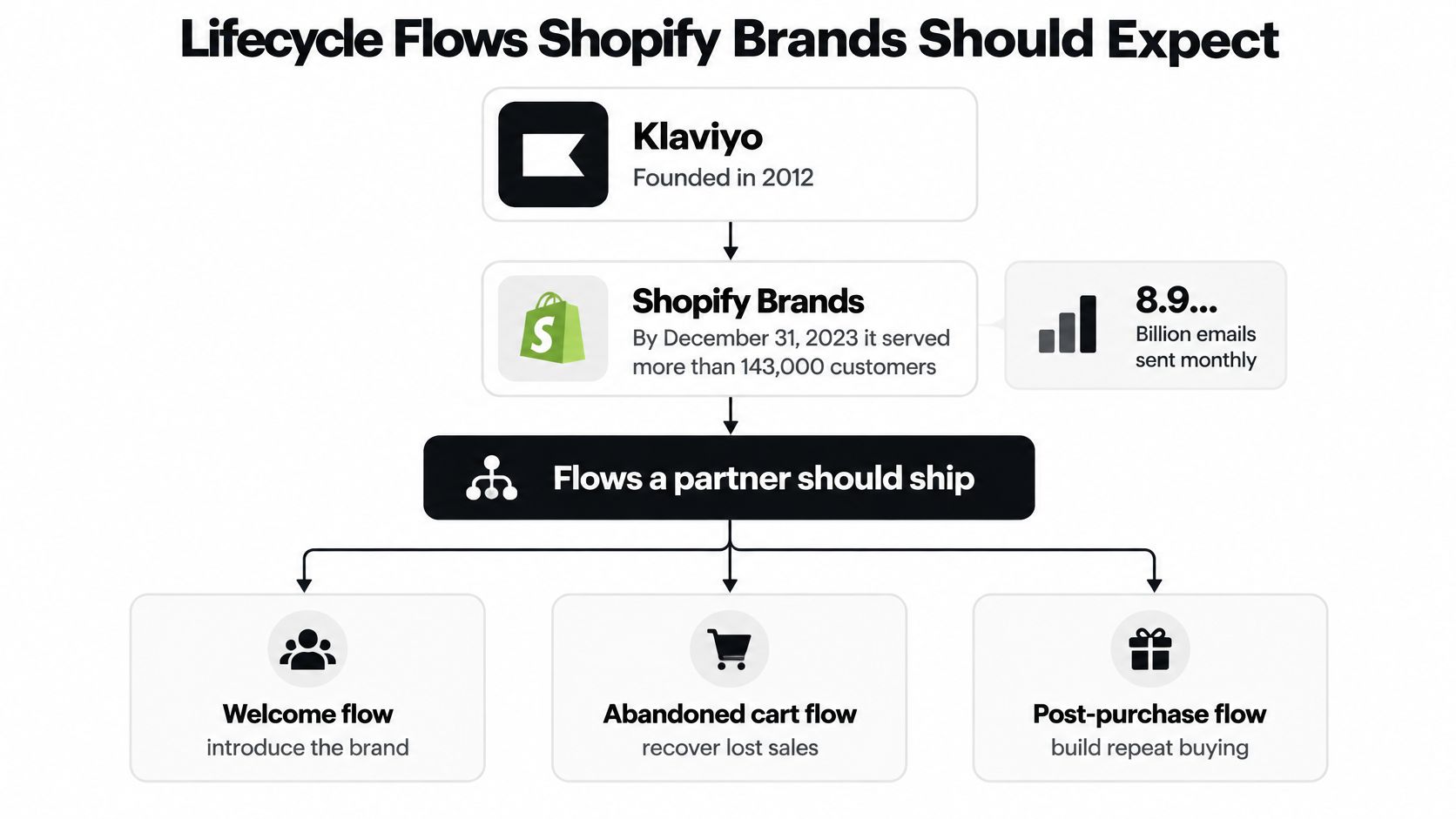
Each flow needs its own eligibility rules. A welcome series shouldn't swallow a post-purchase buyer. A win-back discount shouldn't reach someone who ordered last week. If your account holds one generic nurture stream, you don't have a lifecycle system yet. Our explainer on the phases a customer moves through breaks down how these stages connect.
The short walkthrough below shows how these sequences look inside a working account.
A brand running only a welcome series and an abandoned cart leaves the repeat-purchase moments unbuilt. That's usually where the margin is, because the customer already trusts you enough to have paid once. Post-purchase and replenishment flows convert that trust into a second and third order without new ad spend.
Email should earn the second order, not just announce the first.
Brands that want that system custom-built can review a Klaviyo agency and compare its flow list against the six above. Keep the company figures in proportion. They describe Klaviyo's overall customer base. They don't prove every partner configures triggers, splits, and suppressions well. Ask to see the actual flow map, trigger by trigger, before you pay for it.
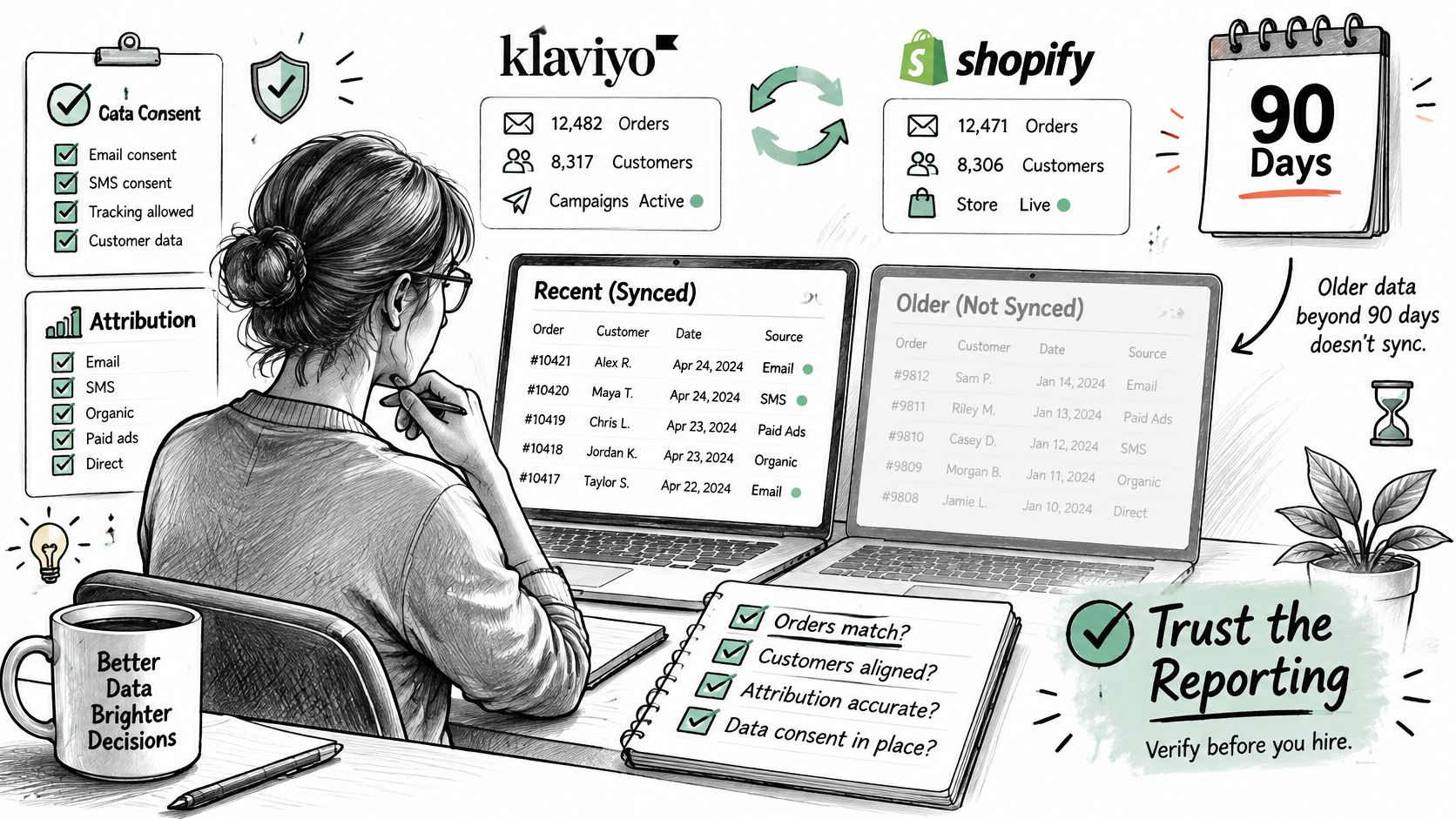
Here's the limit most flow pitches skip. Klaviyo's documentation on extended identification and the Shopify pixel sync says the Shopify integration initially syncs only the previous 90 days of order and customer data, while newer capabilities extend anonymous identification for as long as one year and connect previously anonymous browsing activity after a shopper identifies themselves. Your shiny new account may know far less about your customer history than you assume.
The consequences stack up. Historical cohorts can be incomplete, so a win-back segment built in week one may miss buyers from last year. Anonymous browsing joins a profile only under specific identification conditions, so browse abandonment coverage depends on how shoppers identify themselves. Longer-lived tracking raises governance questions across countries, especially where consent rules differ by market.
This checklist view shows the sync points a partner should verify before building anything.
Shopify Markets brings regional currencies and languages into the account, and SMS or WhatsApp consent can be collected at checkout and at post-purchase touchpoints. Each market can therefore hold different consent states for the same person. A partner who expands tracking before defining consent capture, profile merging, and attribution rules can produce worse reporting than a simpler setup. More data, joined carelessly, just means more confident mistakes. If your store sells across regions, it's worth choosing a consent management platform deliberately rather than accepting whatever banner a theme ships with, since consent records decide who you may legally message.
Get one question answered in writing before you sign. Exactly what customer and behavioral data will be available, from which date, under what consent, and how will duplicate or anonymous profiles affect lifecycle reporting? A serious partner answers with dates, sync rules, and a backfill plan. A vague partner answers with a mockup.
Newer traffic sources complicate attribution further. ChatGPT referrals can appear in Shopify and pass into Klaviyo as a UTM source, and Klaviyo has explored capturing contact information and consent inside large-language-model experiences. A partner should segment AI-referred visitors separately, distinguish assisted discovery from a purchase the automation caused, and still collect lawful email or SMS permission when the first interaction happens off your site. A high conversion rate from AI traffic doesn't prove a flow worked. It may prove the shopper arrived already decided.
Predictive segmentation has its own floor. Klaviyo's predictive analytics documentation states an account needs an ecommerce integration or API-based order data, at least 180 days of order history, recent orders within the applicable lookback period, at least 500 customers who have placed an order, and at least some customers with three or more orders. Below that floor, lifetime-value predictions aren't available, and fixed sequences are the honest fallback. Don't pay for predictive targeting your data can't support yet.
US SMS and MMS campaign thresholds
| Metric | Great | Critical |
|---|---|---|
| Click rate | 14.6% or higher | Below 5.9% |
| Conversion rate | 2.1% or higher | Below 0.5% |
| Revenue per recipient | At least $2.42 | Below $0.18 |
Those bands come from Klaviyo's U.S. SMS/MMS benchmark guidance, which classifies campaign click rates of 14.6% or higher as "great," conversion rates of 2.1% or higher as "great," and revenue per recipient of at least $2.42 as "great", while results below 5.9% click rate, 0.5% conversion rate, or $0.18 revenue per recipient are categorized as critical. Paste them into your kickoff agenda. They're diagnostic boundaries, not vanity targets.
Judge performance at the flow, campaign, and channel level rather than from one account-wide open rate. Klaviyo's benchmark framework separates reporting into campaigns, flows, business performance, and sign-up forms, and account-level channel benchmarks require at least 25 delivered messages in that channel during the previous six months. The same benchmark reporting notes that the top 10% of campaigns generate order rates more than five times those of the overall campaign population, drawn from billions of email and text messages. That gap points at audience selection and message sequencing. Sending more is rarely the fix.
A high click rate with a weak conversion rate usually means the problem sits downstream. Shoppers tapped, then hit a landing page that didn't match the message, an out-of-stock product, an offer that didn't pencil out, or a checkout with friction. Rewriting the text message won't cure any of those. Flip the pattern and the fix flips too. A low click rate with acceptable conversion among clickers points at weak creative, poor timing, or an audience that's too broad, because the people who do click are ready to buy.
Our guide to measuring email marketing conversion properly walks through that pairing in detail. The habit to build is simple. Never accept a single metric in a partner report. Ask what it pairs with and what changed upstream.
Establish a control baseline for each flow type, including welcome, browse abandonment, cart abandonment, post-purchase, replenishment, and win-back. Then compare conversion rate and revenue per recipient against the relevant benchmark cohort. Email revenue per recipient is total revenue attributed to email during a period divided by the number of people who received email in that period. That denominator keeps everyone honest, because a flow can't look brilliant just by mailing a bigger list.
Coordinate the channels instead of duplicating broadcasts. Email carries longer-form education and product comparison. SMS carries time-sensitive replenishment, back-in-stock alerts, and offer reminders. A purchase event should stop promotional messages immediately after conversion, in both channels. Report revenue by channel, flow, and customer status so the same order isn't counted twice and credited to whichever message touched it last. Test eligibility logic, suppression rules, purchase-frequency segments, and product recommendations one at a time, because account averages hide underperforming branches. That's how a partner proves incremental orders rather than decorated attribution.
Case results are useful when you read the outcome alongside its limits. Published work includes brands in fashion, health and wellness, and food and beverage, such as GUIZIO, Kush Queen, and Four Sigmatic. You can browse Class A Media's case studies to see examples across those categories.
In the KIWI case study, Class A Media's email flows increased sales by 421%. That result belongs to one brand and its starting point. A store with little existing automation may have more room to improve than one with mature flows, so the figure is evidence of what happened for KIWI, not a forecast for another store.
Chill Chair offers a second example. After its email flows were revamped, open rates reached 50%, flow revenue rose 168%, and total revenue rose 27%. Read the measures together: open rate reflects engagement, flow revenue shows sales attributed to the sequences, and total revenue provides broader business context.
Practical rule: Ask which flows produced the result, what baseline was used, and whether total store revenue changed. Attributed email revenue alone can give an incomplete picture.
For a comparison of how an established fashion retailer presents its ecommerce work, see a closer look at Matchesfashion. A polished case page can help explain the work, but the measures and their context are what let you judge the result.
Class A Media is named one of Klaviyo's fastest-growing agencies. That describes agency growth, not a guaranteed outcome for a particular brand. More purchase touchpoints, behavior-based timing, and separate flows for distinct moments can create more opportunities for repeat purchases than relying only on a welcome email and a cart reminder. For any result, ask which flows were involved, what period they were compared against, and whether repeat-purchase timing changed.
Use these checks in order. They'll narrow a long directory to a short list quickly.
This checklist sums up the three verification steps to run first.
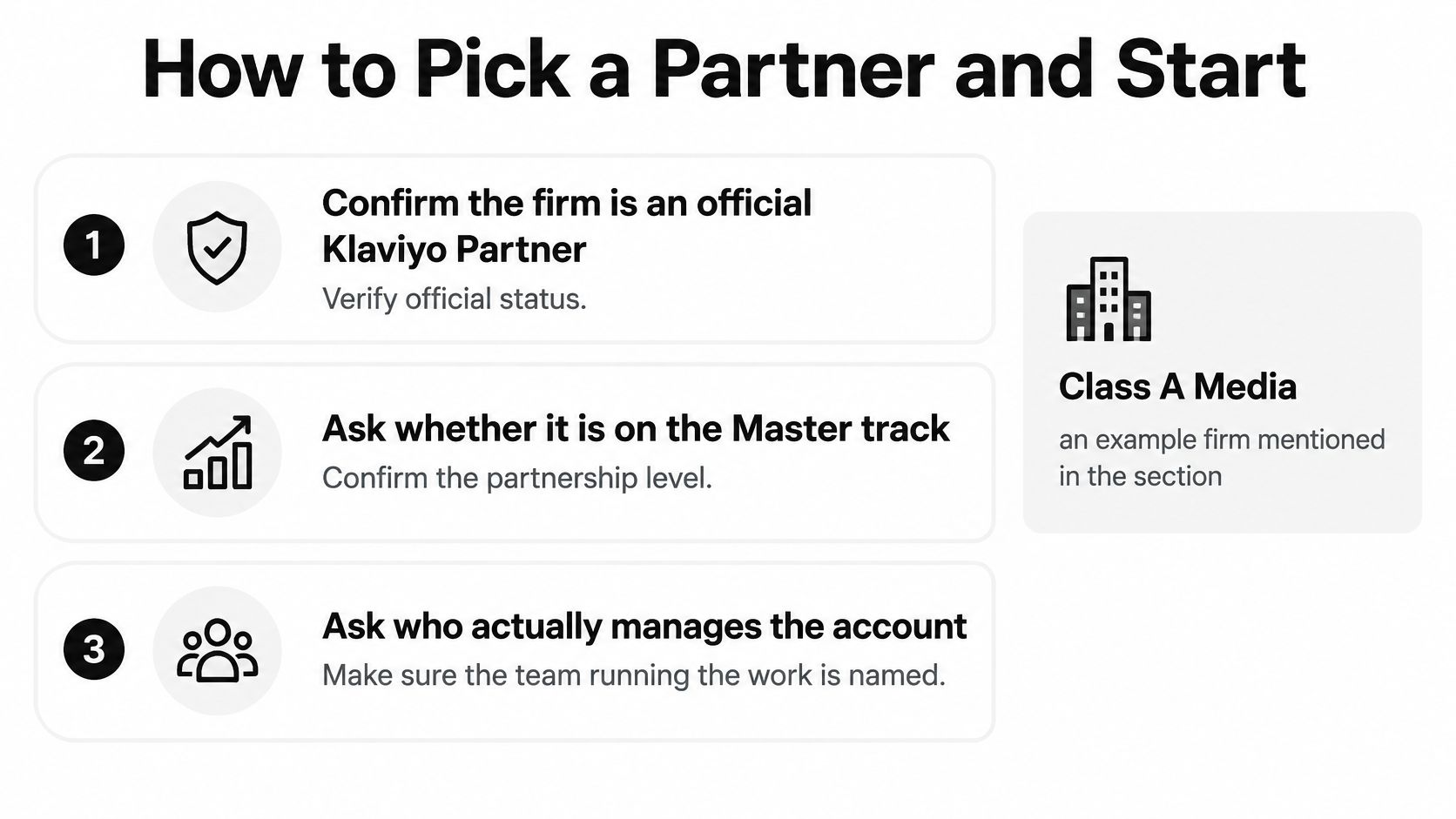
Notice what's missing from that list. There's no step that says pick the highest tier or the prettiest portfolio. Tier tells you about program volume. The checks above tell you about the work you'll live with, including clean identity data, defensible attribution, and flows timed to real purchase behavior.
Your next step is to take one official partner's scope, timeline, and attribution rules and score them against the tier questions and benchmark bands in this guide. If a firm answers the data question with dates, shows baselines by flow, and builds in your account, you've found a partner worth hiring. If it leads with the badge, you haven't.
If you're ready to replace a basic welcome and cart setup with a custom Shopify retention system, we build data-connected email and SMS flows inside your own Klaviyo account, with clear baselines and revenue reported by flow. Visit Class A Media to see how our one-time build works and whether it's the right fit for your brand.
Let's build retention system that drive predictable, scalable revenue - without ad spend, without retainers, without guesswork.


The Ultimate Ecommerce Email Marketing Agency
Get in touch: hello@classamedia.com