Blog post
Insights
Klaviyo Explained: Features, Uses and Retention Flows
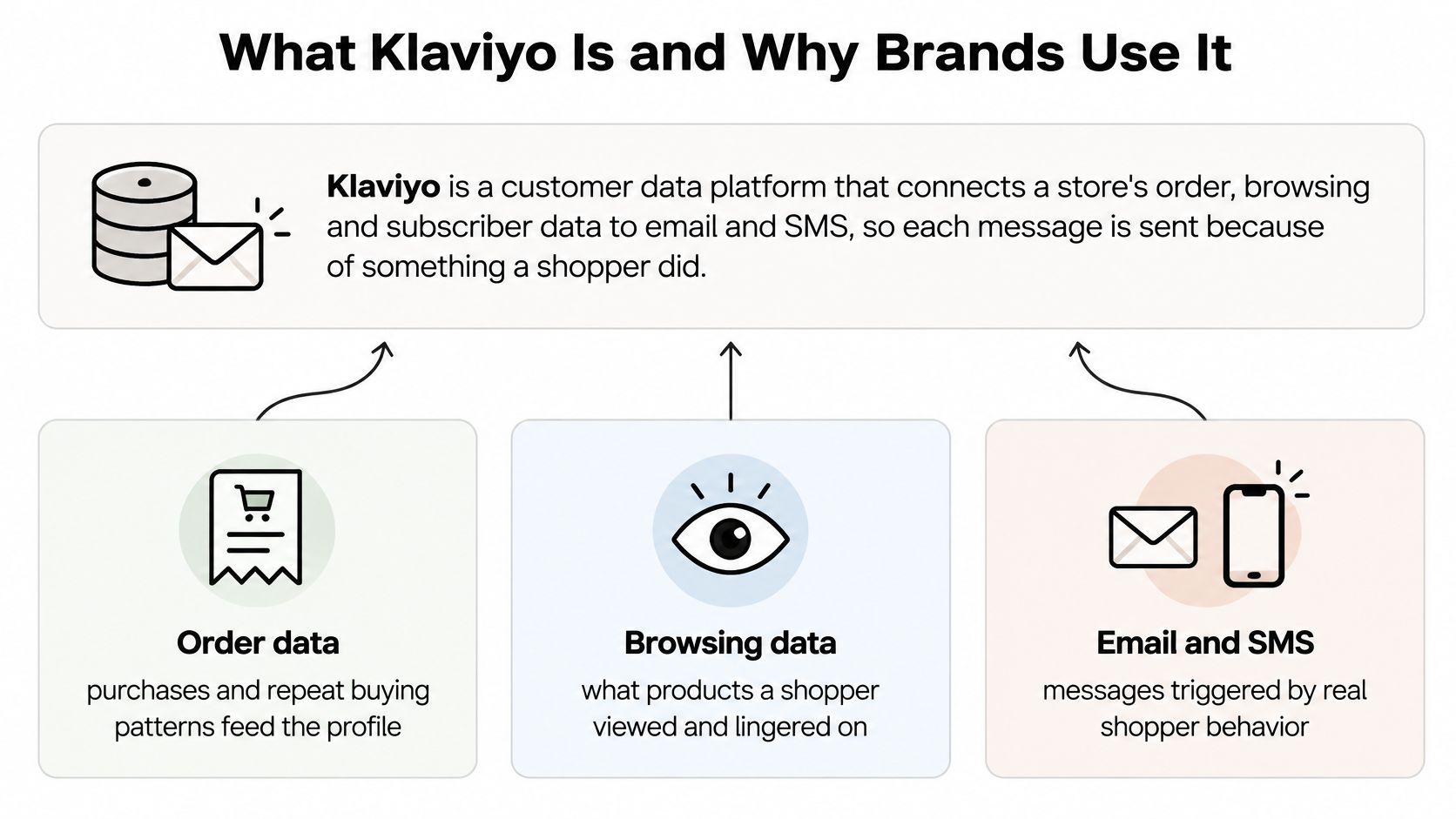
Klaviyo is a customer data platform that sends email and SMS based on what each shopper does, such as browsing, adding to cart, or placing an order. By the end of 2025 it had reached $1.234 billion in revenue, 31.6% growth, and more than 193,000 customers.
You're looking at a Shopify month that spent well on ads and still didn't bring those buyers back. A welcome note went out. A discount blast went to everyone. The cart from Tuesday is still open, and the person who bought a 30-day serum in March hasn't heard a word since. Klaviyo is built for that gap, but the revenue tile on its dashboard is a claim. A shopper who was going to pay anyway can still get full credit for a text they never opened. Before you rebuild every sequence, it helps to know what the platform sends, what it can measure, and how to test whether the money is real.
A shopper browses a product, leaves without buying, then returns days later. Klaviyo can connect that activity with the shopper's order and subscriber data, giving a store a way to send relevant email and SMS rather than the same newsletter to everyone. It works like a store's memory, linking visits and purchases to later messages. Klaviyo developed around ecommerce and direct-to-consumer brands, and its customer base has grown to include larger accounts.
| Year | Revenue |
|---|---|
| 2023 | $698.1 million |
| 2024 | $937.5 million (34.3% growth) |
| 2025 | $1.234 billion (31.6% growth) |
The Klaviyo fiscal-year filing reports net revenue retention of 110% at December 31, 2025. In plain terms, recurring revenue from existing customers was higher than a year earlier, after expansions, downgrades, and cancellations. That figure describes revenue across the customer base; it does not show that a particular message caused a purchase.
For an individual store, treat Klaviyo-attributed revenue as a starting point for investigation, not proof of incremental sales. Compare dashboard credit with what happens when a similar group of shoppers does not receive the message. If you are comparing platforms, browse HubSpot and Mailchimp alternatives and consider how each connects customer profiles to sends.
Email and SMS both read the same customer profile, so a message can name the jacket someone bought or the serum they viewed. The split that confuses new owners is campaigns versus flows.
A campaign is a newspaper printed once and handed to a chosen list at a chosen hour. A flow is a concierge who speaks only when that guest walks in. You need both. Campaigns carry a launch or a sale. Flows carry the moments that happen every day without you pressing send.
One-time campaigns: You pick a list or segment, write the message, and send it on a schedule.
Automated flows: Behavior starts the sequence. Nobody has to remember the Tuesday cart.
Dynamic segments: Membership updates as people buy, browse, or go quiet.
Profile filters: A message in the middle of a sequence can change, or stop, when the profile changes.
SMS uses that same profile and the same flow logic, but delivery is scored differently. Email talks about bounce rate. SMS talks about a failed-to-deliver rate.
Reporting has floors. Per Klaviyo's benchmark guide, email benchmarks need at least 25 delivered emails in the previous six months, and SMS benchmarks need at least 25 delivered texts in that period. An account deliverability score, from 0 to 100, needs at least 1,000 emails sent in the last 30 days. A quiet store should trust order and revenue counts first, and wait to treat peer benchmarks as stable.
A flow starts when a shopper does something, not when your calendar says it's Tuesday. Timing follows the person.
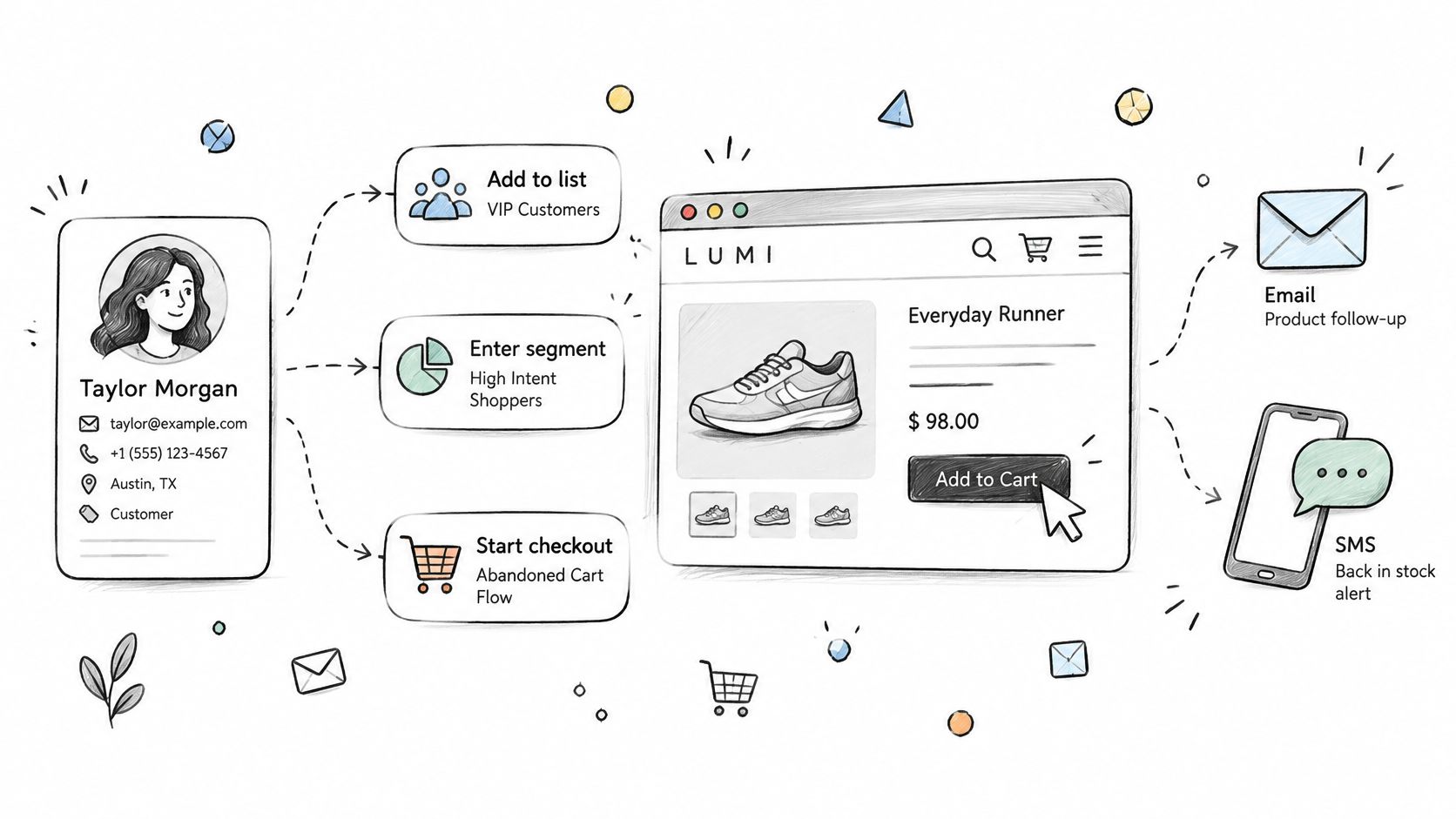
Klaviyo's flow documentation lists the triggers brands use: list membership, dynamic segment membership, tracked metrics such as placing an order, date properties, price drops, and low-inventory events. Filters on profile attributes or behavior can suppress or adapt a message when the customer's situation changes.
Say someone buys a wool jacket. The placed-order metric drops them into a post-purchase flow, and three days later they get care instructions, not another ad for the same coat. A different shopper viewed a sold-out lamp. When stock returns, a low-inventory or back-in-stock style event can send that one person a note. A price-drop trigger does similar work for anyone who viewed an item that later gets cheaper.
A filter can require that the person hasn't ordered since they entered. If they buy on day one, later emails in that sequence shouldn't still nag them. The filter reads the profile again as circumstances change, which is why a purchase can pull someone out before the next send.
Try this on paper before you build anything. List five moments in your store, then match each one to a trigger the platform can see.
Predictive segments group people by what they're likely to do next, not only by what they already did. Once a store qualifies, Klaviyo's predictive analytics guide says you can segment on historic customer lifetime value, predicted customer lifetime value, churn risk, and average time between orders.
A buyer whose usual gap is 45 days, and whose churn risk is climbing, can sit in a win-back segment before they fully disappear. You're acting on a pattern, not on a hunch that "it's been a while."
Check your store against every row before you turn the feature on.
| Requirement | Minimum | Why it matters |
|---|---|---|
| Data connection | Ecommerce integration or API order data | Predictions need order records to learn from |
| Order history | At least 180 days | Enough history to measure time between orders |
| Recent activity | At least one order in the past 30 days | Shows the store is still trading |
| Buyer base | At least 500 customers who have placed an order | Gives the model enough examples |
| Repeat buyers | Some customers with three or more orders | Lets the model estimate lifetime value |
Order records are the textbook. Without a Shopify integration or API orders, there's nothing to learn from.
180 days is what makes a gap between orders visible. A store that launched last month doesn't have that span yet.
One order in 30 days tells the model the shop is still selling, so old history isn't the only signal.
500 buyers is a pile of examples. Fewer than that, and a prediction is mostly noise.
Three or more orders on some profiles is how lifetime value gets a shape. One-and-done buyers can't teach a repeat pattern.
Practical rule: If you fail a row, don't force a prediction. Build a rule on last order date and total spend until the history exists.
A skincare shop under 500 buyers can still segment "ordered in the last 60 days and spent over $80" without any model. That segment is blunt, and it's honest. When the table is fully green, switch the win-back audience to churn risk plus time between orders, and keep the simple segment as a backup you can compare. For a wider map of how audiences get built, see customer segmentation models.
Retention flows are the sequences that ask a one-time buyer to come back, with a reason tied to what they already did.
| Flow | Trigger | Goal |
|---|---|---|
| Welcome series | New email or SMS subscriber | Turn subscribers into first buyers |
| Abandoned cart | Added to Cart or Started Checkout event | Recover checkouts that stalled |
| Browse abandonment | Viewed product without adding to cart | Re-engage shoppers showing interest |
| Post-purchase | Placed order | Support the buyer and encourage reviews or cross-sell |
| Replenishment | Order date plus product reorder interval | Prompt repeat purchase on time |
| Win-back | No order within a set period | Reactivate lapsed customers |
Welcome series. Someone signs up from a popup on a candle site. The first emails teach the scent families and offer a small first-order reason while interest is fresh. This usually comes first, because a subscriber who never buys is an expensive name on a list.
Abandoned cart. A shopper starts checkout on a wool throw and leaves. The flow starts from Added to Cart or Started Checkout and tries to finish that order. The build steps sit in the next part of this guide.
Browse abandonment. They viewed a sofa and never added it. The note can show that product again, plus a close alternative, without pretending they were at the payment step.
Post-purchase. A homewares store sends styling ideas and a review ask after the order, not another pitch for the same item an hour later. The buyer still trusts you. Use that window for help, then a sensible cross-sell.
Replenishment. A skincare brand knows a serum bottle lasts about six weeks. The reminder is timed to the end of the bottle, using the order date plus that interval. A mug doesn't need that flow. A coffee subscription bag does.
Win-back. The quiet period should match how often that product is normally reordered. A 90-day lapse fits a quarterly vitamin. It is a poor fit for a wedding dress. Don't copy a generic "we miss you" delay from another niche.
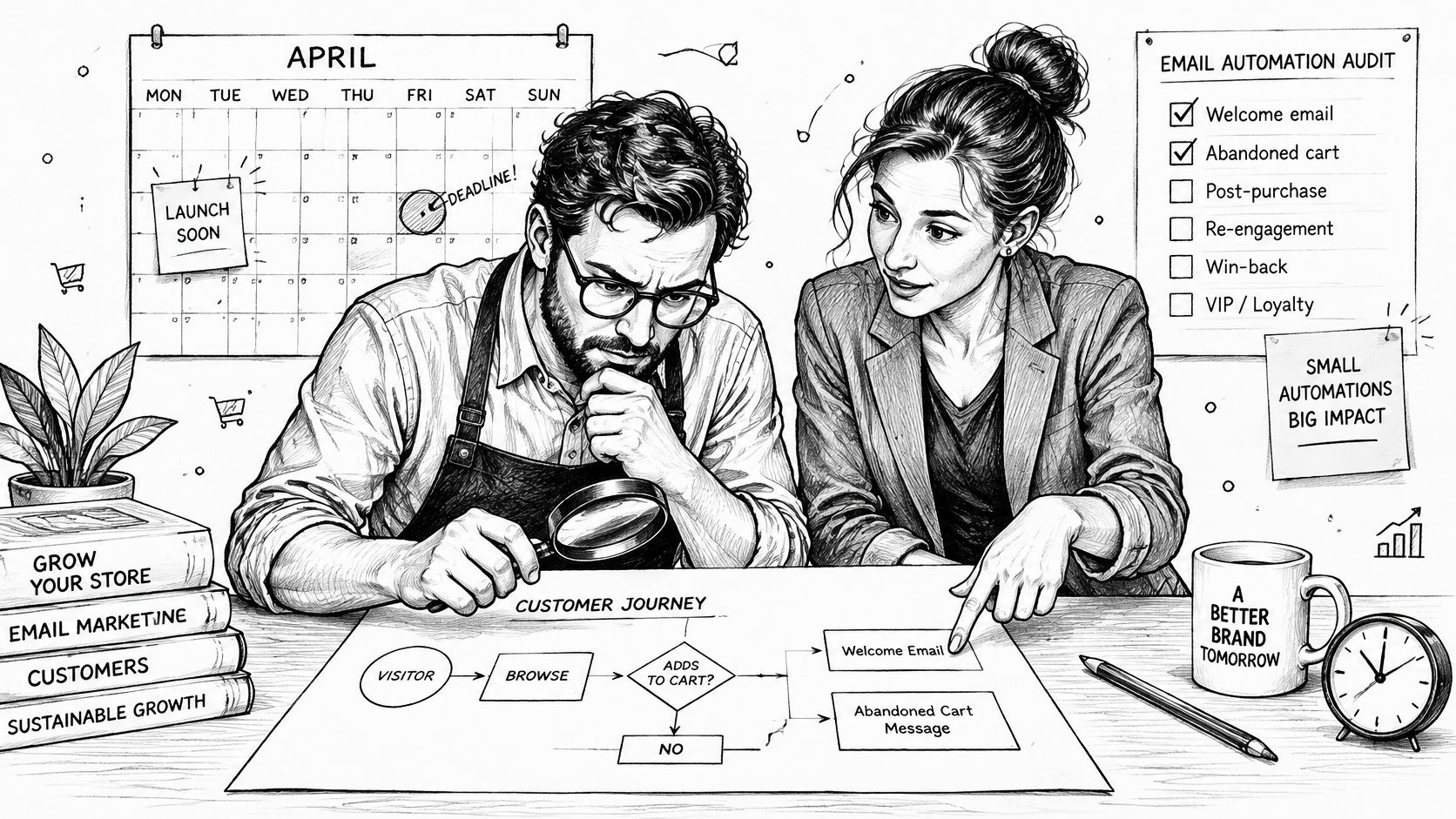
Start a new store with the welcome series and the abandoned cart flow. Add replenishment only after you know the reorder cycle from your own orders.
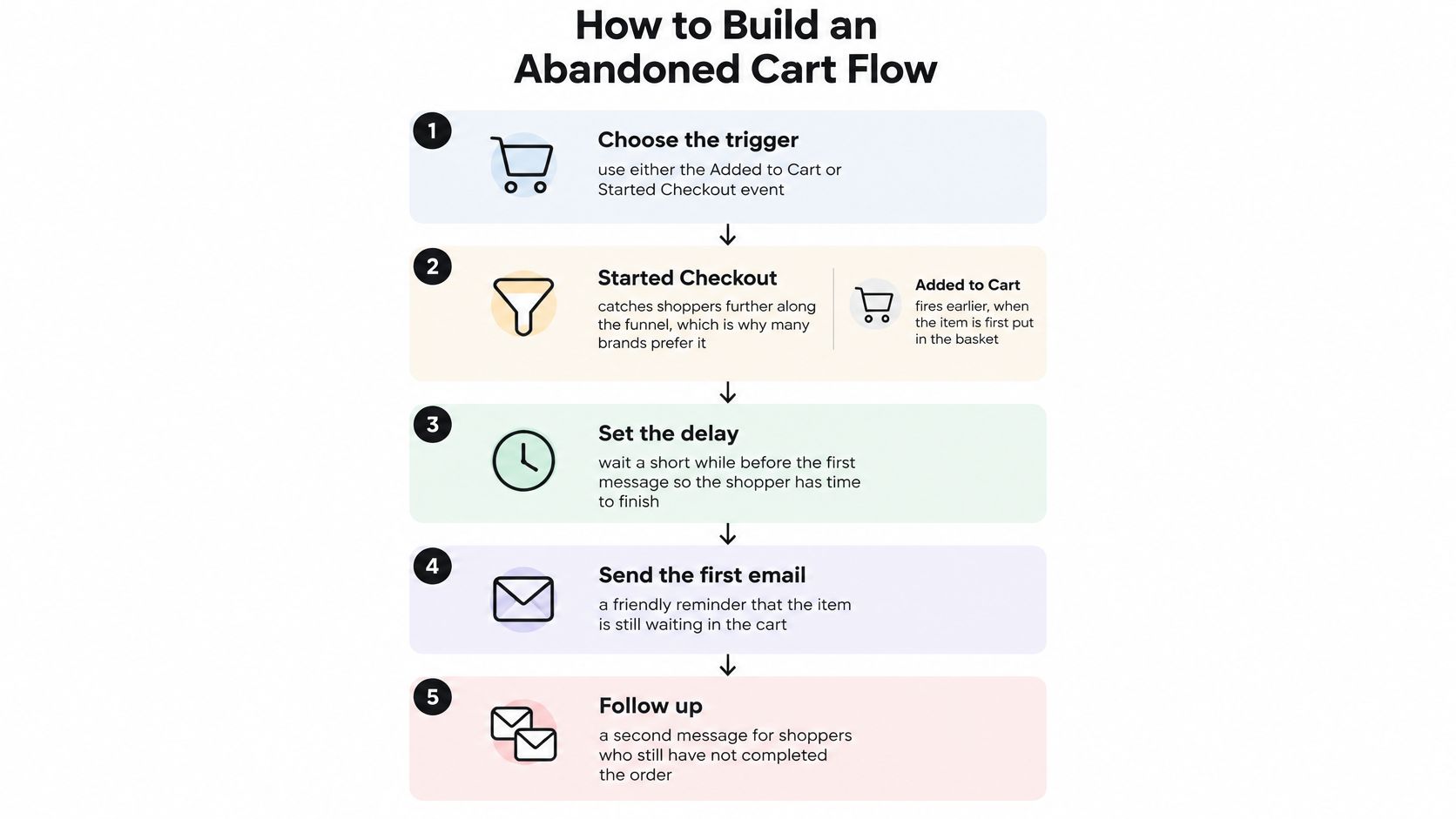
A shopper adds a ceramic lamp, reaches shipping, and closes the laptop. The flow should help finish that order, then stop the moment they pay. Later the flow report will credit messages for sales. Treat that credit as a claim to check, not as proof the emails created the purchase.
Choose the trigger. Use either the Added to Cart or Started Checkout event. Started Checkout catches people further down the funnel, which is why many brands prefer it. Added to Cart reaches shoppers earlier, when the item first hits the basket. Turning both on without a filter sends one person two overlapping sequences. That overlap is the usual slip.
Add the zero-orders filter. Require that the profile has placed zero orders since entering the flow. Klaviyo's abandoned-cart article notes that these filters are rechecked before messages send, so a completed purchase can remove the person from later reminders. Skip this and you email someone who already paid.
Set the first delay. Wait a few hours so they can finish on their own. An instant send often feels like you were watching the tab. Waiting until the next afternoon can miss the impulse. Pick one delay and leave it until you have a baseline.
Show the cart. Pull in the products they left, with image, name, and a link back. Generic "you forgot something" copy converts poorly because it could be any store. If the dynamic block is empty in a test, the event isn't passing line items. The block works like a receipt of what they already chose, not a second catalog.
Write two or three different follow-ups. The first is a plain reminder. The second can cover shipping or returns, where a lot of stalls happen. If the same products stall at the payment step every week, read Browse UX fixes for checkout drop-offs before you add another email. A final incentive belongs only if the margin can carry it. Repeating the same 10% off three times trains people to wait.
Test with a profile you control. Add an item, leave checkout, and confirm the first message arrives after the delay. Then place the order and confirm later messages stop. Whether that first message gets opened depends heavily on the subject line. A set of abandoned cart email subject lines is a useful starting list, as long as you rewrite them in your brand voice.
If the test profile still receives message three after a purchase, the zero-orders filter isn't on that message. Fix that before you raise volume.
The dashboard's default story is simple, and it's easy to over-read. Klaviyo's attribution documentation says the default model assigns 100% of conversion credit to the last eligible touchpoint. Default windows include five days for email opens and clicks, five days for SMS clicks, and as little as 12 hours for SMS deliveries.
An SMS delivery can receive conversion credit even though delivery doesn't prove the person read the message. A buyer who was already going to reorder can still land on that tile. Apple Mail Privacy Protection makes opens worse as a compass. Apple-generated opens can be excluded from attribution while remaining present in reporting, so a high open rate can be machines, not shoppers.
Keep a share of eligible people out of the flow for a set period. Compare revenue per recipient for the messaged group with the unmessaged group. The gap is closer to incremental revenue than the attributed total. Also split first orders from repeat orders, and subtract discounts plus message costs before you call it profit. Changing the attribution window will rewrite history. Write down the windows you used so last quarter stays comparable.
A lower attributed figure can mean the measurement got more honest, not that retention got weaker. The number worth taking to leadership is incremental revenue per recipient, not dashboard ROAS.
Watch each flow on its own. Klaviyo's flow analytics reference sets these email benchmarks. Opens and clicks can include automated activity, including Apple opens and bot clicks, so conversion, revenue, bounces, complaints, and unsubscribes should outweigh open rate.
| Metric | Healthy | Needs attention |
|---|---|---|
| Bounce rate | Below 1.0% | Above 2% (1-2% has room for improvement) |
| Spam complaint rate | Below 0.01% | At or above 0.01% |
| Unsubscribe rate | Below 0.3% | At or above 0.3% |
| Click rate | Above 1.2% | At or below 1.2% |
| Open rate | Above 33% | Below 33% (inflated by automated opens, so do not use alone) |
If complaints or unsubscribes cross the healthy line on one message, pause that message and fix the segment or the offer before you send more. A welcome email and a win-back email shouldn't share one blended score.
Outside help makes sense when nobody on the team has time to build and test, when you only have a basic welcome and a basic cart flow, or when an audit shows sends going out and repeat orders standing still.
Check any provider on three points before you look at a pitch deck.
Klaviyo's partner program fundamentals set tier requirements that include examples such as $40,000 in minimum managed monthly recurring revenue, $8,000 in platform adoption, more than one case study per year, and certification training for members of the organization. Verify the listing yourself. A logo on a homepage isn't the same check.
We're an official Klaviyo Partner, and we focus only on Klaviyo email and SMS flows. Our Flow Blueprint builds 12 hyper-targeted, data-connected flows built for each brand, with 50+ emails, delivered in 30 days. If you want to compare that scope with other partners, start from our Klaviyo agency page, and read how a Klaviyo partner engagement is structured before you book calls.
Audit your current flows against the health table. Note which moments have no sequence. Then ask each proposal to show how that flow will be measured against a holdout, not only how pretty the templates look.
Class A Media builds custom Klaviyo email and SMS flows for Shopify brands that want repeat orders measured clearly, not just attributed on a dashboard. The work covers lifecycle sequences, from welcome and cart recovery through replenishment and win-back, with the measurement to match. Visit Class A Media to see how a one-time flow build fits your store.
Let's build retention system that drive predictable, scalable revenue - without ad spend, without retainers, without guesswork.


The Ultimate Ecommerce Email Marketing Agency
Get in touch: hello@classamedia.com