Blog post
Insights
Jewelry Email Marketing: Flows, Segments and Benchmarks

Jewelry campaigns generate a 0.08% placed-order rate, while jewelry flows reach approximately 1.85%, according to RetentionSide's jewelry email case-study benchmarks. That contrast reframes jewelry email marketing: the opportunity isn't sending more promotions. It's helping an interested shopper resolve enough uncertainty to buy.
For higher-priced pieces, build your email program around materials, fit, authenticity, delivery and aftercare. Then measure whether those answers produce orders and revenue, rather than treating inbox engagement as the final result.
Jewelry's campaign problem looks more like a purchase-confidence gap than an attention gap. RetentionSide's jewelry email benchmarks report a 1.60% campaign click rate against 1.69% across industries, but a 0.08% placed-order rate against 0.16% overall; the same benchmark summary gives jewelry flows a 1.85% placed-order rate and 5.42% click rate, against 2.11% and 5.58% across industries.
The comparison below separates engagement from completed purchases.
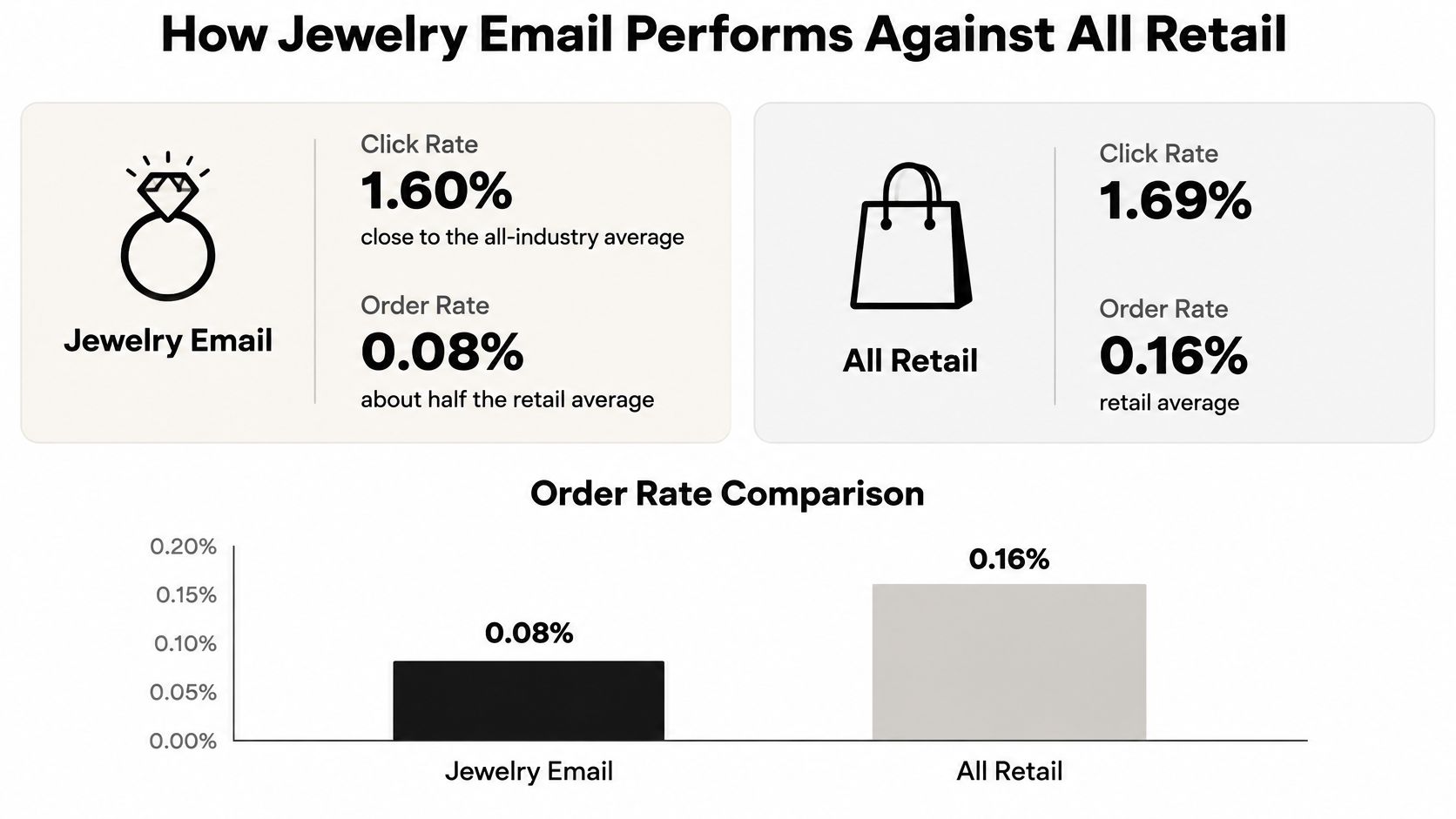
For a separate conversion definition, Klaviyo's email benchmarks report jewelry flow click-to-purchase conversion of 1.77%, versus 1.02% for campaigns, alongside a 44.11% average jewelry open rate that should be treated only as directional.
Jewelry email benchmarks by message type
| Metric | Jewelry campaigns | Jewelry flows | All-industry comparison |
|---|---|---|---|
| Placed-order rate | 0.08% | 1.85% | 0.16% campaigns; 2.11% flows |
| Click rate | 1.60% | 5.42% | 1.69% campaigns; 5.58% flows |
| Click-to-purchase rate | 1.02% | 1.77% | Not supplied for this definition |
| Average open rate | No separate figure supplied | No separate figure supplied | 44.11% jewelry average, directional, not all-industry |
Start with placed orders. Campaigns reach a broad audience at a scheduled moment; flows reach people after a relevant action. That audience difference matters before you attribute better results to automation itself.
Next, read the click row. Jewelry campaign engagement sits near the broader benchmark, yet purchasing falls further behind. A reasonable working hypothesis is that shoppers need more help after clicking, not merely a more persuasive subject line.
Finally, keep click-to-purchase separate from placed-order rate. They use different denominators, and you shouldn't derive one from another across these datasets. The more-than-twenty-threefold campaign-to-flow order-rate contrast is directional, not a controlled result.
Practical rule: Treat a click as evidence of interest, then identify the unanswered question between that click and checkout.
Apple Mail privacy features can inflate recorded opens, making open rate a weaker indicator of intent. Use the Sami Jewels case study as an implementation example, not a guaranteed benchmark. Your target should be a sustained improvement in placed-order rate and revenue per recipient against your own comparable sends, using unchanged attribution settings.
Build the flow map around a consideration window, not an assumption that every subscriber should buy immediately. For example, plan for a shopper who researches a piece over one to four weeks, and give each message a different question to answer.
The following timings are a test configuration, not observed category benchmarks.
Core jewelry lifecycle flows
| Flow | Trigger | Timing | Job in the flow |
|---|---|---|---|
| Welcome series | New subscriber | Test 3 to 5 emails over 10 to 14 days | Introduce materials, sizing and the brand |
| Browse abandonment | Product or collection viewed, no cart | Within a few hours of the view | Show the viewed piece with care and sizing details |
| Cart abandonment | Item added, no order | Test at 1 hour, 24 hours and 72 hours | Answer objections on returns, shipping and authenticity |
| Post-purchase care | Order delivered | Test around day 7 to 14 after delivery | Care instructions and styling ideas |
| Review request | Delivery confirmed | 2 to 3 weeks after delivery | Social proof for later shoppers |
| Cross-sell by metal or stone | Previous purchase category | 30 to 60 days after purchase | Matching piece in the same metal or style |
| Back-in-stock | Waitlist sign-up | Within hours of restock | Convert a demand signal into a sale |
| Win-back | No repeat purchase after a test interval of 90 to 180 days | 3 emails over 2 weeks | Re-engage with the new collection |
The welcome series should deliver the signup promise before introducing more products. Follow with material explanations, a sizing resource and the brand's relevant craftsmanship details. Stop first-order messaging when the subscriber becomes a customer.
Browse abandonment needs a lighter touch. Show the exact piece or collection viewed, then add information the product image can't communicate, such as chain length, clasp construction or finish care. If the shopper enters the cart flow, stop the browse sequence.
For cart abandonment, assign a distinct objection to each message. Lead with checkout continuity, follow with delivery or returns information, then address authenticity or product-specific assurance. Don't repeat the same product tile with increasingly urgent language.
Use a customer lifecycle phases map to document eligibility and exits before building the automation. For sending diagnostics, the mailX email deliverability toolkit from mailX is a resource to evaluate alongside your platform's delivery and complaint reporting.
Send the order confirmation at purchase and a delivery message when delivery is confirmed. Reserve care education for when the customer can use it, and base instructions on the actual metal, finish and stone rather than generic cleaning advice.
Ask for a review after the buyer has had time to inspect and wear the piece. For gifts, offer a shareable care page rather than assuming the purchaser is the wearer.
Cross-sell with compatibility, not a random bestseller. A matching metal or design language gives you a clear reason to recommend something. Back-in-stock messages should respect the requested variant, while win-back messages should reflect the customer's previous interests.
For The M Jewelers, our new email system drove a 90% increase in flow revenue. That's a brand-specific result, not a forecast for another store.
Exclude completed orders from cart and browse flows, and recheck that condition immediately before every send. Test the full journey with an actual test order so a newly converted buyer doesn't receive a purchase reminder.
A collection launch and a consideration sequence serve different decisions. The launch tells subscribers what's available; the consideration sequence helps an interested browser decide whether a particular piece is right for them.
For a hypothetical launch calendar, send a waitlist teaser 7 to 10 days before release, a launch-day email, a 48-hour reminder, and a final message when access or availability ends. Use that rhythm as a starting test, not a mandatory frequency.
This visual separates the launch stages.
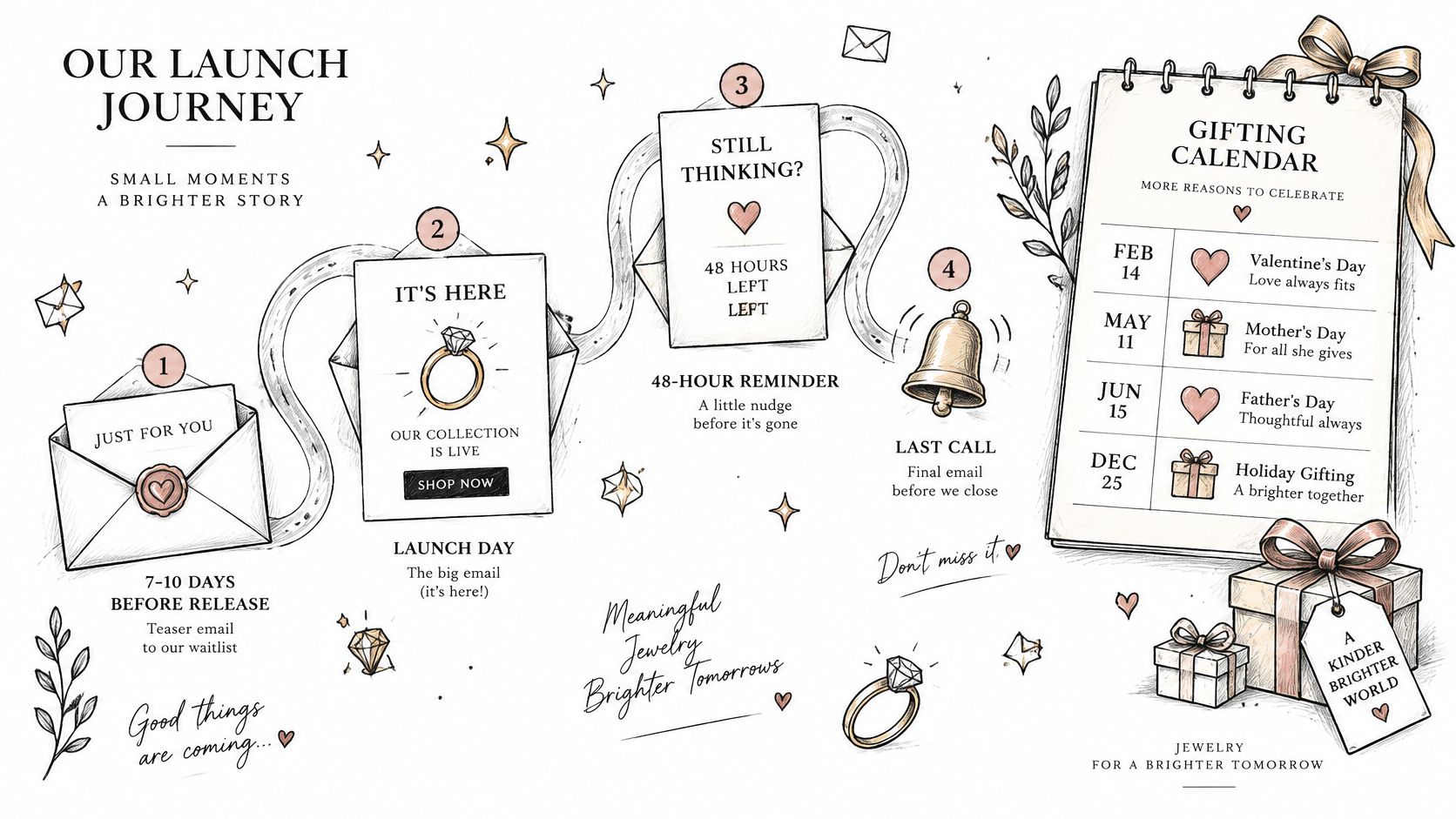
For Mother's Day, Valentine's Day and holiday gifting, a test calendar could begin three to four weeks ahead. Work backward from production, engraving and dispatch cutoffs. Offer subscriber early access where you can support it, rather than making a discount the default reason to act.
A repeated product viewer who never adds to cart hasn't necessarily abandoned checkout. They may still be evaluating the product itself. Route that subscriber into an educational sequence instead of sending a cart-style reminder.
For example, test these four messages over a fourteen-day window:
If the shopper compares several pieces, offer a virtual consultation instead of another product grid. Let them ask about differences your product pages may not resolve.
Use the following video as an additional walkthrough.
Set a weekly promotional-send cap in Klaviyo, and count overlapping launch and lifecycle messages when reviewing frequency. Honor consent and preference choices throughout, including requests for fewer collection updates.
Don't approve an email until you can name the purchase question it answers.
Frequent discounts can encourage waiting without resolving uncertainty. Education earns its place when it makes materials, fit, evidence or purchase terms easier to evaluate.
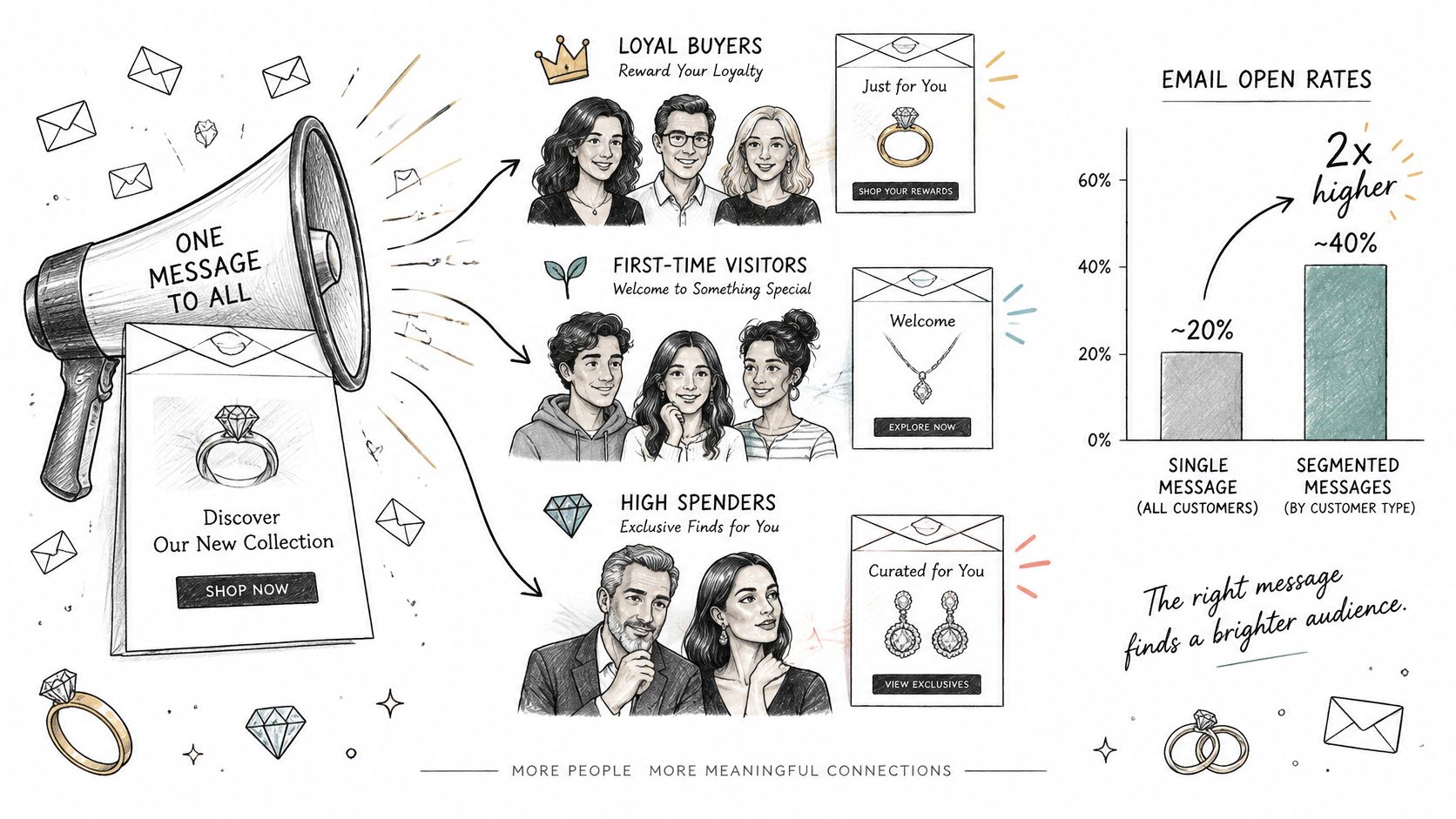
Highly segmented jewelry campaigns performed approximately twice as well as unsegmented campaigns across opens, clicks and revenue per recipient in Klaviyo's segmentation benchmark analysis of more than 2.5 billion emails. Among the strongest jewelry campaigns, 60% used segments, with reported averages of 59.23% opens, 25.84% click-through and $32.03 revenue per recipient.
Those are category-level observations, not the result of randomly assigning identical customers to different treatments. Stronger brands may also have better lists, product-market fit or merchandising. Use the finding to prioritize relevance, not to promise that a segment will double revenue.
The visual illustrates the difference between broadcasting and routing by customer context.
Useful fields include first-time versus repeat customer, product category, price tier, browsing behavior, gift timing and time since purchase. Each field should change eligibility, content or the next action. If it doesn't, it's adding complexity without helping the customer.
For example, a bridal shopper comparing settings needs different information from a returning customer browsing everyday silver earrings. A high-value customer may need access to a consultation, not the same introductory offer shown to a new subscriber.
Use these operational rules as an initial test design:
These are proposed settings, not benchmark-derived thresholds. A customer segmentation framework for ecommerce can help your team document the underlying fields and exclusion logic.
Compare placed-order rate and revenue per recipient for the messaged group and its holdout over the same window. Keep product availability, eligibility and attribution definitions consistent.
Report total customer revenue alongside platform-attributed revenue where possible. A segment full of likely buyers may generate impressive attributed sales even when the email adds little incremental value. The holdout helps distinguish customer selection from persuasive messaging.
A gifting-only lifecycle overlooks a substantial audience. Survey evidence summarized in RetentionSide's guide to email marketing for jewelry brands indicates that 80% of American adults have bought fine jewelry for themselves, rising to 86% among Millennials; personal style and milestone marking each accounted for 22% of self-purchase motivations, while roughly 60% of self-purchasers considered themselves collectors.
That doesn't mean every self-buyer wants frequent product launches. It means you shouldn't assume romantic gifting is the reason someone subscribes or purchases.
These paths distinguish purchase intent without assigning people a permanent identity.

Three content paths for one list
| Path | Who it serves | Content focus | Routing signal |
|---|---|---|---|
| Gift buyer | Shopping for someone else | Deadline assurance, gift packaging, exchange policy and occasion reminders, tested 3 to 4 weeks ahead | Declared recipient or gift choice at signup or survey |
| Self-buyer | Buying for personal style or milestones | New drops, styling ideas and care education | Selects myself and browses by category |
| Collector | Repeat buyer treating jewelry as a collection | Cross-sells by metal, stone or design language | Example rule: second order within 60 days of a self-purchase |
Add a simple shopping-purpose question at signup or in a post-purchase survey. Offer choices for self-purchase, gifting and uncertainty, and let subscribers update them. Don't force someone to disclose an occasion just to receive useful content.
Use behavior to refine the answer, not override it. Product category, browsing history and an optional recipient field can support routing, but a delivery address alone doesn't establish who will wear the piece.
For gift-focused content planning, ECI Jewelers' guide to choosing diamonds and luxury watch gifts offers a relevant example to review. Translate inspiration into concrete selection help, such as budget, recipient style, sizing requirements and availability.
Avoid inferring gender or relationship status from product choices. Apart from feeling intrusive, those assumptions can route a self-buyer into irrelevant anniversary messages.
Routing safeguard: Store shopping purpose at the order or occasion level when possible, not only on the customer profile.
A customer can collect for themselves and buy gifts for others. Preserve both contexts rather than overwriting their entire history with the latest purchase.
As a hypothetical routing example, someone who selects myself and buys again within sixty days could enter a collector-oriented path. Treat that as an eligibility rule to test, not proof of identity, and give the customer an easy way to change preferences.
The median twelve-month repeat-purchase rate was 14.6% across 46 Shopify jewelry and accessories stores during September 2025 to August 2026, according to Mage Loyalty's jewelry and accessories benchmarks, with the top quartile beginning at 18.9%; the same page reports Bluecore's 2024 prior-year buyer retention of 19.1% for jewelry and accessories versus 27.4% across industries, the lowest result among seven verticals.
The median means fewer than one in six customers in that sample placed at least two orders within the measurement period. The top-quartile boundary is a useful reference, but it isn't a universal target for every price point or assortment.
Jewelry repeat-purchase benchmarks
| Benchmark | Value | Scope | How to use it |
|---|---|---|---|
| Median 12-month repeat-purchase rate | 14.6% | 46 Shopify jewelry and accessories stores, Sept 2025 to Aug 2026 | Baseline for comparable customer cohorts |
| Top-quartile repeat-purchase rate | 18.9% | Same 46 stores | Reference target for post-purchase and win-back flows |
| Prior-year buyers retained | 19.1% | Jewelry and accessories retailers, 2024, Bluecore | Assess the category's lowest retention result |
| Cross-industry retention average | 27.4% | All seven verticals, 2024, Bluecore | Longer-term context, not a like-for-like jewelry target |
Tag first-time buyers by acquisition month, then track whether they place another order. In a proposed reporting dashboard, inspect progress at ninety, one hundred eighty and three hundred sixty-five days. Only compare fully matured annual cohorts with annual benchmarks.
Keep the denominator fixed: customers who placed their first qualifying order in the acquisition period. Define how you handle cancellations, full refunds and replacement orders so operational activity doesn't masquerade as retention.
The Bluecore metric answers a different question from an acquisition cohort's second-order rate. It tracks prior-year buyers who returned, so don't combine it with the Shopify sample into a single performance average.
Use order history to propose a credible next purchase. JewelryBuyDirect's guide to segmenting jewelry shoppers for repeat sales is a useful planning resource for organizing those follow-ups.
Don't manufacture replenishment logic for a durable piece. A matching item, another design in a preferred collection or an optional occasion reminder is more defensible than an arbitrary replacement prompt.
Sami Jewels increased its flow revenue by 298%. That business result demonstrates revenue potential, but it doesn't establish a repeat-purchase lift: flow revenue can include first orders as well as returning customers.
For a hypothetical VIP test, qualify customers after their third order, then offer collection previews and early access. Compare their subsequent annual repeat behavior against an eligible holdout, while also checking contribution margin. Rewarding customers isn't automatically profitable if the benefit merely subsidizes purchases they would have made anyway.
Start with the welcome flow, then build post-purchase care and review, followed by cart recovery with a separate consideration branch. This order gives new subscribers an introduction, customers useful aftercare, and active shoppers help with the decision in front of them.
For an initial test, book a results review after thirty days. Evaluate placed-order rate and revenue per recipient against an eligible holdout, but treat early results as provisional when purchases take longer or order counts are small.
Build in-house if your team can maintain customer events, segment definitions, exclusions and content accuracy. Work with a Klaviyo agency if execution capacity and the flow calendar are the bottlenecks.
For high-ticket products, we build education-first systems that move prospects from discovery to decision. Our Flow Blueprint provides 12 hyper-targeted, data-connected flows with 50+ emails, delivered in 30 days, alongside done-for-you execution.
Before launch, confirm that your customer records contain the fields your lifecycle and consideration logic requires:
Pick the three flows, assign the holdout and book the first results review before sending. Give someone responsibility for correcting broken events and outdated product information after launch.
Class A Media builds custom email flows that help jewelry shoppers resolve purchase questions and give existing customers relevant reasons to return. Visit Class A Media to discuss an education-first retention system built around your products, customer data and first flow priorities.
Let's build retention system that drive predictable, scalable revenue - without ad spend, without retainers, without guesswork.


The Ultimate Ecommerce Email Marketing Agency
Get in touch: hello@classamedia.com