Blog post
Insights
How to Increase Customer Lifetime Value: Steps That Work
A 5% increase in customer retention can raise profits by approximately 25% to 95%, depending on industry economics, according to Bain research associated with Frederick Reichheld and W. Earl Sasser's 1990 Harvard Business Review work. Acquiring a new customer typically costs several times more than keeping an existing one, so retention can be a cheaper route to profit.
That makes how to increase customer lifetime value a margin problem, not a reason to send more email. Retained customers may buy more over time, require less selling, and cost less to serve. Campaign revenue alone will not show whether those gains outweigh the cost of discounts, fulfillment, and service.
The profit effect of keeping a few more customers is real, and it is not automatic. It depends on gross margin, how often people reorder, and when they churn. A brand with thin margins and a long gap between orders will not see the same result as a brand whose buyers come back on a short cycle.
Revenue-based customer lifetime value (CLV) multiplies average order value by orders and by lifespan. That number flatters any brand that discounts hard. A second order at 30% off can lift repeat rate while the order loses money after shipping, fees, and the incentive that bought it.
Build the baseline from these inputs, pulled from Shopify orders and your finance sheet:
Subtract those costs from revenue and you get contribution profit. That is the only CLV I would manage to. If you want a worked walkthrough of the same idea, Sprints & Sneakers shows how to analyze customer value beyond revenue.
| Metric | How to calculate | Where to find it | Reference range |
|---|---|---|---|
| Average order value | Revenue divided by number of orders | Shopify analytics, order export | Track by cohort, compare quarter over quarter |
| Repeat purchase rate | Customers with 2 or more orders divided by all customers in the cohort | Shopify customer report or Klaviyo | Benchmark each cohort against its own history |
| Reorder interval | Median days between first and second order | Shopify order export | Sets the timing of the second-order flow |
| 12-month contribution CLV | Sum of contribution profit per customer over 12 months | Cohort spreadsheet using finance data | Compare cohorts against each other, not against industry averages |
| CLV to CAC ratio | Contribution CLV divided by customer acquisition cost | Ad platform spend plus finance data | About 1.5:1 to 3:1 for DTC ecommerce |
CLV-to-CAC for DTC ecommerce is commonly reported around 1.5:1 to 3:1, well below the ratios people borrow from software, as noted in this margin-based CLV discussion. Treat that band as a sanity check, not a target to hit with discounts.
Group buyers by first-order month. Record the discount that cohort used. Track contribution profit at 90 days and at 12 months. Ecommerce repeat purchase is reported at roughly 52% by month three and 28% by month twelve in these CLV timing benchmarks, so compare each cohort's curve with its own month-one figure. You should finish with one contribution number per cohort. Later tests have to beat that number.
A CLV figure that ignores margin is a forecast of revenue, not profit.
The first split is purchase history, not age or gender. A message that helps a first-time buyer irritates someone who reordered last week. For Seat Cover Solutions, the audience was segmented into first-time purchasers, high-LTV customers, and dormant leads. That same three-way cut, plus two timing cuts, is enough for most Shopify stores. A deeper pass on rules lives in our note on ecommerce customer segmentation.
| Segment | Definition rule | Threshold example | Lifecycle goal |
|---|---|---|---|
| First-time buyers | One order placed | Order within the last 60 days | Earn the second order inside the reorder interval |
| Repeat buyers | Two or three orders | 2 to 3 orders, no order in 60 days | Increase order frequency and introduce a second product category |
| High-LTV customers | Top 20% by 12-month contribution profit | Re-ranked every quarter | Retain with early access and loyalty rewards |
| Dormant subscribers | Email or SMS opt-in, no purchase | No purchase in 90 days | Reactivate with a low-frequency message or suppress |
| Lapsed buyers | Past expected reorder window | Past 1.5 times the median reorder interval | Winback with a reason to return, not a blanket discount |
First-time buyers get education and one clear second-order prompt inside the reorder interval you already measured. Don't open with a sitewide code.
Repeat buyers with two or three orders, and nothing in 60 days, are ready for a second category. Match the cross-sell to what they already bought. A serum buyer doesn't need a random bestseller.
High-LTV customers, the top 20% by 12-month contribution profit, get early access and rewards you can fund inside the margin model. Re-rank them every quarter. Last year's VIP isn't this year's.
Dormant subscribers opted in and haven't bought in 90 days. One low-frequency note, or suppress them. Silence is cheaper than a dead list.
Lapsed buyers sit past 1.5 times the median reorder interval from the cohort sheet. Win them with a reason to return. A blanket discount trains the rest of the file to wait.
Say a pet-supplement store sends first-time buyers a feeding guide before the bag runs out, gives high-LTV buyers early access to a new flavor, and sends dormant leads one note a quarter. Recently purchased replenishable buyers stay out of reactivation until their expected cycle has passed. If you want a model behind who is about to go quiet, retention modeling with PlotStudio AI is a useful starting point. Rebuild the segments monthly so the thresholds match current behavior, not last year's export.
Flows should follow the customer's path, not a content calendar. Map every purchase moment before you write a subject line.
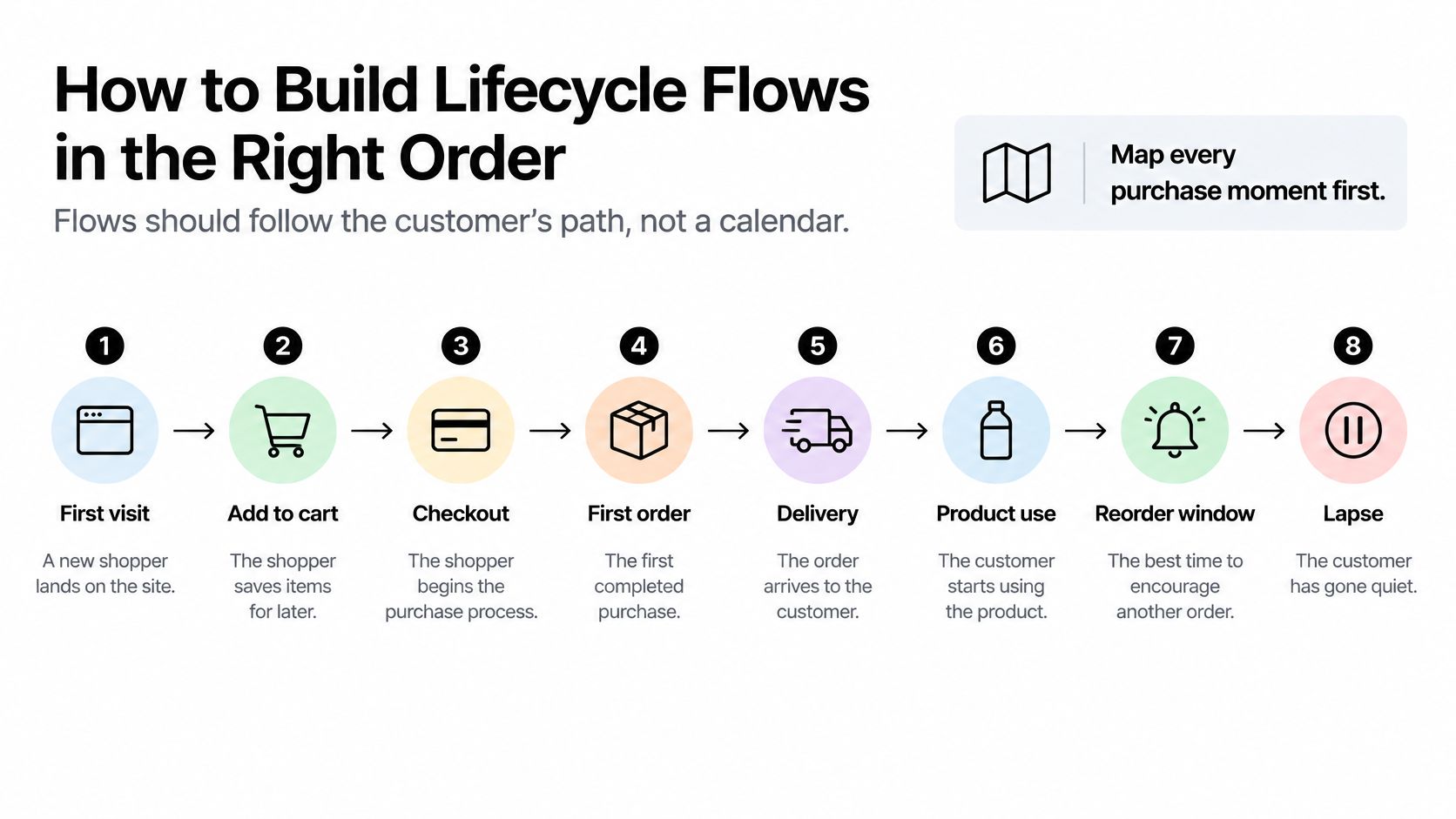
The path runs from first visit, to add to cart, to checkout, to first order, to delivery, to product use, to the reorder window, and then to lapse. Build in that order. The phases are spelled out in our guide to customer lifecycle phases.
Personalization here means purchase history, product category, order frequency, and status. It doesn't mean a first name on a generic offer. In McKinsey research published in 2021, 78% of surveyed consumers said personalized content made them more likely to repurchase. The same research found personalization commonly produces a 10% to 15% revenue lift, with company results from 5% to 25% by sector and execution.
First-time buyers get use education. Replenishment buyers get a run-out reminder. Prior-category buyers get a cross-sell from that category. Lapsed buyers get a winback timed to their reorder window. Each of those sends also returns behavioral data, which is what you use to tighten the segments next month.
This walkthrough shows the same path from first visit to lapse, which is worth watching before you wire the triggers.
More messages are not more lifetime value. A supplement buyer and a jewelry buyer don't come back for the same reason, so one reminder calendar fails both. Sometimes the highest-value action is a single on-time note, or no note at all.
| Product type | Trigger | Touchpoints | Main risk |
|---|---|---|---|
| Replenishable (supplements, pet food, skincare) | Expected run-out date | 1 reminder per cycle plus a winback after the lapse window | Reminders that arrive before the customer needs the product |
| Durable (jewelry, home goods) | Time since purchase, with care or styling content | 2 to 3 touchpoints a year after the first order | Long gaps that let the brand fade from memory |
| Seasonal fashion | Season opening and end of season | 1 to 2 sends per season, suppress recent buyers | Promotional fatigue and discount dependence |
| High-ticket products | Consideration stage, not purchase date | Education sequence over 2 to 4 weeks | Pushy sends that reduce trust before the decision |
Replenishable goods earn one reminder per use cycle, plus a winback only after the lapse window. A reminder that lands while the jar is still half full teaches people to ignore you.
Durable goods such as jewelry and home goods don't have a run-out date. Two or three useful notes a year, care or styling, keep the brand in memory without inventing a need. For high-ticket products, an education-first flow beats a countdown. Move the reader from discovery to a decision over two to four weeks, and stop once they buy.
Seasonal fashion gets one or two sends at season open and at season end. Suppress anyone who just bought. A mid-season code on top of that is how you build discount dependence.
SMS is stricter than email. Use a text at the replenishment point, not as a second copy of every email. Remove anyone who opted out, and remove people who haven't clicked a recent text. Irrelevant reminders are how you lose the number.
If the next purchase is uncertain, seasonal, or unnecessary, skip the reorder nudge. Send a reason to engage instead, such as a care tip or a seasonal use idea. If those notes also get ignored, stop. Don't "save" the contact with a deeper discount.
Fatigue shows up in three places. Unsubscribes rise on a flow that used to be quiet. Click rate falls on a flow that already converts. Returns climb after promotional sends. Any one of those is a reason to cut frequency before you rewrite the copy.
A higher repeat rate is not a better CLV. A discount-driven second purchase can raise the repeat metric, cut contribution on that order, and teach the buyer to wait for the next code. I would not call that a retention win.
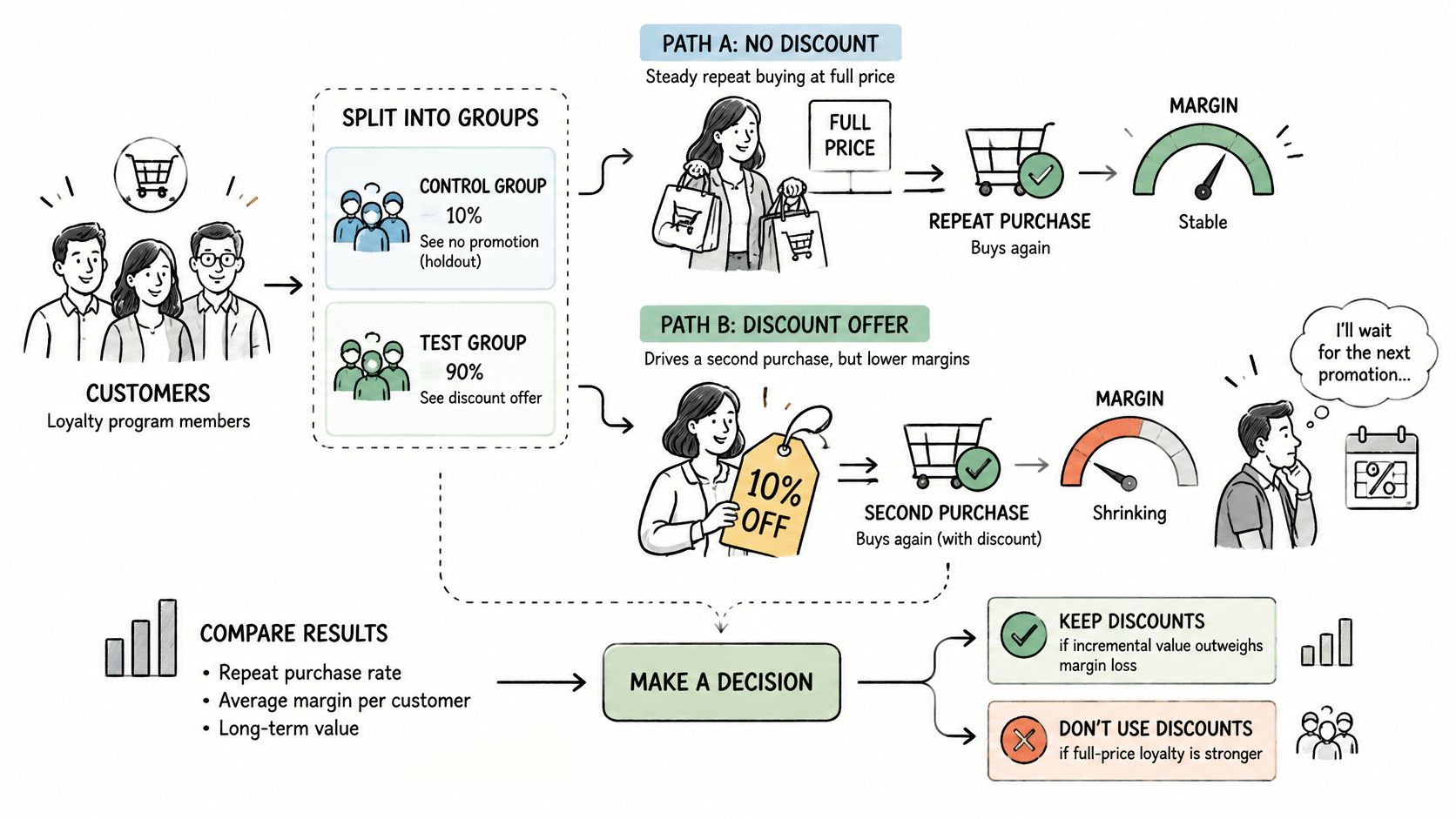
Hold the change against people who never saw it. Open rate will lie to you. So will gross revenue.
If you need a clean way to read the split, Presidio's guide to evaluate Shopify A/B test results is a practical companion to the holdout.
Rewards can still earn their place. In 2025, 78% of consumers surveyed by Acxiom said they were more likely to remain loyal to a brand when adequately rewarded. Fund that reward inside the margin model. Early access and a modest loyalty credit beat a standing 20% off. If the reward cost is larger than the extra contribution, you are renting the second order.
If repeat orders rise while average margin per order falls, the change is buying volume, not value.
Decide from the cohort sheet, then touch one flow.
Do three things this month. Set up the cohort sheet with first-order month, discount used, and contribution profit at 90 days and 12 months. Pick one segment. Run one holdout for at least one full reorder interval.
If the sheet already shows the fix, keep the build in-house. An outside build is worth it only when the team can't run the sheet and the test. Flow Accelerator includes 60 days of post-launch support, during which Class A stays with the client to optimize and maximize performance, and the Flow Blueprint package includes a dedicated customer success manager. Either way, the number that matters is still contribution profit versus the holdout.
Class A Media builds custom email and SMS lifecycle flows for Shopify brands, with segmentation and repeat-purchase timing aimed at contribution profit rather than open rates. If you want that system without a monthly retainer, start with the cohort sheet and one holdout, then talk with Class A Media about which flow to rebuild first.
Let's build retention system that drive predictable, scalable revenue - without ad spend, without retainers, without guesswork.


The Ultimate Ecommerce Email Marketing Agency
Get in touch: hello@classamedia.com