Blog post
Insights
Email Marketing Ecommerce for Repeat Purchases

Automated flows posted a placed-order rate of 2.11% against 0.16% for broadcast campaigns in a 2026 ecommerce benchmark, about 13.2 times the campaign rate, and one setup behind that comparison uses a five-day click window that gives the sale to the last clicked email (Solo Media Group's email and SMS benchmarks). That gap is real commercial signal. It is not pure profit. The platform can credit email for an order an ad, a text, or the buyer's own habit already started.
Privacy changes made opens a weak referee for the same reason. A high open rate can flatter a calendar blast that nobody needed. Attributed flow revenue can flatter a message the buyer would have converted without. Email marketing ecommerce belongs on the retention P&L when it raises repeat purchases and contribution margin from people the brand already acquired.
A skincare buyer checks out on Monday. The serum is paid for, the address is saved, and the brand finally knows who she is. By Friday the media buyer is bidding for a new stranger, while that first customer is still figuring out how many drops to use and whether the bottle is worth a second one.

That Friday habit is how a lot of Shopify brands treat the list. Acquisition did its job. Checkout took the card. Then the relationship goes quiet until a sitewide code needs an audience. Ecommerce email marketing is the retention channel that uses permission, order history, and behavior to earn the second order and the replenishment order. It is not a prettier version of the ad.
A shopkeeper who remembers the last bag will always beat a billboard that shouts at traffic the buyer has already walked past.
Ads buy the first visit. Strong checkout design converts that visit. Email is what happens after the session ends, when the person is identifiable and the next message can wait for a real moment. The first-time serum buyer doesn't need the same note as someone on her third bottle. She needs use instructions, a delivery expectation, and a replenishment cue tied to how long the product lasts.
Creators can still open the door. A practical look at ecommerce influencer marketing shows how outside voices create that first visit. The list is what you own after the creator's post stops getting reached. If the only follow-up is another paid click, you rent the relationship twice.
Judge the channel on repeat-purchase rate and contribution margin from people you already paid to acquire. A pretty open rate doesn't pay for the bottle she didn't reorder. The rest of this piece stays on that job: which automated messages beat one-off blasts, which lifecycle steps create the next order, which segments change the copy, which metrics still hold when opens lie, and what changes when a brand treats the list as revenue infrastructure.
Read the commercial rows before you fall in love with an open rate. The table below is a priority list, not a trophy case.
| Message type | Open rate | Click or revenue signal | Placed-order context |
|---|---|---|---|
| Automated flows | About 38% | CTR about 5.58% | Event-triggered, far above one-off sends |
| One-off campaigns | About 30.7% | CTR about 1.69% to 2.09% | Placed-order rate about 0.16% |
| Abandoned-cart messages | About 50.5% | About $3.45 revenue per recipient | Highest commercial intent in this set |
| Automated flows, orders | Do not judge by opens | Placed-order rate about 2.11% | About 13.2 times the campaign rate |
Start at the bottom of the commercial signal, not the left-hand open column. Abandoned-cart messages are the clearest row. A benchmark compilation of large-scale email datasets put them near 50.5% opens and about $3.45 in revenue per recipient, while automated flows overall averaged about 38% opens and a 5.58% click-through rate in 2025, against about 30.7% opens and roughly 1.69% to 2.09% clicks for general campaigns (Axis Intelligence's email marketing statistics). Someone who left a cart has already picked a product and a price. A Tuesday newsletter is asking a colder question.
The order rows matter more than that click gap. Broadcast campaigns in the 2026 comparison sat near a 0.16% placed-order rate. Automated flows sat near 2.11%, about 13.2 times higher, because the send follows a signup, cart activity, a purchase, or a replenishment window. The person is in a behavioral state. The calendar blast hopes the whole list is in the mood.
Those open rates are shaky. Apple Mail Privacy Protection, list quality, device mix, industry, and inbox placement all move the open number even when the buying didn't change. A flow can “win” opens because Apple preloaded the image, not because more people cared. Revenue per recipient and placed orders are the columns to trust first. Repeat-purchase rate and contribution margin are the columns that tell you whether to keep the flow.
Treat the 13.2 times gap as platform-attributed. A five-day click window and a last-clicked-email rule can assign the order to email after another channel already did the persuading. If you report that 2.11% as profit, you will overfund messages that only caught customers who were going to buy anyway.
Practical rule: Fund cart, post-purchase, and replenishment flows before you fund another calendar blast, then test whether the exposed buyers reorder more than a held-out group.
Use the table as a build order. If cart recovery, the post-purchase sequence, and replenishment are thin, another promotional send is the expensive option. Campaigns still have a job for launches and deadlines. They shouldn't be the system you use to get the second order.
A lifecycle isn't a content calendar. It's the path the shopper is already on. Each flow has one trigger, one job, and one exit when they buy or go quiet.
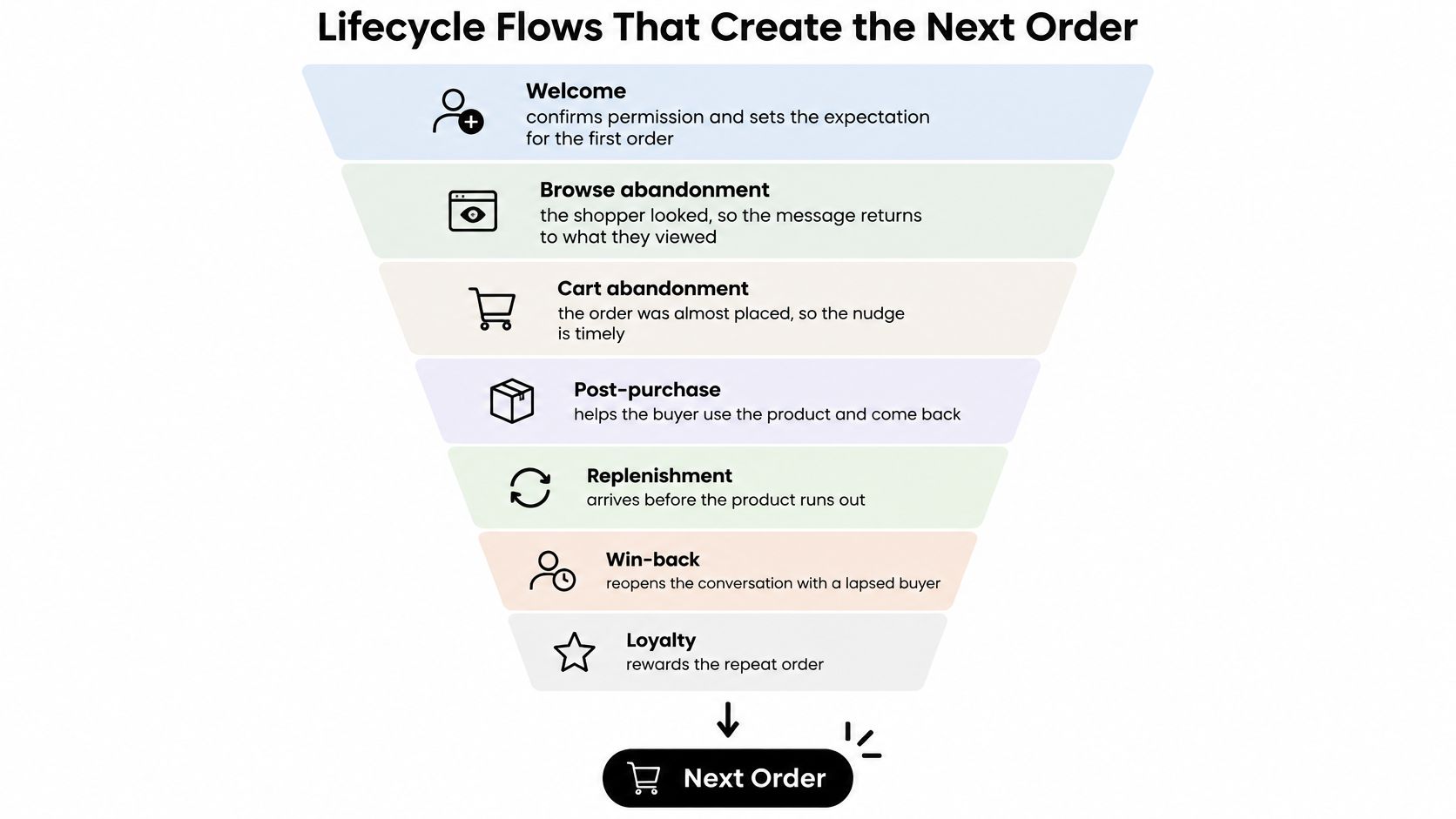
Global cart abandonment sits near 70.19%, drawn from more than 14 years of checkout studies, audits of over 150 leading sites, and testing across more than 4,400 participant sessions (Baymard Institute's checkout research). Baymard also finds the average large site has 32 checkout improvements available and could see about a 35% conversion-rate lift from checkout UX alone. Fix the checkout. Also follow the demand you already created, instead of buying a fresh click for every almost-order.
The same path logic shows up in how customer lifecycle phases line up from first permission to a lapsed buyer. Email just times a message to the phase the person is in.
| Flow | Trigger | Job | Exit |
|---|---|---|---|
| Welcome | New subscriber or first permission | Confirm expectations and point to one next product | Purchase or series end |
| Browse abandonment | Viewed a product and left | Return to the viewed item, not a sitewide sale | Purchase or no further views |
| Checkout abandonment | Started checkout and did not pay | Recover stated intent while demand is fresh | Placed order since the flow started |
| Post-purchase | Order placed | Teach use, set delivery expectations, then offer the logical second item | Second order or sequence end |
| Replenishment | Consumption window such as 30 days | Time the next unit to real use | Reorder or window passes |
| Win-back | Buyer gone quiet | Give one reason to return | Purchase or continued inactivity |
| High-ticket education | High-consideration product interest | Prove fit before any discount | Purchase or disqualification |
Welcome fires on a new subscriber or the first permission. The job is short. Confirm what they signed up for, tell a tight brand story, and point at one next product. Exit on purchase or when the series ends. Don't keep welcoming someone who already ordered.
Browse abandonment fires when they viewed a product and left. Talk about that item, or a close alternative, not a sitewide sale. Exit on purchase or when they stop viewing. A 15% code here trains people to browse and wait.
Checkout abandonment fires when checkout started and payment didn't. With roughly seven in ten carts left behind, this is demand you already paid to create. The job is to recover stated intent while it's fresh. Exit the moment an order is placed after the flow starts. Emailing a paid cart is how trust dies.
Thank-you and post-purchase starts when the order exists. Teach use, set the delivery expectation, and only then offer the logical second item. The first order has to feel safe before you ask again. Exit on the second order or at the end of the sequence.
Replenishment waits for a real consumption window, a 30-day supplement, a coffee bag, a serum that lasts six weeks. It is not a weekly newsletter with a reorder button. Exit on the reorder, or when the window passes and a later win-back can take over.
Win-back is for buyers who have gone quiet. One reason to return, then a stop rule if they stay inactive. Endless “we miss you” mail burns the sender and the person.
High-ticket education starts from interest in a high-consideration product. Proof, fit, and objections come before any discount. Exit on purchase or when they clearly aren't a fit. A code on email one cheapens a decision that needed information.
If post-purchase and replenishment are missing, build those before you polish welcome copy. Welcome introduces the brand. The next order usually comes from the messages after the first box arrives.
A short walkthrough of how those automated paths differ from one-off campaigns makes the sequence easier to map onto a Shopify store.
A lifecycle flow fails when every subscriber walks the same path. The split is what the person just did, not a vague interest tag from six months ago.
The critical rule is the exit. Klaviyo's abandoned-cart guidance requires cart and order events to sync, and it tells you to exclude anyone who buys after entry with a condition equivalent to “Placed Order zero times since starting this flow.” Without that filter, you email a customer about a cart they already paid for. That's the bug people feel, even when the creative is strong.
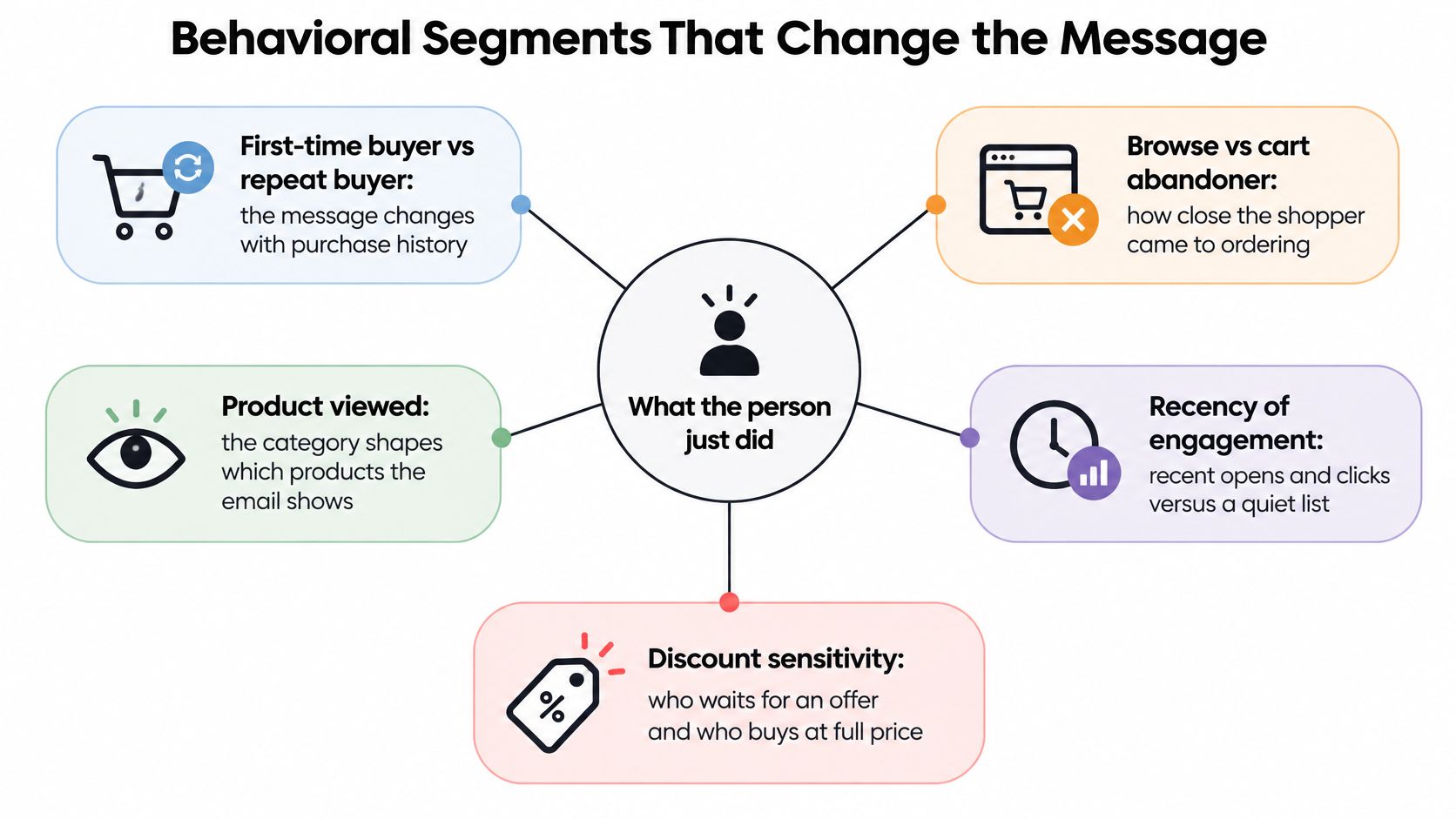
Behavioral customer segmentation is the same idea applied past the cart. These five cuts are enough to stop a single path from talking to the wrong person. Brands on other platforms can borrow the same cuts from BigCommerce shopper segmentation methods, then wire them to live events rather than a static export.
Email can carry a short series. SMS can't. Klaviyo's US compliance guidance says the recipient must have expressly consented to SMS and to cart-abandonment reminders, collection uses double opt-in, only one SMS goes out per recipient in that flow, and it must send within 48 hours of abandonment. Disclosures belong in the mobile terms of service and the privacy policy. Miss any of those and the text isn't a clever nudge. It's a compliance problem.
Suppression of inactive subscribers is a deliverability control, not only a segmentation trick. Authentication can pass while marketing mail still lands in promotions, and repeated low-engagement sends teach mailbox providers to file you there. One event decides entry. One profile field decides the variant. One purchase, or one consent failure, pulls the person out.
Opens fell apart as a management metric, and the buying metrics didn't fall with them. Email open rates declined from 48.69% in 2022 to 26.9% in 2025, a drop tied largely to privacy protections, while global inbox placement averaged 87.2% in 2025, up 3.7 points year over year, and Shopify's summary of Omnisend data put click-to-conversion up 53% in 2025, from 5.9% to 9% (Validity's 2026 benchmark report). Lower opens can sit next to stronger buying. Higher clicks still don't prove incremental profit.
A large share of mail is still never seen. An 87.2% inbox average means the rest didn't reach the inbox at all. That's a visibility problem, not a subject-line problem.
| Metric | 2025-2026 signal | Use it for | Limit |
|---|---|---|---|
| Open rate | Fell from 48.69% in 2022 to 26.9% in 2025 | Rough hygiene only | Distorted by mail privacy protection |
| Inbox placement | 87.2% global average in 2025, up 3.7 points | Whether mail can be seen | A large share is still unplaced |
| Click-to-conversion | Rose from 5.9% to 9% in 2025 | Creative and offer quality | Not incremental profit |
| Placed orders and revenue per recipient | Rank flows after the benchmark table | Commercial priority | Platform-attributed, not a holdout |
| Repeat rate and margin | Exposed group versus holdout | Keep, fix, or stop a flow | Needs a clean exclusion group |
Rank flows with placed orders and revenue per recipient, and label both platform-attributed. Then prove the ones you intend to keep.
If attributed revenue rises while the holdout reorders at the same rate, change the offer or the send time. The flow caught buyers, it didn't create them. If only the exposed group reorders, and the unsubscribe rate stays tolerable, that flow has earned its place. “More attributed revenue” after you replace a basic automation often means you credited people who were going to purchase anyway.
Retention mail fails when it authenticates and still misses the primary inbox. An independent 2025 benchmark of more than 11,463 marketing emails from over 100 ecommerce brands found SPF passed for 99.89% of messages, DKIM for 99.89%, and DMARC for 96.50%, while 91.22% landed in promotional folders (TargetBay's email deliverability test). Authentication shows the sender is legitimate. It doesn't guarantee primary-inbox visibility.
Passing SPF, DKIM, and DMARC proves you are who you say you are. It doesn't decide whether the buyer sees you above the promotions tab.
That split is the operating lesson. Almost every brand in that set looked “set up.” Most of the mail still didn't sit with personal messages. For a post-purchase note or a replenishment reminder, the promotions tab is where timely mail goes to wait.
The longer version of this setup lives in our note on email deliverability and the spam folder. The weekly version is five checks.
Post-purchase and replenishment should be the cleanest sends you have. They're the messages that carry the relationship you're trying to keep. If those land in promotions because last week's blast annoyed the list, the retention system is paying for an acquisition mistake.
Benchmarks tell you flows can outrun blasts. Brand results show what changes when a thin welcome-and-cart setup is replaced by a system tied to behavior. Read the three lifts as flow outcomes for a catalog type, not as a promise that every store will match them.
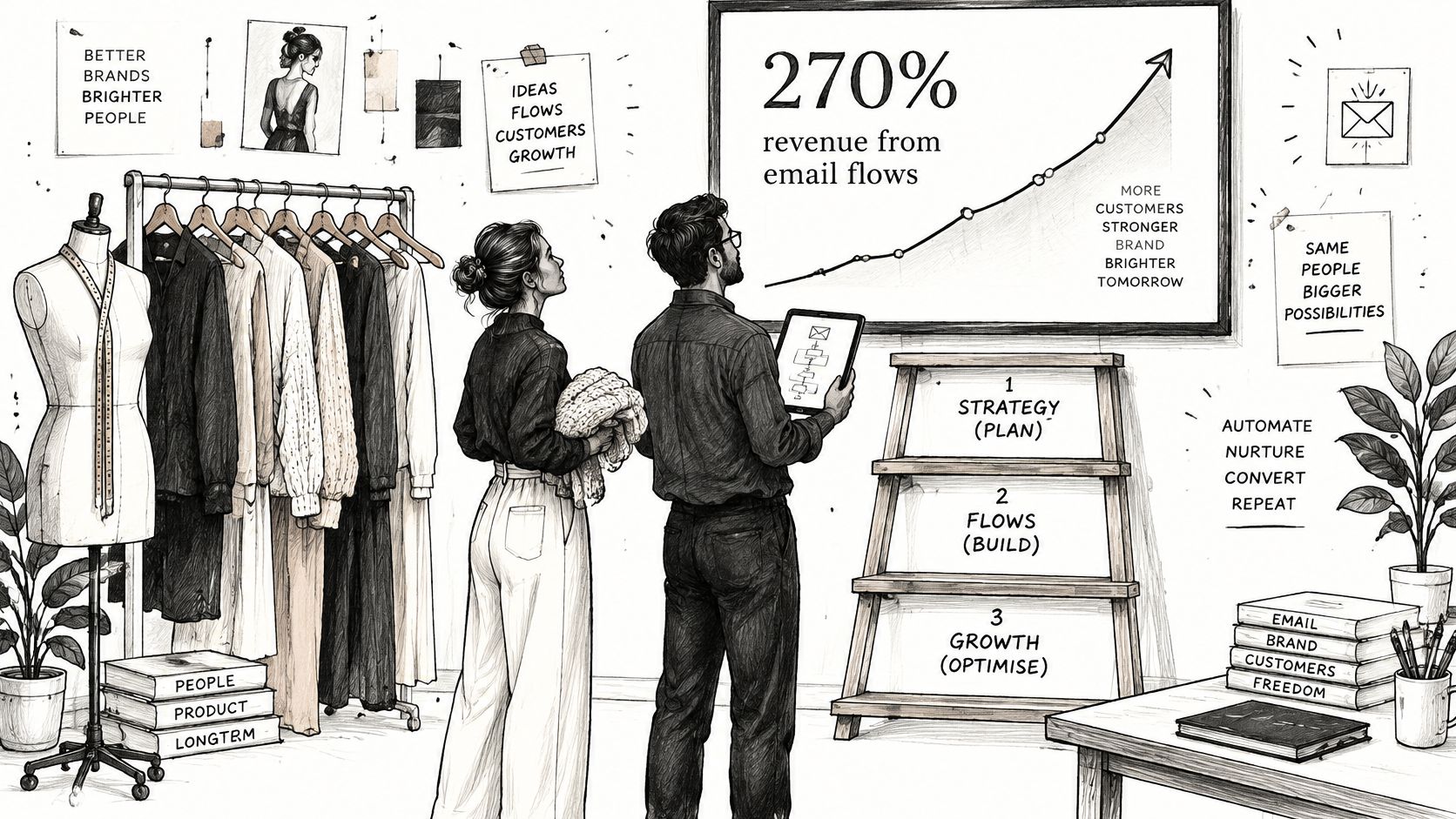
For GUIZIO, our email flows drove a 270% increase in revenue. Fashion is a category where drop timing, size, and styling education decide whether someone comes back. A welcome series and a cart reminder can catch the first dress. They don't teach how to wear the next piece, or when the next drop is relevant to that buyer. The lift fits a catalog that replaced generic sends with flows tied to what she already bought.
For The M Jewelers, a new email system drove a 90% increase in flow revenue. Higher-consideration goods punish a one-day code. The buyer needs proof, fit, and time. Flow revenue moving that far usually means the path got longer and more specific, not that the list got a louder discount. If your average order takes a week of consideration, an education path will outperform a 24-hour coupon.
For STEPR, the email strategy led to a 29% increase in sales. That's a useful correction if you only remember the fashion number. Retention gains aren't a category story. A consumable brand in health, wellness, food, or beverage should judge success by reorder timing and repeat rate, not by a single campaign spike. A 29% sales lift that shows up as on-time second orders is healthier than a 29% lift that shows up as one weekend of codes.
The pattern across the cases is the same. The list didn't get magically bigger. The system got tied to behavior, and the lift was counted on flows rather than on list size. Pick the case closest to your catalog. Fashion implies post-purchase styling. Jewelry implies education before the ask. Consumables imply a replenishment window with a real stop rule. Name that missing flow before you add another blast.
You can make the next build decision this week without a new platform.
If the account has only a welcome series and an abandoned cart, the next build is post-purchase plus replenishment or win-back. It isn't another promotional blast. If high-ticket products stall after the first click, add an education path before a discount. If messages still reach people who already ordered, fix the purchase exit before you write new creative. Count the live flows. Name the repeat-purchase metric each one owns. Either build the missing stage in-house or hand the lifecycle to a partner who will connect the events, the segments, and the design in one project.
Brands that want that system built, rather than assembled from a generic nurture, can use a Klaviyo agency that stays on email and SMS flows. We're an official Klaviyo partner, and we focus only on Klaviyo email and SMS flows, with migration support when a brand is ready to move. Flow Blueprint builds 12 data-connected flows and more than 50 emails for the individual business, delivered in 30 days. Our post-purchase sequences are written to encourage the next order through loyalty, not a single coupon.
The test stays simple. If you can't name which live flow owns the second order, that flow is the one to build next.
Class A Media builds Klaviyo email and SMS flows that treat the list as retention revenue, from the first permission through the reorder, instead of stopping at a welcome series and a cart reminder. If your repeat purchases still depend on more ad spend, we'll map the missing lifecycle stage and connect the events, segments, and design in one project. Visit Class A Media when you want that system built for your catalog.
Let's build retention system that drive predictable, scalable revenue - without ad spend, without retainers, without guesswork.


The Ultimate Ecommerce Email Marketing Agency
Get in touch: hello@classamedia.com