Blog post
Insights
Customer Segmentation Behavioral Marketing Guide
In 2024, 60% of U.S. consumers surveyed by Deloitte said they were satisfied with the current level of personalization in their loyalty programs, while 51% were willing to share data for a more personalized experience, according to Deloitte's 2024 personalization and loyalty insight. That's not a blank check to guess harder. It's a reason to use what customers have already done, carefully, and to prove each segment earns its keep.
Say two shoppers live in the same city, are the same age, and bought from the same Shopify store. One reorders coffee every five weeks and just bought again. The other bought once during a sale, opened nothing since, and hasn't returned. Demographics call them similar. Their behavior says they need opposite messages.
That's the core of customer segmentation behavioral work. You're grouping people by what they do, not who you assume they are. The signals are plain ones from your own store: when they last bought, how often they buy, how much they spend, which categories they return to, what they browse without buying, whether they engage with your email or SMS, and whether they only order when there's a discount.
Think of a good shopkeeper. Knowing a customer's birthday is nice. Remembering that she reorders coffee about every five weeks, prefers the larger bag, and never uses coupons is useful. You'd remind her before she runs out. You wouldn't send her a desperate discount, and you wouldn't treat her like a first time visitor.
Demographics describe who might be in a market. Age, city, and gender can help you choose creative or find a broad audience. They don't tell you who's drifting away, who's about to need a refill, or who bought once and needs help getting value from the product.
Behavior does. A long gap since the last order is a drift signal. A second purchase in the same category is a habit signal. Repeated browsing without checkout is an interest signal, though it's not proof of intent. That last distinction matters. A segment describes an action. It doesn't explain why the person acted.
A click tells you something happened. It doesn't tell you why, and it doesn't prove your message caused the next purchase.
You'll leave with four practical things: a signal to action map that gives each behavior one allowed job, a clear view of how recency, frequency, and monetary value split a real retail file, rules for turning those states into email and SMS flows, and tests that stop a bad assumption before it becomes an expensive habit. Brands that want the broader acquisition context can pair this with targeted marketing for growing ecommerce brands, then return here to decide which signals are allowed to trigger a retention message.
Start with the map. Read one row, write one allowed message, and stop there before you add another signal.
| Signal | What you observe | Allowed marketing job | Do not treat it as |
|---|---|---|---|
| Recency | Days since last order | Education, replenishment, or win-back by time window | A permanent loyalty label |
| Frequency | Orders inside a set window | Separate one-time buyers from repeat buyers | Proof of intent without a holdout |
| Monetary value | Cumulative spend or average order value | Recognition and margin-aware offers | A reason for blanket discounts |
| Category affinity | Repeated buys in one category | Replenishment near the expected use interval | A cross-sell of unrelated products |
| Browse behavior | Repeat views without a purchase | An interest path with a relevant suggestion | An automatic buy-now message |
| Discount sensitivity | Orders that occur only on promotion | Non-price incentives or margin-protected offers | The same promo sent to full-price buyers |
| Lifecycle stage | First purchase, repeat, or dormant | One mutually exclusive flow per state | One sequence for every customer |
Shopify's ecommerce customer segmentation guide identifies purchase frequency, recency, average order value, category affinity, browsing behavior, discount sensitivity, and lifecycle stage as core behavioral dimensions, and recommends measuring repeat-purchase rate, segment-level AOV, and CLV. That list is useful because each signal answers a different question.
Recency asks, how long has it been? A customer who bought three days ago needs education or reassurance. A customer near the normal reorder point needs replenishment. A customer well past it may need win-back. Don't turn a recent purchase into a permanent badge. Recency decays every day.
Frequency asks, has this happened more than once? One order can be curiosity, a gift, or a mistake. Three orders inside your window look more like a pattern. Still, a pattern isn't proof that your flow caused the next order, which is why the table pairs frequency with a holdout.
Monetary value asks, how much is at stake? High spend supports recognition, early access, or careful service. It doesn't automatically support a discount. If someone happily pays full price, training them to wait for a code destroys margin for no clear gain.
Category affinity is stronger when it comes from purchases, not views. Repeated buys in one category support replenishment near the expected use interval. They don't justify pushing unrelated products just because you want to expand the basket.
Browse behavior is the row readers most often overread. Repeat views without a purchase can mean interest, comparison shopping, sizing confusion, or a return in progress. Put that person in an interest path with a relevant suggestion or helpful content. Don't send an urgent buy-now text as if intent were settled.
Discount sensitivity protects margin. If orders happen only under promotion, try bundles, early access, loyalty credit, or a smaller margin-protected offer. Don't send that same promotion to full-price loyal buyers and then wonder why contribution falls.
Lifecycle stage keeps the system tidy. First purchase, repeat, and dormant are mutually exclusive states. One customer shouldn't receive a new buyer sequence, a VIP message, and a win-back in the same week.
The risk is over-targeting. Send one promotion to high-intent browsers, loyal full-price buyers, and discount-dependent shoppers and you'll erode margin while muddying attribution. You won't know who would've bought anyway.
Put four controls beside every row:
If you're building the underlying record, a practical next read is our walkthrough on how to build a comprehensive customer profile, because a segment is only as clean as the profile behind it. Teams sorting out consent and data use alongside targeting can also review these privacy-safe personalisation workflows before they widen collection.
Pick one row this week. Write the single message that signal is allowed to send. Don't add a second signal until the first one has a holdout result.
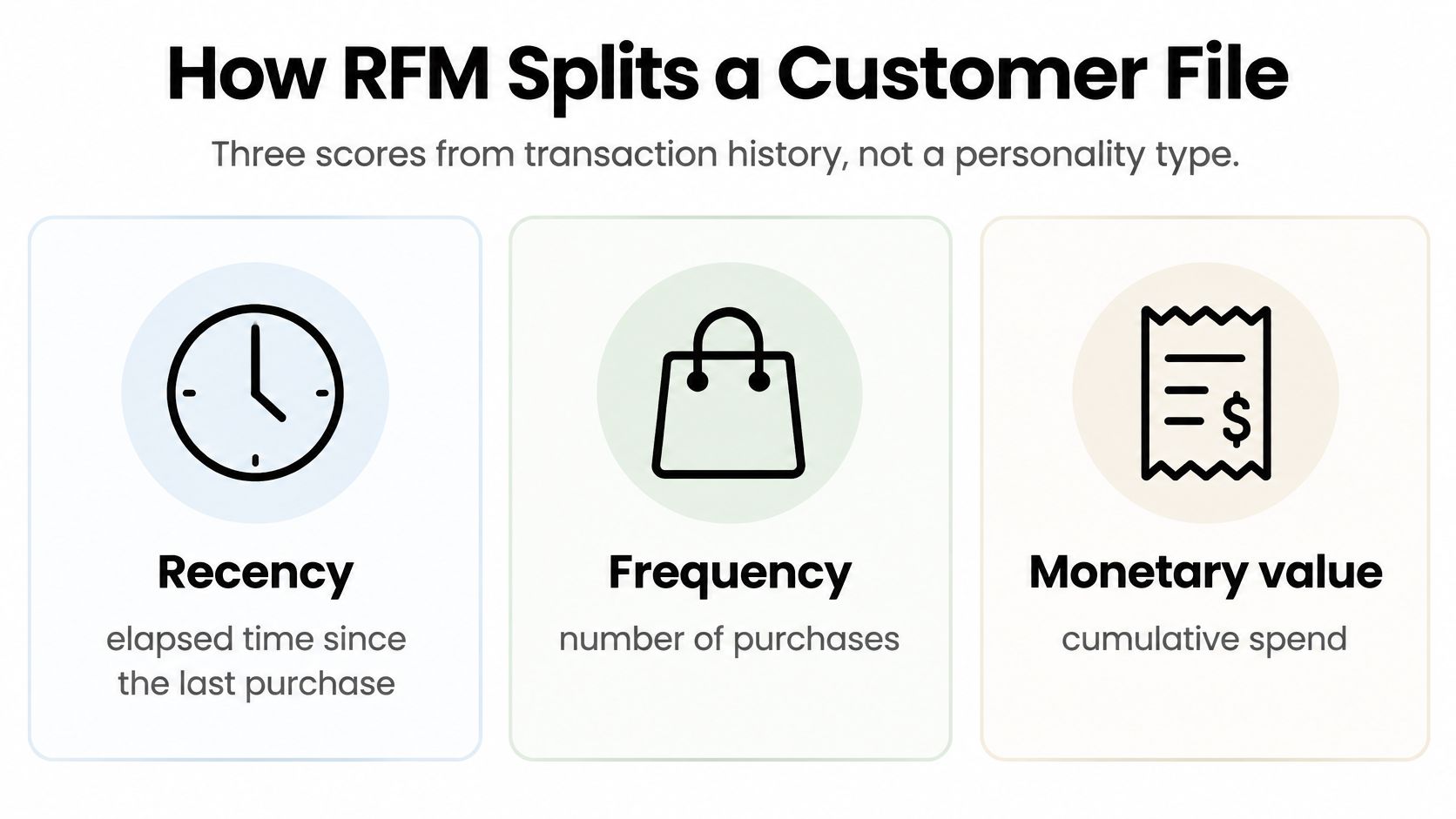
RFM turns transaction history into three scores that describe what customers have done recently. Use them to form a short-lived hypothesis about what message might fit, not a permanent label or an explanation for why someone bought.
The diagram below shows the three scores side by side before you assign any message to them.
A 2025 empirical study in a Springer journal applied RFM segmentation to an online retail dataset containing 541,909 transaction records. After removing missing values, negative quantities, and duplicates, researchers retained 397,884 valid records, approximately 73.4% of the original dataset.
That cleaning step affects the result. Returns, duplicate orders, and blank customer IDs can distort scores, so clean the file before ranking customers.
Using Bisecting K-Means clustering, the study found three behaviorally distinct groups:
| Group | Observed behavior | Retention treatment |
|---|---|---|
| High-spending frequent purchasers | Frequent orders, high spend | Loyalty or VIP communications |
| Inactive customers | Long gap since last purchase | Win-back incentive |
| Recent but low-spending customers | Recent orders, low spend | Education and a second-order offer |
| Three-cluster validation | Silhouette Score 0.65; Davies-Bouldin Index 0.48 | Groups reasonably separated and coherent |
The validation measures describe how well the groups separate. A Silhouette Score of 0.65 and a Davies-Bouldin Index of 0.48 indicate reasonably distinct, coherent clusters in this dataset. They do not prove that the same groupings will work for every store.
The practical distinction is clear: a recent low spender, an inactive customer, and a frequent high spender call for different test messages. Education may suit the recent buyer, a win-back may suit the inactive customer, and recognition may suit the frequent buyer. Treat each assignment as a hypothesis. Keep a holdout to see whether the message changes behavior.
Choose an observation window first, such as the last 90 or 180 days, and calculate all three scores within it. Otherwise, a purchase from years ago can make a currently inactive customer look valuable.
Normalize monetary value so one unusually large order does not distort the scale. Cap or transform outliers before ranking customers.
Set replenishment windows by category. Coffee, skincare, pet food, and apparel have different usage cycles. Suppress customers whose recent activity, such as an active checkout, suggests a purchase may already be underway.
RFM scores can help organize customers into addressable groups, but group names are only a starting point. Assign one treatment to each group, then use a holdout to test whether the treatment performs better than sending nothing.
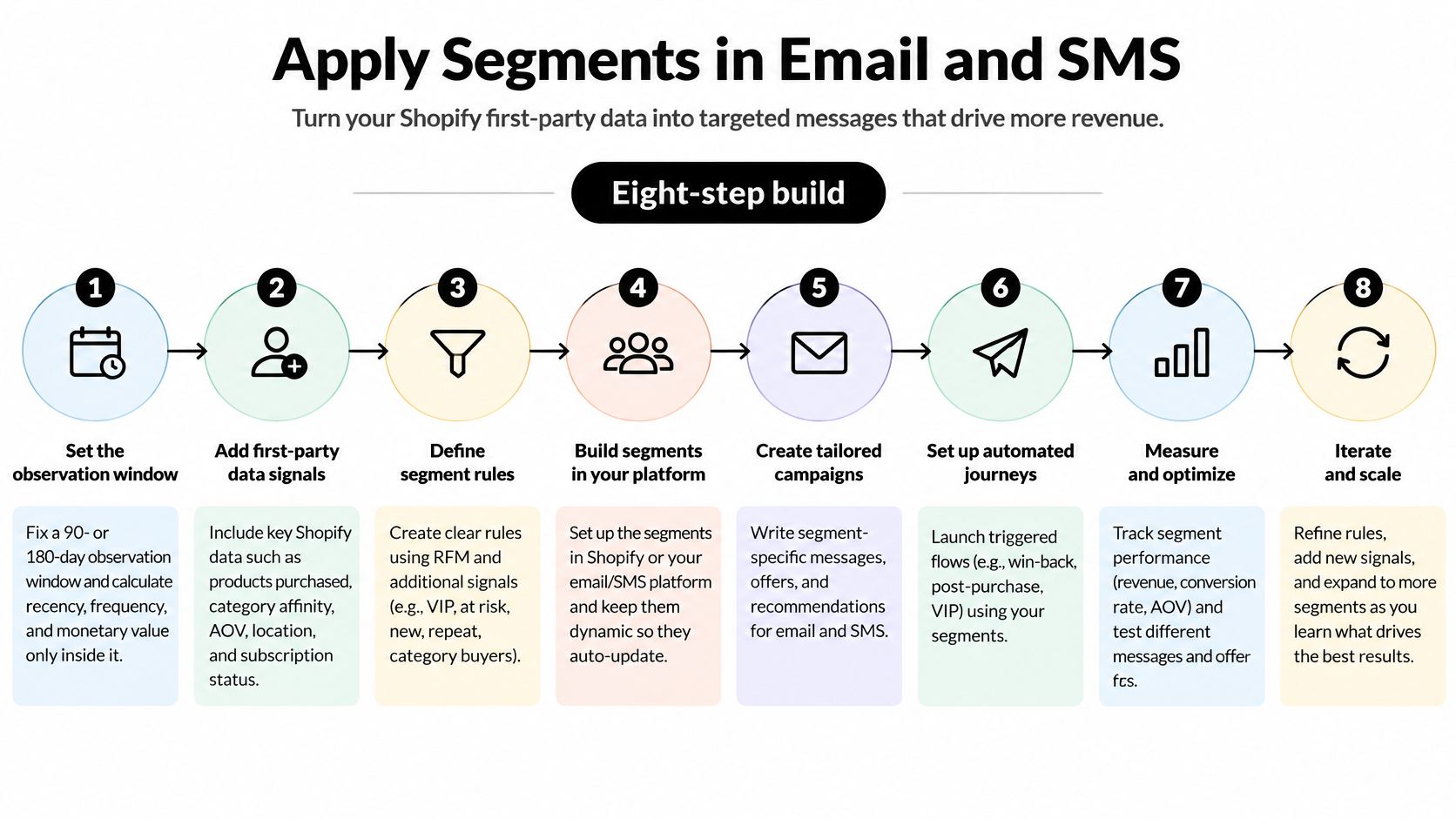
Build this in order. Don't write copy until the states, suppressions, and holdouts exist.
The flow diagram below maps the eight step build from observation window to measurement.
Shopify's enterprise retention guide reports that Shopify customer analytics can classify shoppers into 11 RFM groups and convert those groups directly into addressable segments, and it describes an Iowa State University e-commerce study that found frequency and monetary value to be strong indicators of customer-value potential, while recency was negatively correlated with value when measured as elapsed time since purchase. In plain terms, the longer the gap, the weaker the signal. That's why worsening recency in a high-value customer deserves attention before the gap becomes dormancy.
If you're sequencing these touches over days rather than sending a single campaign, our guide to planning a drip email campaign shows how to space messages without turning one state into a daily nag.
The short video below walks through the flow logic visually, which helps if your team argues better from a diagram than from a spreadsheet.
The recent low spender. Say a customer bought a starter size last week. Don't send a VIP message or a win-back. Send use instructions, what to expect, and a timed second-order offer when the starter should be running low. The job is confidence, then a second purchase.
The dormant high spender. Say a customer used to reorder a staple and has gone quiet well past the usual interval. Send a service-oriented check on that product. Ask if it worked, offer help, and make reordering easy. A sitewide blast ignores the specific habit that made this customer valuable.
The repeat browser. Say a shopper views one category three times without checkout. Send a curated suggestion for that category, perhaps a comparison or a bestseller with a clear reason to choose it. Don't pretend you know she's ready to buy today. You're testing whether relevance moves her.
The discount-only buyer. Say the last four orders all used a code. A deeper discount teaches the same lesson louder. Try a bundle that protects margin, early access, or loyalty credit instead. Measure contribution margin, not just whether the order happened.
The high-ticket researcher. Say a prospect keeps reading sizing or setup content. Send an education sequence with a customer story and direct answers on price, setup, and long-term value. For expensive products, unanswered objections block more purchases than a missing coupon does.
Practical rule: Every state gets one primary treatment, one suppression rule, and one holdout. If you can't name all three, the flow isn't ready to send.
Recalculate states as new orders, browses, and engagements arrive. A customer who buys during a win-back leaves that state immediately. A repeat buyer who stops ordering moves toward risk. Treat the label as a short-lived hypothesis about what might help next, not as a permanent identity.
Personalization can improve relevance, but customers don't automatically welcome the tracking behind it. That tension should shape which signals you use and how openly you use them.
The checklist below puts the survey numbers and the testing controls in one place.
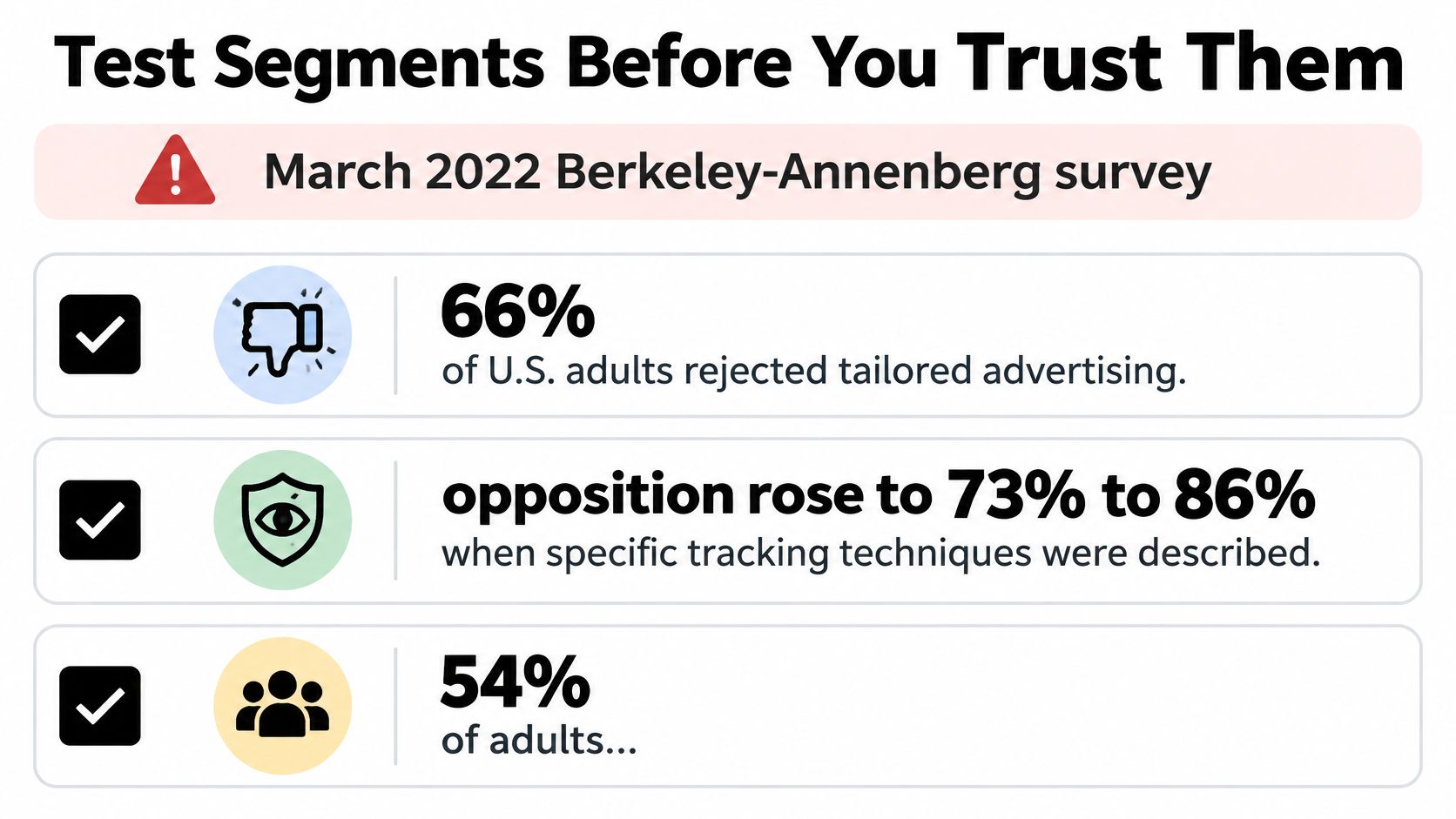
A nationally representative Berkeley-Annenberg survey reported in March 2022 found that 66% of U.S. adults rejected personalized advertising. When respondents were told about specific behavioral-targeting techniques, such as tracking online activity and using it to customize ads, opposition increased to between 73% and 86%, depending on the technique.
Younger adults were not an exception you can build on. 54% of people aged 18 to 24 rejected customized advertising, and 92% supported a legal requirement allowing individuals to request deletion of stored personal information. Shopify's 2026 guidance, cited in Campaigner's behavioral segmentation overview, also notes that 71% of customers take action to protect their privacy.
Segment on signals the customer can understand: purchase recency, order frequency, product category, subscription status, and engagement with your own email or SMS. That's permission-based lifecycle communication. It's different from opaque third-party tracking stitched together across the web.
Give customers clear consent choices, a preference center that changes what they receive, and a workable way to request deletion. If you can't explain a segment in one sentence a customer would accept, don't use it. "You bought this 40 days ago, so we sent a refill reminder" passes. "A partner profile suggested you might respond" doesn't.
Preferences change. Catalogs change. Seasons and traffic sources change. A category interest from last winter may mean nothing this summer, and a very narrow segment can shrink until it's too small to operate or measure.
Use short-lived states instead of permanent labels: replenishment likelihood, current category interest, recent discount sensitivity. Expire or downgrade each state after a defined period, then let new behavior earn it again.
Report three groups separately: known consented customers, anonymous visitors, and customers with incomplete cross-device matches. Identity stitching can merge a household's behavior into one profile or mislabel a new buyer as a returning browser. If you blend those groups, your results will look cleaner than your data deserves.
Ask one question of every segment: what evidence would prove this assumption wrong?
Opens, clicks, and attributed revenue aren't causal proof. A click can be an accidental tap, a shared device, a return lookup, or a customer checking tracking. A high-engagement customer may also be the person most likely to buy without another text, which makes the extra message pure cost.
Withhold the message when the customer is already likely to buy, when the signal could plausibly be a return or someone else on the device, or when consent no longer covers the use. Restraint is a segmentation decision too.
If the holdout buys at the same rate, don't keep the segment live. Retire the treatment and spend the effort on a state that changes behavior.
Ship one split before you build a full model. Three mutually exclusive groups from your own orders are enough to learn whether behavioral states beat your current blasts.
For Seat Cover Solutions, the audience was segmented into first-time purchasers, high-LTV customers and dormant leads. That same three-group start works as a first build for most Shopify stores because each group has a different job and a different failure mode.
Before the first send, set three guardrails: the observation window, a frequency cap across email and SMS, and a randomized holdout for each group. Then wait for one full purchase cycle before you judge. A first-week read mostly measures novelty and timing luck.
Read incremental repeat-purchase rate and contribution margin by group. Our email and SMS flows have generated over $150 million in attributable revenue for eCommerce brands, but attributable revenue alone won't tell you which of your three treatments caused anything. The holdout will.
If you want a plain-English companion on reading retention numbers before you scale, a retention guide for small businesses covers the analytics basics without assuming a data team. For the stage definitions behind these groups, see our breakdown of customer lifecycle phases.
Brands running only a welcome flow and an abandoned-cart flow can add these three states without buying more ads. Add a new signal only after one group has a proven treatment. If a holdout buys at the same rate, drop that group's treatment before adding another.
Consider outside help only when your team can't run holdouts or refresh states on schedule. Compare that cost with running the three-group start in-house first. A small proven system beats a large untested one.
If your Shopify brand is still sending one sequence to first-time buyers, high-value repeat customers, and dormant leads, Class A Media can build the segmented email and SMS flows, holdouts, and replenishment timing described here as a custom retention system. Start with the three lifecycle groups, prove which treatment changes repeat purchases, and then expand only what earns it. Visit Class A Media to see how we'd structure that first build for your store.
Let's build retention system that drive predictable, scalable revenue - without ad spend, without retainers, without guesswork.


The Ultimate Ecommerce Email Marketing Agency
Get in touch: hello@classamedia.com