Blog post
Insights
Klaviyo Agency Partner: What It Is and How to Choose One
Most agency-hiring guides still give the same shortcut: open Klaviyo's partner directory, filter for an official badge, and book the shop with the cleanest site. That filter tells you almost nothing about whether the team can build flows that make money.
A partner badge confirms ecosystem participation. It does not confirm that anyone on the account can architect a lifecycle, repair broken Shopify tracking, or show that a sequence produced net-new profit rather than revenue the brand would have taken anyway.
Demand for Klaviyo implementation has grown with the platform, and the directory has filled up behind it. Generalist shops add a Klaviyo agency partner logo to the footer because every new store on the platform needs someone to turn events into flows. The logo is easy to display. Hands-on fit is not.
Before you sign, inspect five things. Which program track the agency holds. Who on the named delivery team logs into your account, not just who sells the retainer. How they wire behavioral store events into each flow. How they measure incremental revenue instead of taking credit for every order that touched an email. What templates, logic, and flows you still own when the contract ends.
I would treat the badge as a starting filter, then drop any partner that cannot answer those five checks on the first call.
A Klaviyo agency partner works like a specialist electrician rather than an interior decorator. Klaviyo supplies the software infrastructure and messaging pipes, much like the utility grid feeding a building. The agency designs the circuit layout inside your brand's own account, wires the triggers to live customer behavior, tests the load, and makes sure the right message fires at the right moment without shorting out your deliverability.
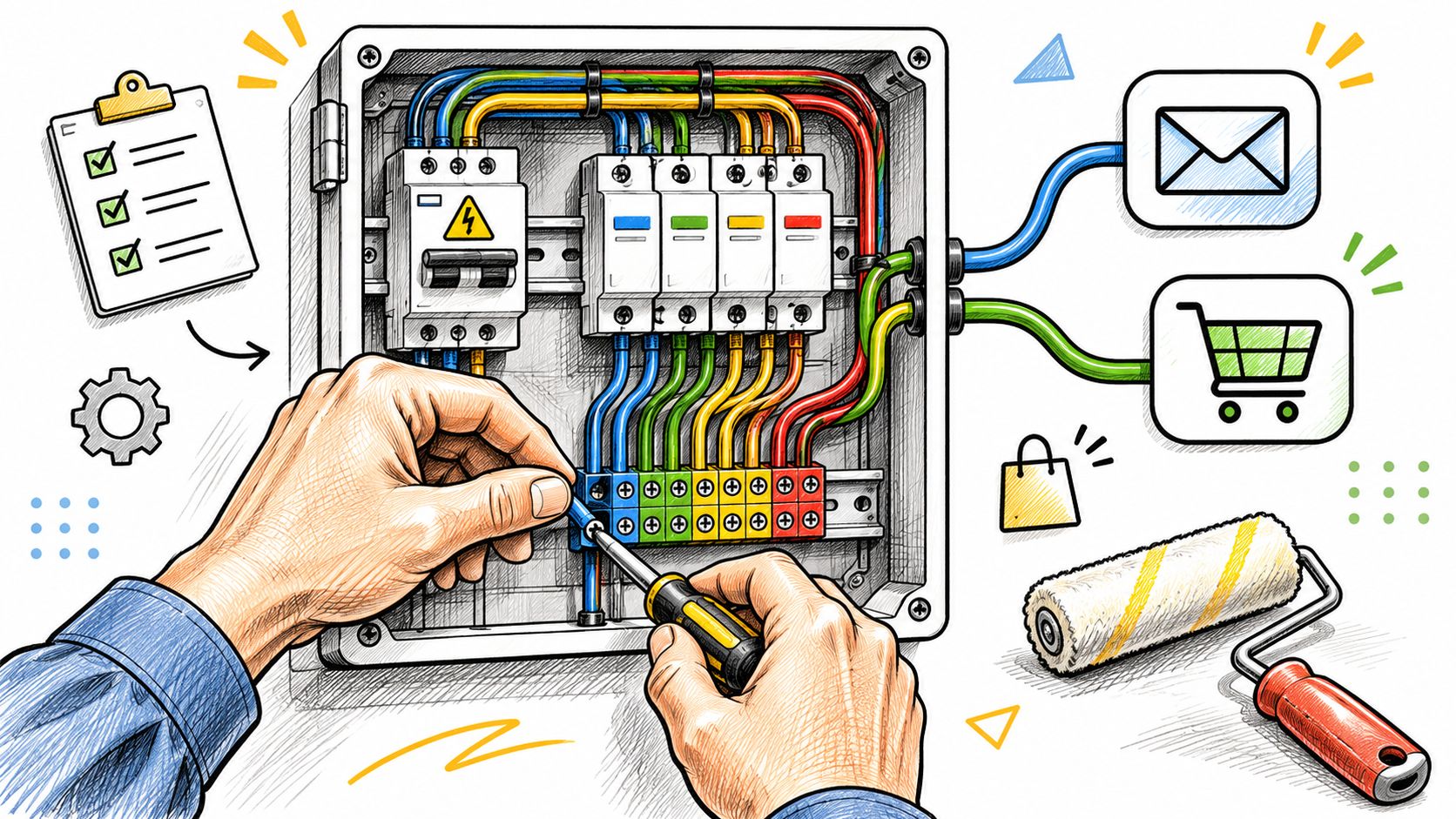
A decorator picks colors and swaps out seasonal banners. An electrician maps how current moves through the walls so nothing trips when traffic spikes during a product launch.
When an ecommerce brand hires a retention partner to build or overhaul its flows, three distinct jobs usually sit on the agency's plate:
When those three jobs operate under one roof, messages react to what shoppers do on your store instead of blasting the same discount to every subscriber. None of it works without clean, unified customer data feeding the triggers. Brands still stitching scattered store and marketing data together can use this ecommerce customer data platform guide to get that foundation in place alongside the agency buildout, since a flow is only as sharp as the events and profiles behind it.
The official partner label confirms program participation, nothing more. On Klaviyo's partner program page, the platform reports more than 6,500 agency partners and over 350 integration partners, with 85% of Klaviyo customers enabling at least one integration across an ecosystem open to agencies, freelancers, and systems integrators. Klaviyo's partner directory tells a similar story, listing thousands of agencies supporting high-intent brands around the world.
Badge counts like these explain the buyer's problem. When thousands of agencies hold partner status, the badge functions as a starting filter rather than proof that a shop can run your account.
Specialization tells you far more than directory membership. Vertical experience in apparel, supplements, or food and beverage, deep Shopify familiarity, proven lifecycle-automation engineering, and documented revenue outcomes separate builders who move the needle from generalists who resell templated setups. Ask any candidate agency which of those four it can evidence, and listen for specifics: named verticals, live flow examples, and revenue figures tied to a measurement method rather than screenshots of dashboard totals.
Before reading a single agency pitch deck, check which track the firm occupies inside Klaviyo's partner program. Many buyers assume every listed partner actively builds and manages client accounts, yet Klaviyo splits its ecosystem into two different roles.
| Track | What the partner does | Who works in your account | What to ask for |
|---|---|---|---|
| Advisor | Refers businesses to Klaviyo without actively managing accounts | Your internal team or a separate agency | Who will build and maintain your flows |
| Master | Provides Klaviyo services for mutual customers | Named partner delivery team | Team certifications and case studies |
As detailed in Klaviyo Academy's partner program requirements, the Advisor track covers partners that refer business to the platform without managing day-to-day execution, while the Master track covers agencies delivering hands-on Klaviyo services for mutual customers. Klaviyo also applies materially different tier requirements across managed monthly recurring revenue, referred monthly recurring revenue, platform adoption, training, certifications, and case-study obligations.
For a Shopify brand hiring an outside team to engineer flows, manage domain deliverability, refine audience segments, and interpret attribution, confusing an Advisor with a Master is an expensive mistake. Directory status alone doesn't prove hands-on implementation skill.
Official partner status opens the door to the vendor ecosystem. It never proves that the people joining your kickoff call know how to debug a broken cart trigger or protect your sender reputation.
Class A Media is an official Klaviyo Partner, and we advise every prospective buyer to treat that credential as a minimum entry check rather than the final reason to sign. Fit depends on whether the agency matches your lifecycle complexity, industry economics, and preferred commercial model.
Run these three verifications before spending an hour on a discovery call:
Agencies that hesitate on these questions usually outsource execution or rely on referral revenue rather than in-house retention engineering. Ask for verifiable evidence instead of slide-deck summaries, and remove any candidate who can't name the people touching your customer data.
Follow one shopper, Sarah, through a normal Tuesday evening on a Shopify store. She clicks an ad, lands on a serum product page, reads the ingredient list, and adds one bottle to her cart. Her phone rings, she closes the tab, returns the next morning, starts checkout, hesitates at shipping costs, and finally completes the order two hours later after receiving a reminder. Four days after that, the courier drops the box on her porch.
Every single step Sarah took generates a distinct Shopify event inside Klaviyo. Below is how those five behavioral and transactional milestones stack across the customer journey.

A skilled partner architects lifecycle automation around these event-level signals instead of blasting static lists. According to Klaviyo's Shopify integration reference, the native sync captures behavioral and transactional events including Viewed Product, Viewed Collection, Submitted Search, Added to Cart, Checkout Started, Placed Order, Ordered Product, Fulfilled Order, Refunded Order, and Delivered Shipment. Separating those triggers lets you send a soft educational nudge to an Added to Cart browser while reserving urgency or shipping reassurance for a higher-intent Checkout Started shopper.
When auditing how an agency plans to structure your Klaviyo email flows, map every synced event to its exact job and pre-launch safeguard.
| Shopify event | When it fires | Flow it supports | Check before launch |
|---|---|---|---|
| Viewed Product | Shopper opens a product page | Browse abandonment and education | Profile is identifiable |
| Added to Cart | Item added but checkout not started | Early-stage cart reminder | Suppressed once the shopper buys |
| Checkout Started | Shopper begins checkout | High-intent abandoned checkout | Timing and discount rules set |
| Placed Order | Order completed | Thank-you and cross-sell | Excludes products already bought |
| Fulfilled Order | Order shipped | Shipping update and care guide | Fulfilment status is current |
| Delivered Shipment | Delivery confirmed | Review request and product tips | Delivery timing is accurate |
| Refunded Order | Refund issued | Removes shopper from upsell sequences | Refund suppresses sends |
| Ordered Product | Specific product purchased | Replenishment and win-back | Product-level conditions set |
Notice how post-purchase signals do just as much revenue work as pre-purchase triggers. Using Ordered Product and Delivered Shipment separately lets you time a review request after the box arrives, trigger a replenishment reminder right before a 30-day consumable runs empty, and suppress unhappy buyers automatically if Refunded Order fires.
Don't judge flow performance until you validate identity resolution and privacy settings. Klaviyo warns that Shopify behavioral events can arrive without an identifiable shopper profile when relevant customer-privacy settings are disabled or misconfigured. When an event fires anonymously, Klaviyo can't attach it to an email address or phone number, which breaks profile attribution and stops browse and cart flows from sending.
Watch this short walkthrough to see how event triggers and integration checks fit together inside a live Shopify setup.
Counting total flows tells you almost nothing about account quality. Ten sloppy automations will annoy subscribers faster than four tight ones. Every flow an agency builds should ship with four written specifications plus one clear commercial target:
If an agency can't hand you a one-page spec showing those elements for each flow, auditing or editing the account six months later turns into guesswork.
Benchmarks have a narrow job here: they give you a size check, not a sales promise. Most ecommerce stores launch with two basic automations, a welcome discount and a single abandoned-cart reminder. Stopping there leaves serious lifecycle revenue untouched. According to Klaviyo's ecommerce benchmarks resource, welcome, abandoned-cart, browse-abandonment, and win-back automations operate as distinct ecommerce flows, and Klaviyo recommends maintaining welcome series, abandoned cart, and browse abandonment as core always-on sequences alongside post-purchase thank-you and replenishment flows.
Keep the channel methodology straight before comparing accounts. As Klaviyo's benchmarks documentation explains, email performance is measured against peer benchmarks, whereas SMS performance is measured against industry benchmarks, with reporting split cleanly between email-flow and SMS-flow results. That matters because a blended number can hide the actual trade-off: email may earn more per recipient, while SMS may drive more immediate clicks.
Using data published in Klaviyo's abandoned-cart benchmarks report, here are the flow figures worth using as published reference points.
| Flow | Email revenue per recipient | SMS revenue per recipient | Email click rate | SMS click rate |
|---|---|---|---|---|
| Abandoned cart | $6.77 | $4.48 | 6% | 10.3% |
| Welcome series | Not published; set store baseline | Not published; set store baseline | 6.5% | 10% |
Browse-abandonment and win-back performance should be judged against your own 90-day store baseline.
The abandoned-cart row shows the practical channel trade-off. Email earns $6.77 per recipient compared with $4.48 for SMS, yet SMS beats email sharply on engagement with a 10.3% click rate versus 6%. The same click gap shows up in welcome flows, 10% for SMS versus 6.5% for email. Email works well for rich storytelling, product education, and multi-item reminders. SMS works as a high-immediacy nudge that pulls mobile shoppers back to checkout fast.
Where the table leaves revenue unpublished, do not let an agency fill the blank with a made-up industry average. Pull your own flow-level results, separate email from SMS, and calculate revenue per recipient from clean sends. A rough baseline is more useful than a borrowed number because your list quality, offer, catalog, and checkout friction shape the outcome.
Benchmarks work best as a rough sizing exercise, never as a guaranteed sales forecast. Take a hypothetical store sending an abandoned-cart email sequence to 10,000 recipients over a quarter: at the $6.77 benchmark average, that volume implies roughly $67,700 in flow-attributed revenue. Running an abandoned-cart SMS sequence to 10,000 opted-in recipients at $4.48 each implies roughly $44,800.
Your actual numbers will shift based on average order value, product margin, and checkout friction. A high-ticket furniture store should beat $6.77 easily, while a low-AOV snack brand may sit below it and still run profitably. That is why the benchmark belongs in a sizing conversation, not a performance guarantee.
Practical rule: Compare your live revenue per recipient against published benchmarks only after you've collected at least a full purchase cycle of clean data, then judge improvements against your own prior cohort rather than an industry median.
Knowing which flows matter also helps you scope the right build size instead of overpaying for unused complexity. Stores starting from a bare setup often begin with foundational coverage: our Flow Essentials package builds four core flows (Welcome, Checkout Abandonment, Browse Abandonment, and Thank You) totaling 20+ emails. Brands with broader catalogs, repeat-purchase cycles, or higher traffic typically need deeper lifecycle branching, which is why our Flow Blueprint builds 12 hyper-targeted, data-connected flows for each brand, spanning 50+ emails delivered in 30 days.
Match the build scope to catalog depth and traffic volume first. A small catalog with limited repeat purchases rarely needs the same branching as a large store with many product paths and replenishment cycles. Once the flows are live, the harder question is how much reported revenue would have happened anyway.
A glowing Klaviyo dashboard can report six figures in attributed revenue while adding almost zero incremental profit to your bank account. That happens far more often than agencies admit, and the reason sits inside default attribution math.
Klaviyo's default reporting credits flows on a last-touch basis: if a shopper opens or clicks a message within the platform's attribution window before ordering, the flow gets credit for the full order value. Add privacy-generated opens from Apple Mail Privacy Protection and automated security-bot clicks, and the platform can claim full credit for an order placed by a shopper who was already typing your URL into their browser. During a sitewide promotion, a welcome or cart flow can appear wildly productive because it brushed past high-intent buyers already checking out.
Attribution credit is not proof of causation. Treating it as proof is how brands end up paying retainers against revenue that would have arrived anyway.
To stop paying agencies for credit they didn't earn, insist that every monthly report separates these six metrics instead of blending them into one headline figure.
| Metric | What it shows | Where it misleads |
|---|---|---|
| Attributed revenue | Sales credited to a flow within its attribution window | Last-touch credit can favour shoppers already intending to buy |
| Delivered revenue | Revenue from orders placed after a send | Ignores whether the send caused the order |
| Repeat-purchase rate | Share of customers who buy again | Needs a cohort baseline to show change |
| Time to second order | Days between first and second purchase | Shifts with product purchase cycle |
| Unsubscribe and SMS opt-out rate | Audience cost of sending more | Low rates can hide heavy send volume |
| Incremental lift from holdout | Difference between a group receiving the flow and a control group | Requires a clean holdout group |
Before any agency touches your templates, put a written reporting standard in place that aligns with your broader ecommerce key performance indicators. A defensible protocol covers six concrete habits:
The holdout habit is the one agencies resist most, because it is the only one that can make their work look ordinary. Treat that resistance as useful information: a partner confident in their lift will propose the control group themselves.
Say a skincare brand runs a five-day anniversary sale with heavy paid social retargeting and a sitewide banner. By Monday morning, Klaviyo attributes a large share of store revenue to flows, and the agency celebrates a record week. Yet when the brand checks a clean 10% holdout group that received zero flow emails during the sale, the holdout shoppers converted at nearly the exact same rate because the sitewide discount did the heavy lifting.
Run the same test in a quiet week and the picture often flips: a well-built abandonment flow shows real separation between the messaged group and the control group. That contrast is the number worth managing, because it isolates what the flow causes rather than what it merely touches. Promotion weeks will always inflate attributed revenue, so schedule holdout measurement during normal trading periods if you want a clean read on baseline performance.
Big attributed-revenue screenshots prove your emails were delivered near a purchase. Only a clean holdout test proves your emails caused it.
Demanding a sample reporting template before signing filters out agencies that hide behind inflated open rates and default lookback windows. Any serious guide to evaluating a Klaviyo agency will tell you the same thing: the quality of a partner's reporting is the quality of their accountability. If the template shows one blended revenue figure and no control methodology, you are looking at a credit-taking operation rather than a lift-building one.
Even a technically sharp agency relationship eventually changes shape. You might bring retention in-house after a strong year, switch commercial models, or pause spending during a warehouse transition. What you wrote into the contract on Day 1 determines whether you walk away owning a clean retention asset or an undocumented black box.
Review these seven ownership and security checks before approving any statement of work.
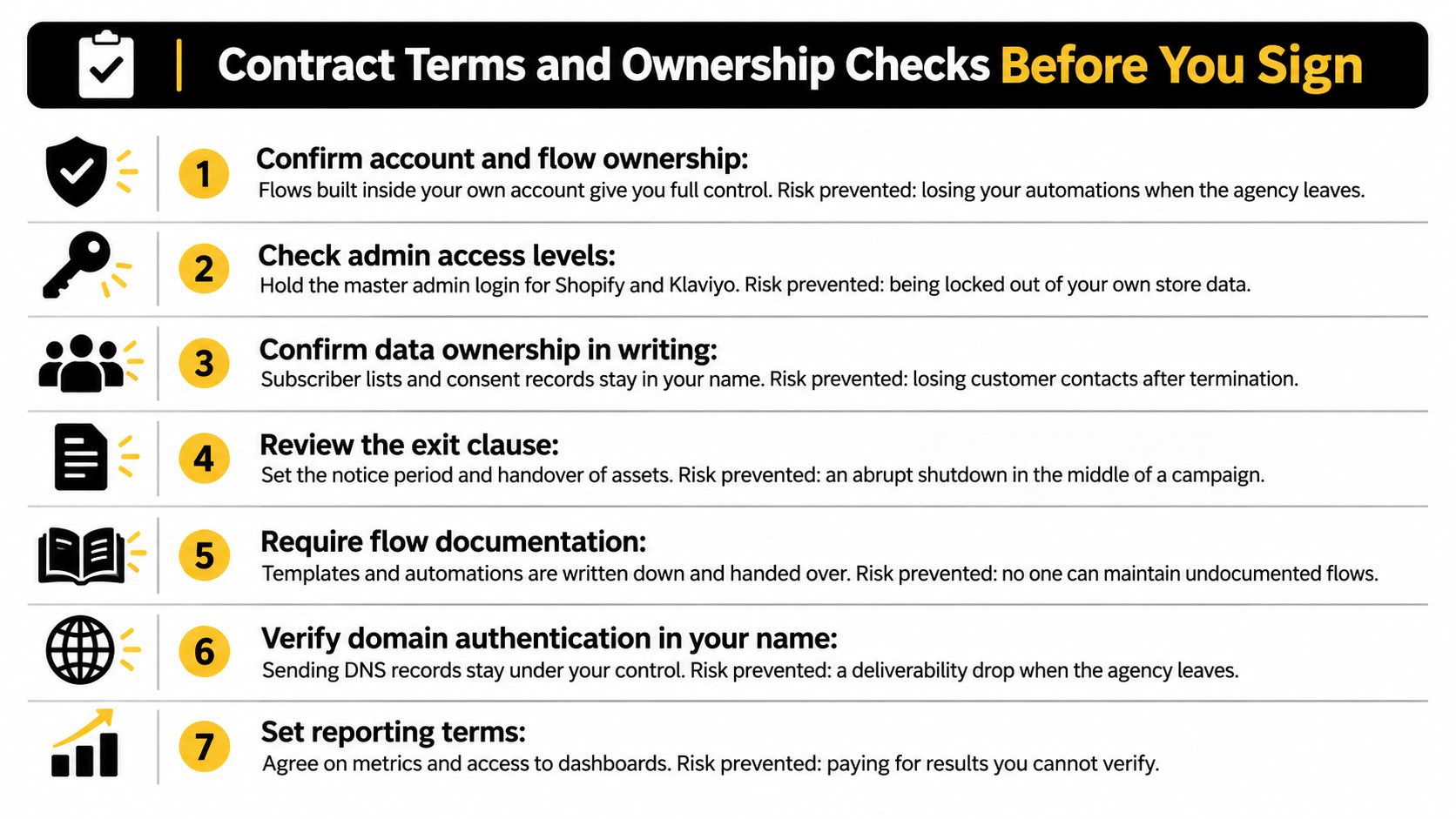
Locking these seven terms into your agreement protects your data and gives your team full operational control the day the build finishes.
A Klaviyo partner badge confirms ecosystem participation. It does not confirm hands-on fit. Sales calls blur that line because every agency sounds confident once the deck is open, so grade the shortlist yourself before you compare proposals.
Use a 10-point scorecard. Score each of five areas from 0 (missing or evasive) to 2 (verified with evidence).
Partner Track and Named Delivery Team (0 to 2). Confirmed Master-track capability, verified team certifications, and named practitioners committed to your account. The badge does not name who builds the flows.
Shopify Event Mapping (0 to 2). Event-level architecture across pre-purchase and post-purchase signals, plus a privacy and identity-resolution validation step.
Incremental Measurement Plan (0 to 2). Separate reporting of attributed versus total revenue, machine-open filtering, cohort tracking, and holdout testing. Credit for revenue the store would have earned anyway is not a result.
Contract and Ownership Terms (0 to 2). Full account ownership, Reporting API readiness, documented QA gates, and clear consent governance.
Evidence of Past Flow Outcomes (0 to 2). Real revenue and conversion proof from comparable stores, the same standard to apply when reviewing verified ecommerce retention case studies.
Before you book a discovery call, email every candidate for three artifacts that should already exist: a sample event map, a blank reporting template, and the names of the people who will build your flows. Agencies that run those documents in delivery can answer without assembling a custom pitch.
The total score should also pick the commercial structure. Brands with an internal marketer who can run weekly campaigns often prefer a focused one-time buildout over an open-ended retainer. Lean teams without in-house bandwidth may want ongoing campaign management. I would not sign a retainer until the named delivery team and the measurement plan both score a 2.
If you're evaluating a dedicated Klaviyo agency built around a one-time flow implementation model, Class A Media starts with a consultation to build a custom plan, focuses strictly on Klaviyo email and SMS flows, and gets flows fully implemented into Klaviyo, quality-assured, and made live by Day 15. Put that plan through the same 10-point scorecard alongside your other finalists.
Take one concrete step this week. Shortlist two agencies, book both calls, and score each one on that same 10-point scorecard from the packet you request 24 hours before you speak. The quality of what comes back in your inbox will tell you almost everything you need to know.
If you want custom Klaviyo email and SMS flows built directly inside your own account without locking into an ongoing agency retainer, we can map out your lifecycle gaps on a quick consultation call. Our team handles strategy, copywriting, design, and technical Klaviyo implementation so you own every flow, logic split, and template after launch. Visit Class A Media to schedule your consultation and get a detailed flow plan for your store.
Let's build retention system that drive predictable, scalable revenue - without ad spend, without retainers, without guesswork.


The Ultimate Ecommerce Email Marketing Agency
Get in touch: hello@classamedia.com