Blog post
Insights
Ecommerce Email Marketing: A Practical Guide for 2026

In 2024, approximately 361.6 billion emails were exchanged worldwide each day, a 5.2% increase from the previous year, according to the efficy Email Benchmark Report 2025. That scale can mislead store owners into sending more campaigns. Effective ecommerce email marketing works the opposite way. It sends fewer, better timed messages based on what a customer just did, then judges each one by incremental revenue and repeat purchases, not opens.
Think of email as an owned channel. You don't rent reach from an ad auction each time, and you can connect messages to signup, browsing, checkout and order events in Shopify. The build order matters because each flow needs different data, and some only pay back once you know how valuable a repeat buyer is to you.
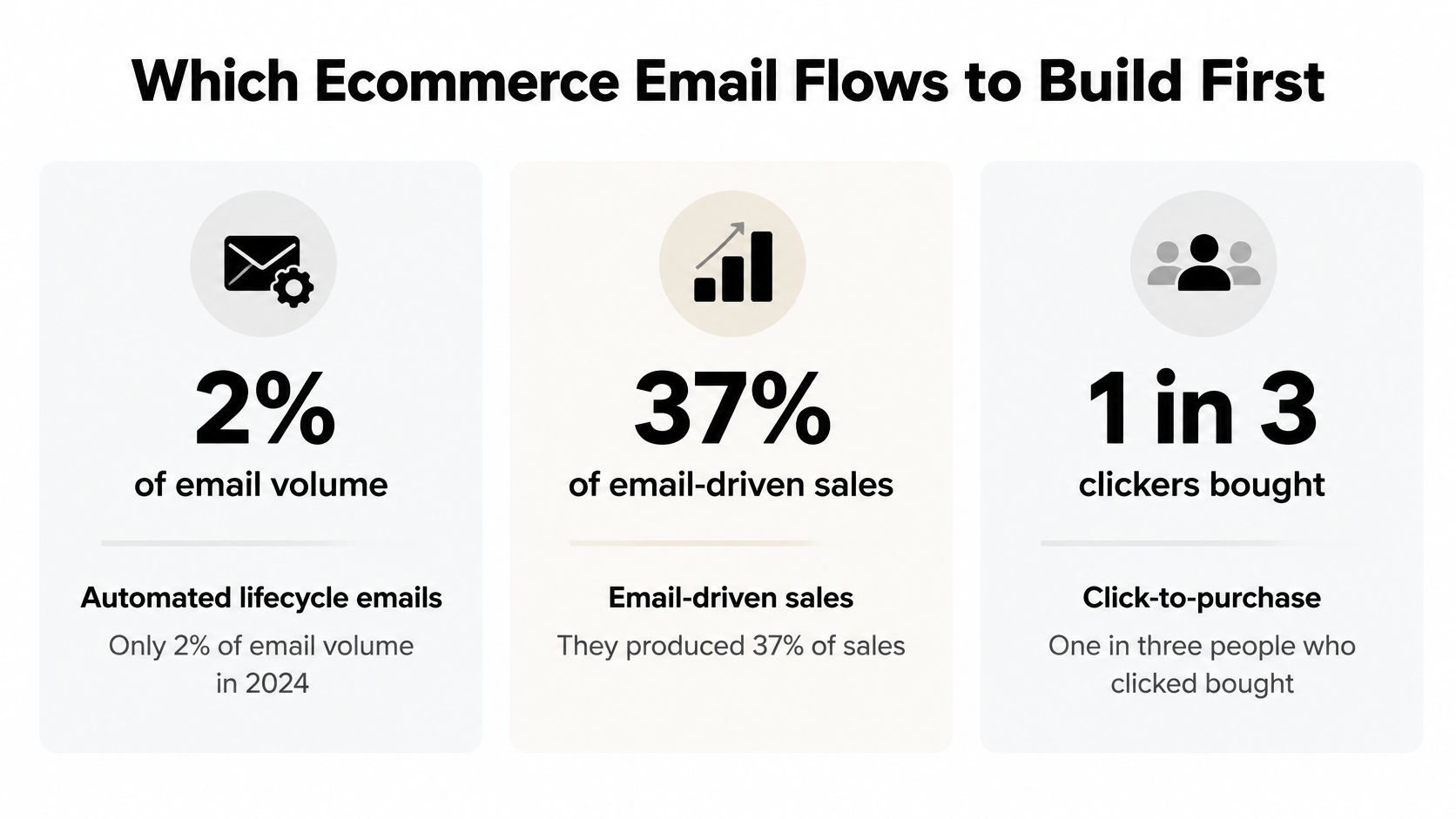
Automated emails accounted for only 2% of total email volume but generated 37% of email-driven sales in an analysis of 24 billion emails sent in 2024 in the Omnisend 2025 ecommerce marketing report. In that dataset, one in three people who clicked an automated message made a purchase, compared with one in 18 people who clicked a scheduled campaign. Treat that contrast as a historical benchmark, not a promise for your store. Category, offer, audience quality, attribution rules and design all move the result.
A useful analogy helps. A campaign is a flyer handed to everyone on the street. A flow is the store clerk who greets a new visitor, follows up after a purchase and calls a regular when they're due back. Flows react to a named event, so the message matches intent.
| Flow | Trigger | Main job | Typical timing |
|---|---|---|---|
| Welcome series | Newsletter signup or first account creation | Turn subscribers into first buyers | 3-5 emails over 5-7 days |
| Browse abandonment | Product views with no add-to-cart | Bring back interest in viewed products | 1-3 emails within 24 hours |
| Checkout abandonment | Cart created, checkout not completed | Recover a started purchase | 1 hour, 24 hours and 48-72 hours after abandonment |
| Post-purchase | Order confirmed | Set expectations, cross-sell, request reviews | Starts at order confirmation, runs 14-30 days |
| Replenishment | Predicted reorder date from product usage | Remind customers before they run out | Timed to the product's usage cycle |
| Win-back | No purchase within the normal buying cycle | Re-engage lapsed buyers | Starts after 90-180 days of silence, adjusted to the cycle |
Where a customer sits in that journey should drive the copy, which is why mapping the customer lifecycle phases comes before writing templates.
McKinsey's recommended process in its guide to customer lifetime value has three steps, collect customer data, determine each customer's true long-term value, and direct investment toward the most valuable customers. Compare that value with acquisition and retention costs before you sequence work.
Apply three checks:
Default order: When no check dominates, build welcome and checkout first, post-purchase next, then replenishment and win-back once order history supports them.
We've built retention systems for over 200 eCommerce brands, and our email and SMS flows have generated over $150 million in attributable revenue. For The M Jewelers, a new email system drove a 90% increase in flow revenue. Those results came from sequencing by value, not from launching every template at once.
Every flow runs on owned customer data, purchase history, browsing behaviour, subscription status and engagement signals. Without those signals, a flow is just a scheduled campaign with a trigger attached. Segmentation turns one list into groups that need different messages.
| Segment | Data signal | Message goal |
|---|---|---|
| New prospects | No purchase yet, subscriber or account only | Onboarding |
| First-time buyers | First order within the last 30 days | Second-purchase nudge |
| Repeat customers | Two or more orders | Loyalty and cross-sell |
| High-value customers | Top spend band | Early access |
| Lapsed buyers | Past the normal reorder window | Win-back |
| Discount-sensitive shoppers | Purchases only on promotion | Value-led messages instead of repeated discounts |
Say a skincare store sees a first-time buyer at day 20. She doesn't need a generic sale email. She needs usage guidance and a relevant second product. A discount-sensitive shopper needs the opposite treatment, reasons to buy at full price, or you'll train him to wait.
In retail and ecommerce, 58.85% of marketers reportedly use AI to optimize email content or subject lines based on customer behavior, according to MoEngage's email marketing statistics by industry. The same summary notes Validity's 2025 deliverability research reporting that one in six legitimate marketing emails fails to reach the inbox. More variants don't help if fewer messages land.
Use AI-assisted lifecycle orchestration instead of unsupervised automation:
Track inbox placement and revenue together. A subject line that lifts clicks while raising spam complaints is a loss, even if the click report looks good.
A second order usually adds more margin than chasing a replacement buyer, because you don't pay acquisition cost twice. Judge these flows on repeat-purchase rate, not on how many people opened a reminder.
Start at order confirmation with delivery expectations and a care guide. Follow with a delivery check-in, then a cross-sell timed to how the product is used. Ask for a review only after the customer has had time to try the product. Run the sequence for 14-30 days and stop promotional messages if there's an open support or returns issue.
Don't guess a 30-day cycle for every product. A 90-day supply reminded at day 30 teaches customers to ignore you.
Define a lapsed buyer as silent beyond the normal buying cycle, typically 90-180 days. Send three emails that lead with what's new, what improved, or what pairs with the last purchase. Add a single SMS after seven days with no email click, counted against the weekly cap. Measure repeat purchases within 90 days against a holdout, because some lapsed buyers would have returned anyway.
Baymard's longitudinal checkout research places the global average cart-abandonment rate at 70.19%, meaning roughly seven of every ten initiated carts do not become completed orders, in the Baymard ecommerce checkout usability report. That pool isn't guaranteed revenue. Some shoppers were comparing prices or hit a checkout problem email can't fix. If you're clarifying terms for your team, the definition of an abandoned shopping cart from AdLibrarySpy is a handy reference for separating cart creation from checkout abandonment.
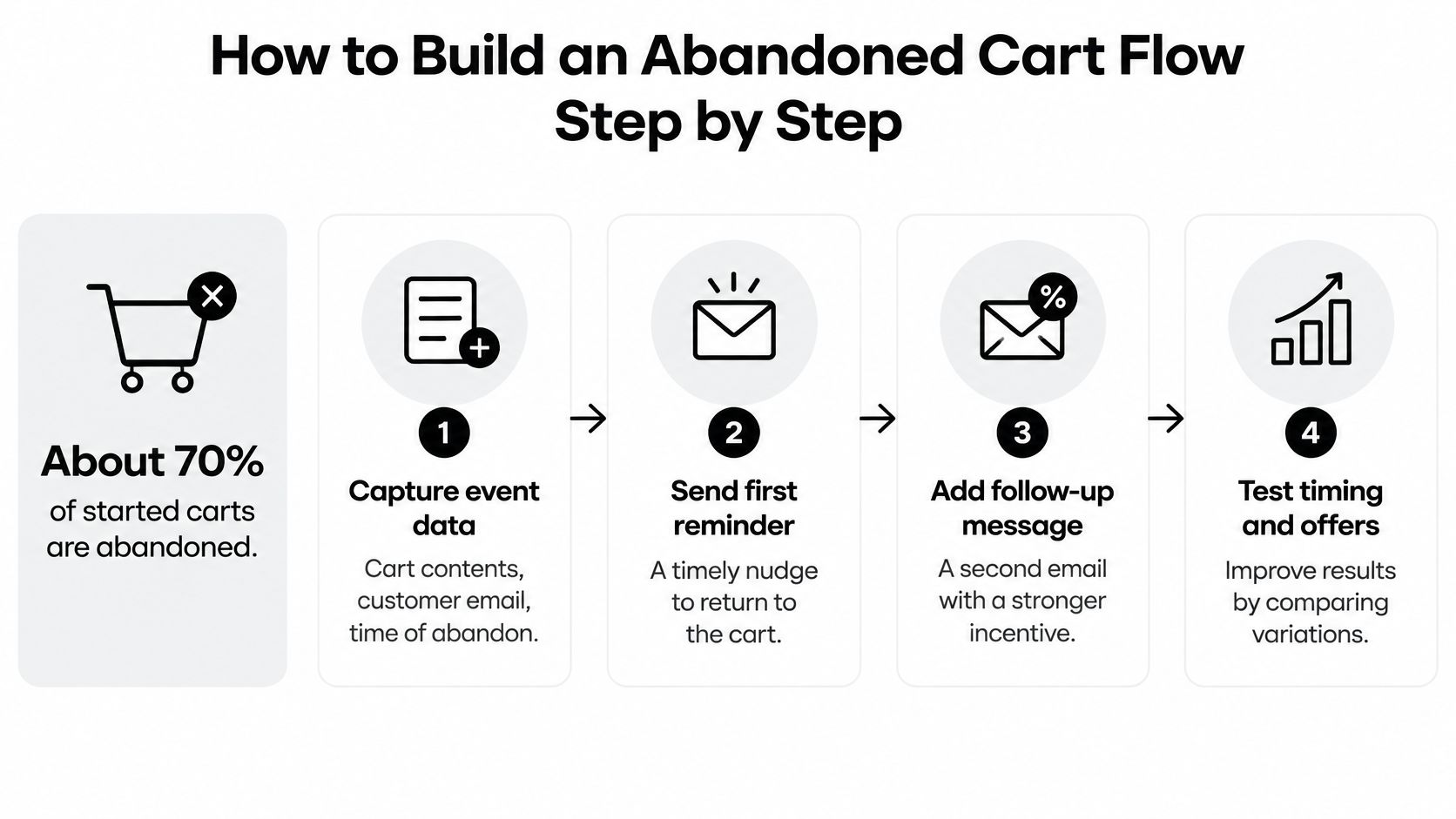
Subject lines decide whether that work gets seen, so test them with the ideas in our guide to abandoned cart email subject lines rather than reusing one line across all three emails.
Before launch, place a test order from a test cart and confirm the flow stops. A recovery email sent after purchase damages trust faster than a missed reminder.
Email carries the full story, product detail and social proof. SMS carries short, time-sensitive nudges and transactional alerts. Trouble starts when both channels send the same offer at the same moment to the same person.
| Stage | Email role | SMS role | Coordination rule |
|---|---|---|---|
| Signup | Welcome series with the brand story and first offer | Confirm opt-in and send one welcome offer | Send SMS only after explicit SMS consent |
| Abandoned cart | Detailed reminder with cart contents and reassurance | One short nudge at about 4 hours if still unpurchased | Never send the same offer in both channels within an hour |
| Post-purchase | Order details, care guide, review request | Shipping and delivery alerts only | Keep SMS to transactional updates, no promotions |
| Replenishment | Reorder reminder with product benefits | Short reminder close to the predicted reorder date | Skip SMS if the customer has already reordered |
| Win-back | Series of 3 emails with a value message | Final single SMS offer after 7 days with no email click | Count every touch against the weekly cap |
Walk through a cart example. The email goes out after one hour with cart contents and a saved checkout link. At four hours, one SMS follows only if the cart is still unpurchased and the shopper gave SMS consent, linking to that same cart. Without SMS consent, the email sequence runs alone and carries the full recovery work. Nothing breaks, and nobody gets chased twice.
Deliverability is now partly an identity and compliance problem, not just a copy problem. Google requires senders to authenticate mail with SPF or DKIM, while bulk senders sending at least 5,000 messages per day to Gmail accounts must configure both SPF and DKIM, publish DMARC, and align the authenticated domain with the visible From domain, under Google's email sender guidelines. Promotional messages also need one-click unsubscribe headers and a visible unsubscribe link.
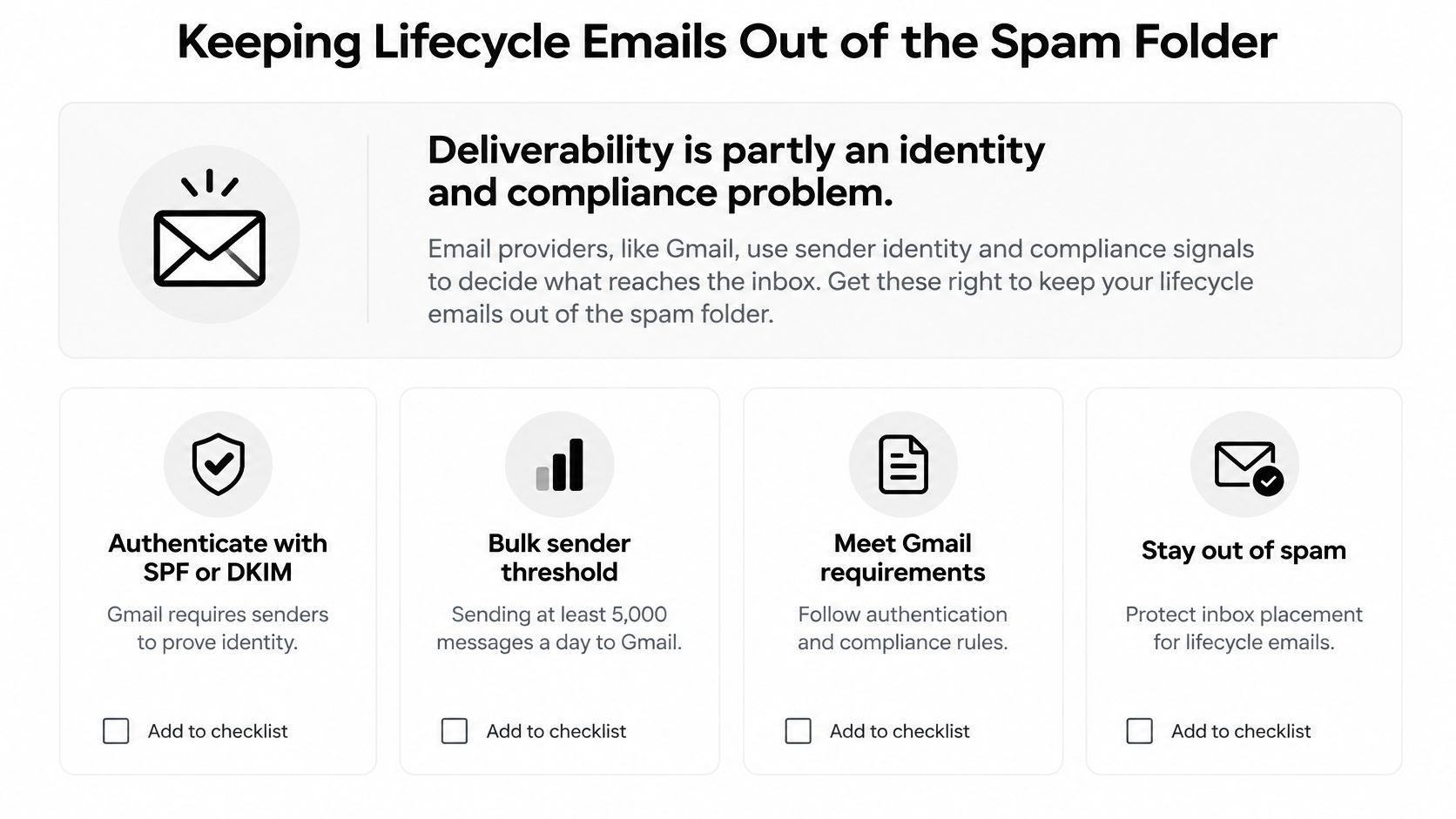
Our deeper guide on email deliverability and avoiding the spam folder covers list hygiene routines in more detail.
Each control protects revenue. Welcome, post-purchase, win-back and abandoned cart flows can't earn or get credited when messages land in spam. If flow revenue drops suddenly, diagnose in this order, authentication first, then complaint spikes, then any recent template or list change. Don't start by rewriting subject lines.
Open rates look precise and mislead anyway. Apple Mail Privacy Protection can register opens through proxy servers, so an open may not mean a person read anything. The visual below sums up why revenue belongs at the top of the report.
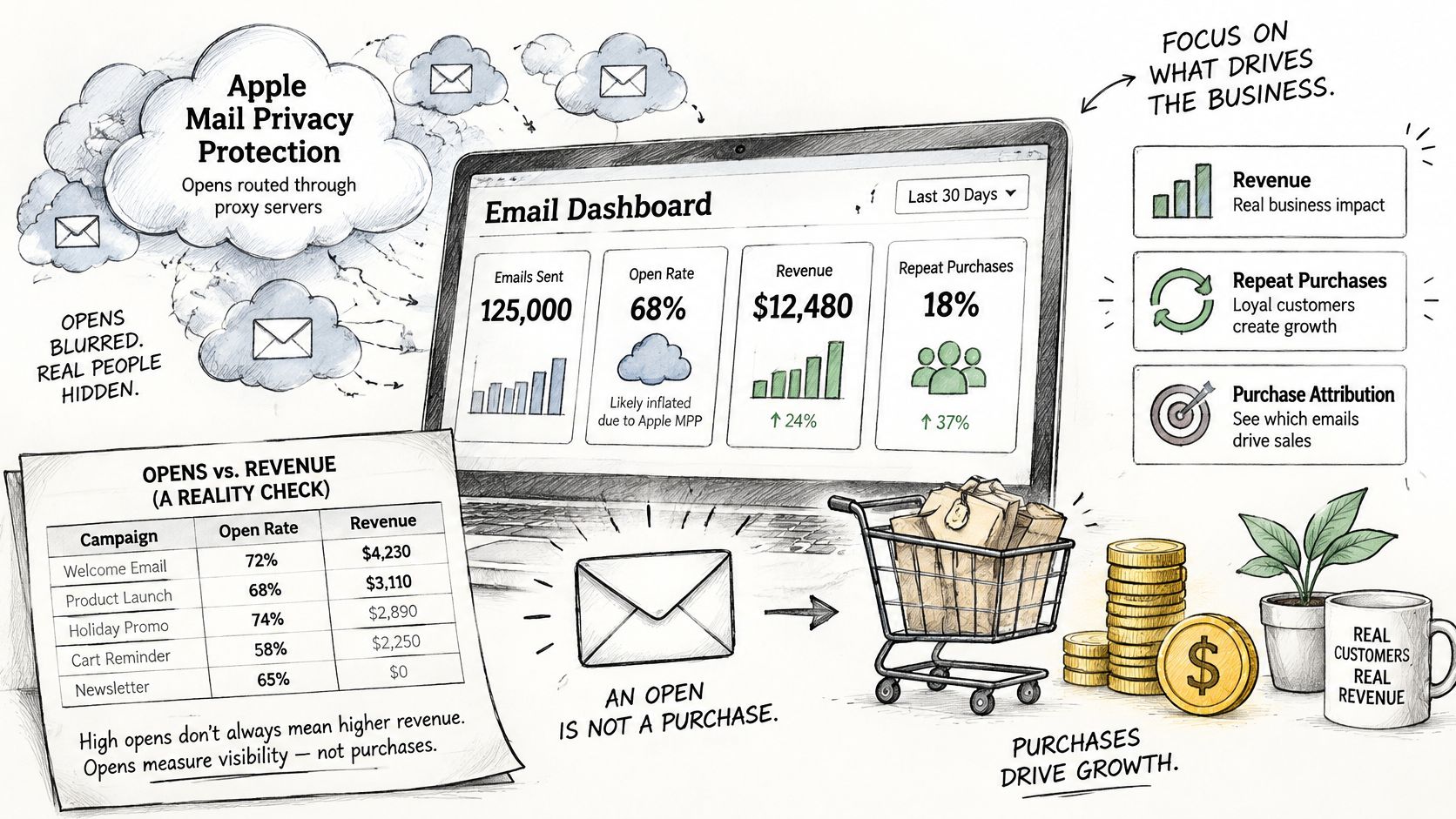
Industry research summarized by Geysera's email marketing benchmarks guide indicates 22% of marketers struggle to measure or prove email ROI, while only 39% assess email's impact on retention or loyalty. If you want outside context before setting targets, you can compare email campaign ROI figures from Rankozo, then replace those averages with your own holdout results.
| Metric | What It Tells You | Use It To | Main Limit |
|---|---|---|---|
| Revenue per recipient | Total flow revenue divided by delivered emails | Compare flows, templates and segments | Can rise with list size effects, so compare like with like |
| Repeat-purchase rate | Share of customers who buy again within 90 days | Judge post-purchase and replenishment flows | Slow to read, so review monthly, not weekly |
| Click-to-purchase rate | Purchases divided by clicks | Compare creative and offers | Ignores purchases made without a click |
| Flow revenue against holdout | Incremental revenue from exposed versus unexposed profiles | Prove the flow adds sales | Needs a holdout of 5-10% of eligible profiles |
| Unsubscribe rate | Share of recipients who leave the list | Spot message fatigue or poor targeting | High rates cut future reach |
| Spam complaint rate | Share of recipients who mark email as spam | Protect sender reputation | Keep below 0.3% |
| Open rate | Opens recorded by the platform | Spot broken send times or subject-line problems | Inflated by privacy proxies, use as a direction only |
Keep 5-10% of eligible profiles out of a flow, then compare their purchase rate and revenue per profile with the exposed group. The gap is incremental lift. Total attributed revenue will always look larger, because it claims orders that would've happened anyway. Count orders from customers who received both email and SMS once, not in both channel reports.
The short video below walks through reading flow performance with that discipline.
Review monthly. Check flow revenue, repeat rate, complaints and holdout lift together, then change one flow at a time so you know what caused the movement.
A new flow inherits every weakness in the setup underneath it. Confirm the foundation can deliver, authenticate and measure before you build on it:
With the foundation confirmed, audit your welcome and abandoned cart flows against the timing in the flow table. Mark which core flows are missing or poorly timed, then fill gaps in the order your lifetime value check set. The flow sitting closest to the next likely purchase usually pays back first, so resist rebuilding everything at once. If your current tool can't connect order events or holdouts cleanly, browse ecommerce email platform options from TopToolAdvisor before rebuilding.
Class A Media is an official Klaviyo partner that focuses only on Klaviyo email and SMS flows. A Klaviyo agency can build and audit these flows for you, and the same checklist applies whichever team does the work.
We build custom Klaviyo email and SMS flow systems for ecommerce brands, sequenced by customer lifetime value so you can see the repeat revenue each flow adds. If your welcome, checkout or post-purchase flows are missing, mistimed, or unproven, visit Class A Media to see how we'd audit and rebuild them for your store.
Let's build retention system that drive predictable, scalable revenue - without ad spend, without retainers, without guesswork.


The Ultimate Ecommerce Email Marketing Agency
Get in touch: hello@classamedia.com