Blog post
Insights
E Commerce Marketing Agency: How to Choose the Right One

You're staring at three agency decks. Each one promises more email revenue, better flows, and a dashboard full of green arrows, but none explains clearly what you'd own, how success would be proved, or why the work fits your products. That's the hiring problem. You don't need another pitch. You need a way to tell whether an e commerce marketing agency builds retention infrastructure or just sells monthly activity.
Most searches start after paid acquisition stops feeling dependable. CPMs rise, iOS privacy changes weaken targeting and measurement, and attribution gaps make it harder to know which ad produced an order. Founders then look at their Shopify store and realize they've paid to acquire customers they barely contact after checkout.
Online retail is no longer a side channel. U.S. e-commerce sales were approximately $5.0 billion in 1998 and reached $519.6 billion in 2018, while total retail roughly doubled over the same period, according to the U.S. Census Bureau history of online retail sales. The same source reports e-commerce rose 43% in 2020, from $571.2 billion to $815.4 billion, and its share of retail reached 16.1% in the second quarter of 2020.
That scale changes the agency question. You're not hiring someone to send prettier campaigns. You're hiring someone to manage first-party relationships created inside a major sales channel, where every order produces data you can use for education, replenishment, cross-sell, and repeat purchase.
Ask these before you discuss creative samples:
Practical rule: If an agency can't explain its measurement logic in plain language, don't let polished design work distract you from that gap.
The right partner treats lifecycle marketing as part of your operating stack. The wrong one treats it as a retainer report. Everything that follows in a serious evaluation, services, pricing, reporting, and niche fit, should help you spot that difference quickly.
The label covers very different businesses. An acquisition agency mainly buys attention through paid social, search, and landing pages. A retention agency builds the system that turns existing traffic and buyers into repeat revenue through email, SMS, segmentation, and automation. Some firms do both, but you should know which discipline is leading the proposal.
Above the waterline, you'll see familiar flows. Welcome messages introduce the brand and complete a first purchase. Browse and cart abandonment messages respond to intent. Post-purchase messages confirm expectations, teach product use, request reviews, and introduce a logical next order.
Those flows matter, but they're not the system. Any competent freelancer can assemble basic versions from templates. The harder question is whether each message knows who should receive it, who should be suppressed, and when the customer should exit.
Below the waterline sits the work that compounds:
Global context reinforces why this infrastructure matters. Businesses across 46 economies representing about three quarters of global GDP recorded nearly $28 trillion in e-commerce sales in 2024, and that incomplete measure points to a still larger worldwide total, according to UN Trade and Development e-commerce statistics.
A serious agency therefore starts with your customer lifecycle, not a template library. It maps first purchase, activation, second purchase, replenishment, loyalty, and lapse as connected states. Onboarding takes longer because the team must inspect data, margins, product intervals, and consent records. Reporting also looks different. Instead of celebrating isolated campaigns, it should show whether customers move from one state to the next at a better rate and with healthier margin.
A serious scope names capabilities, not just a flow count. Use the categories below to benchmark proposals, and read why retention marketing matters if you need a plain-language case for prioritizing existing customers before buying more traffic.

Custom flow builds should include entry rules, exits, delays, branching, and suppression for customers who've already converted. Good looks like different paths by product category, first-order value, subscription status, and discount use. It doesn't look like one welcome sequence copied across every product.
Segmentation design should use recency, frequency, monetary value, product ownership, discount dependence, and predicted replenishment timing. A machine-learning study found purchase frequency and monetary value were strong indicators of customer-value potential, supporting different retention investment by segment, as described in the Iowa State University ecommerce profitability study. For a deeper operational view, review this guide to building customer segments from behavioral data.
The economic case for automation is strong when it's built properly. One benchmark covering more than 20 billion campaign emails and 470 million automated sends found automated email generated $3.41 per email sent versus $0.155 for campaigns, while converting at 1.49% versus 0.08%, according to Omnisend email marketing benchmarks. Don't read that as permission to add endless flows. Read it as evidence that event-driven relevance deserves more attention than broadcast frequency.
Agencies usually package retention work in three ways. None is automatically superior. The right choice depends on whether you need infrastructure built, ongoing operators, or both, and you can compare one transparent example through published agency pricing while reviewing proposals.
| Criterion | Monthly Retainer | One-Time Project | Hybrid Model |
|---|---|---|---|
| Cost predictability | Predictable monthly cost, but it continues whether output slows or not | Fixed fee tied to defined deliverables | Base fee plus variable performance element |
| Revenue alignment | Weak unless reporting and renewal depend on outcomes | Depends on acceptance criteria and post-launch measurement | Stronger on paper, but only if incremental revenue is defined clearly |
| Asset ownership | Must be negotiated, especially templates, segments, and test records | Usually easier to specify handover at completion | Varies, so document ownership before work starts |
| Platform flexibility | Can become tied to the agency's preferred stack and routines | Build can be documented for your internal team | Flexibility depends on who controls data and reporting |
| Flow expansion | New work fits into monthly capacity, sometimes slowly | Replacement or expansion needs a new scope | Ongoing build is included, with incentives needing guardrails |
| Best fit | Brands needing continuous campaign and testing operations | Brands with basic flows that need a proper lifecycle build | Brands with enough volume to measure performance credibly |
Retainers make sense when you need weekly execution. They become poor value when the agency fills hours with minor campaign tweaks after the core system is live. Ask what recurring work remains after launch, who performs it, and what decision each activity informs.
Project fees suit brands that need custom infrastructure without an open-ended commitment. The risk is a launch-and-leave build with no optimization window, documentation, or QA support. Require flow maps, naming conventions, segment definitions, and a handover session.
Hybrid models can align incentives, but they're also easiest to game. If payment follows platform-attributed revenue, the agency benefits from broad attribution windows and aggressive discounts. Tie any performance element to incremental orders or contribution margin, with holdouts where feasible. Put exit terms, asset ownership, response times, and platform access in writing before signing.
Platform-reported revenue is the easiest number to inflate and the hardest number for founders to challenge. Klaviyo, Postscript, and Attentive can each credit an order to a message even when the customer already intended to buy. That doesn't make the platforms dishonest. It makes their default reporting incomplete for judging agency performance.

Abandoned-cart reminders reach high-intent shoppers. Some would return without a nudge, and some learn to wait for a discount code. A flow can therefore show impressive attributed sales while adding little profit, or even reducing margin. Opens and clicks don't solve this problem because they measure interaction, not causality.
Shopify's agency guidance recommends documenting attribution models and agreeing metrics in advance, as outlined in Shopify guidance on choosing an ecommerce agency. Treat that as a minimum standard. Document the window, click and open rules, order source, refund handling, and how overlapping email and SMS claims are resolved.
A flow hasn't proved value because it was last to touch an order. It proves value when treated customers buy more profitably than comparable customers who received nothing.
Ask agencies to show how they'd design measurement for your store, then compare that answer against anonymized examples in their retention case studies. Specific answers mention eligibility, randomization, sample limits, and fixed reporting windows. Vague answers hide behind screenshots. Measurement design is part of the deliverable, not an afterthought you receive after launch.
The workflow should change when repurchase economics change. The image below frames the three categories where founders most often copy the wrong playbook.

Category benchmarks show why one cadence can't fit every store. Approximate two-month repeat rates range from 20–28% for pet supplies and 18–25% for health and supplements to 8–14% for apparel and 3–7% for electronics, according to Shopify cohort analysis benchmarks by category. Use those ranges as context, not as a target copied from another niche.
Fashion apparel, illustrated by GUIZIO, usually needs replenishment-light communication. The work centers on new drops, fit and care education, complementary products, back-in-stock interest, and careful discount control. Strong consent controls matter because frequent trend-led messaging can quickly become noise.
Health and wellness, illustrated by Kush Queen, leans more heavily on education and use intervals. A good agency asks how long a product lasts, what customers need to understand before reordering, and which claims require care. Replenishment reminders should stop or change when a customer has enough product, changed routine, or stopped engaging.
Food and beverage, illustrated by Four Sigmatic, often requires subscription-aware logic. Flows need to recognize active subscribers, skipped deliveries, flavor preferences, and likely run-out dates. Sending a generic win-back discount to a customer with an upcoming subscription shipment is a basic failure.
The short video below gives additional context on how lifecycle thinking translates into practical brand execution.
Across all three niches, expect the same operating rhythm with different logic inside it. Discovery reviews products, margins, and data. Segmentation review identifies valuable and risky cohorts. Flow builds move through QA and consent checks before launch. The first 60 days then focus on timing, branching, offer discipline, and whether repeat behavior is changing.
Take direct questions into the next sales call. You're listening for operational detail, not confidence.
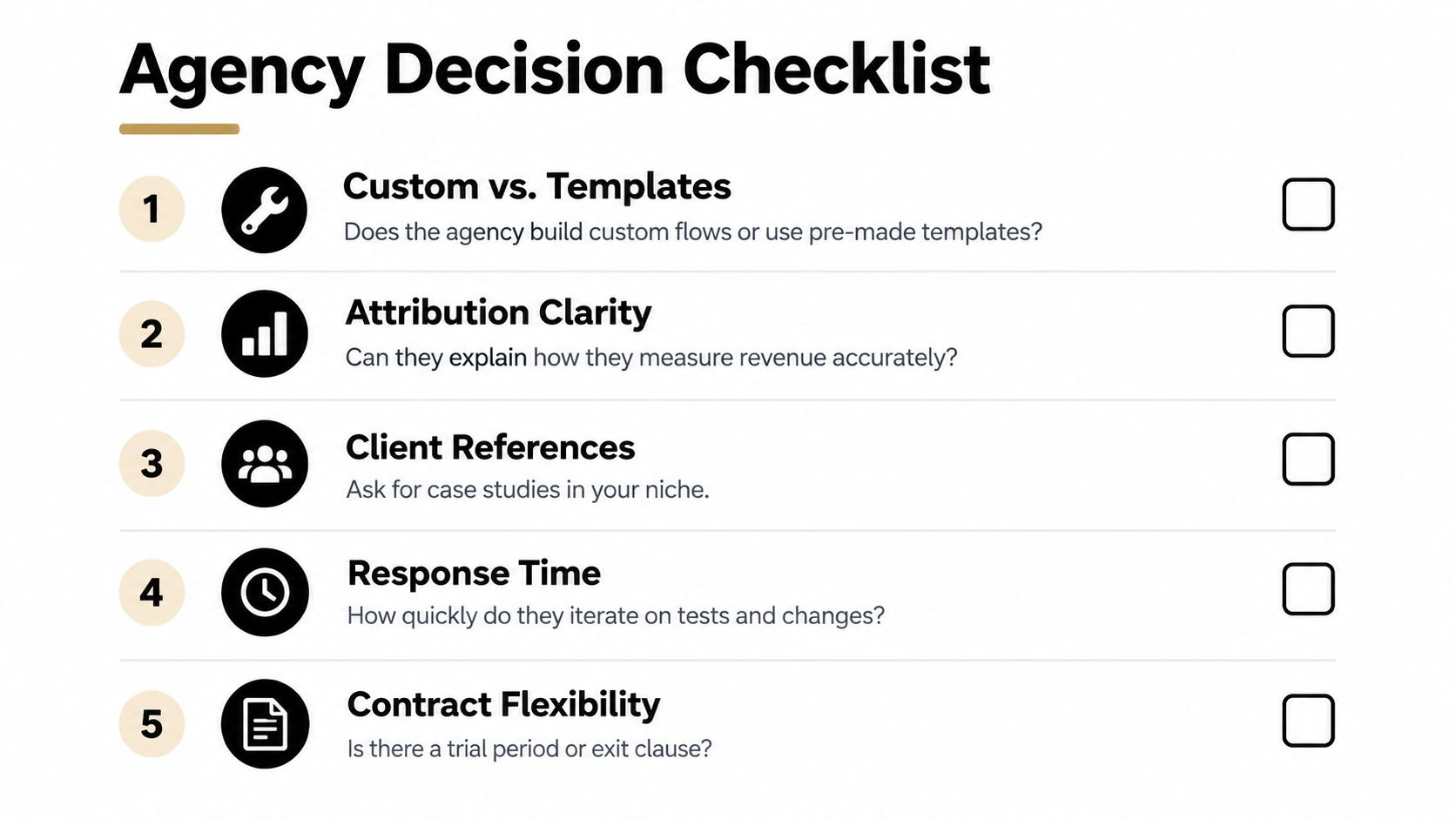
If reporting tools are part of the conversation, compare the agency's approach with independent guidance on the best attribution software for agency reporting rather than accepting a dashboard tour as proof.
Walk away from vague attribution language, guaranteed revenue claims, and one-size-fits-all packages built around an arbitrary flow count. Be equally wary when an agency recommends SMS before checking consent quality, or discounts before testing education and timing.
Decision test: Specific answers name events, segments, windows, owners, and stopping rules. Generic answers name channels and promise growth.
The best agency won't answer every question with a larger scope. Sometimes it'll tell you not to build a flow because customers aren't likely to repurchase soon, consent is weak, or margin can't support the incentive. That restraint is a buying signal.
Give yourself a deadline, or agency selection will drift while basic flows keep underperforming.
Week one is for a shortlist and intro calls. Send every agency the same store context, product economics, current flows, consent status, and measurement questions so proposals can be compared fairly.
Week two is for sample audits and reference checks. Ask references what was built, what handover looked like, how disputes over attribution were handled, and whether reporting changed any real decisions.
Week three is for scoped proposals. Require deliverables, timelines, asset ownership, QA, measurement design, and post-launch responsibilities in writing. Reject scopes that list flow names without eligibility and suppression logic.
Week four is for contract and kickoff. Confirm platform access, data owners, approval steps, reporting cadence, and the first optimization review. Signing isn't the finish line. The first 60 days after launch show whether timing, segmentation, and offers improve repeat behavior without damaging margin or consent.
End every finalist conversation with one question. How will you measure the revenue you cannot take credit for? Agencies that build lifecycle infrastructure will answer with holdouts, cohorts, and margin. Campaign vendors will reach for attributed screenshots.
If you want custom email and SMS retention infrastructure for your Shopify brand without treating attributed revenue as proof, explore how Class A Media builds lifecycle flows around segmentation, repeat purchase, and customer lifetime value. Bring the checklist above to the conversation and ask exactly how your flows, measurement, and handover would be handled.
Let's build retention system that drive predictable, scalable revenue - without ad spend, without retainers, without guesswork.


The Ultimate Ecommerce Email Marketing Agency
Get in touch: hello@classamedia.com