Blog post
Insights
Customer Segmentation Data: A Practical Guide for 2026
Your welcome and abandoned cart flows are live in Klaviyo, campaigns are going out on schedule, and email revenue looks healthy enough on the dashboard. Then you check the repeat purchase rate and it hasn't moved. That's usually where the segmentation conversation starts, not with a lack of effort, but with a lack of useful distinction between customers.
Most Shopify brands don't need more labels. They need better customer segmentation data, meaning the underlying signals that tell you when to send, what to offer, and who to suppress. Get those signals right and segments become decisions instead of folders you rebuild every month.
Consider a Shopify apparel brand with two customers who've both spent the same total amount. In a simple customer view, they're identical. One bought three times in the past two months, opened your last product drop, and typically returns before she needs a discount. The other placed one large order during a sale, hasn't visited since, and ignored your last two campaigns.
If both receive the same cross sell email with the same incentive, you aren't segmenting. You're broadcasting and hoping average behavior will save you. The frequent buyer gets a discount she didn't need, which trains her to wait for one. The one time buyer gets a message built for someone who already trusts the product, when her real barrier might be fit, fabric care, or uncertainty about a second style.
That's the trap with labels like VIP, loyal, and lapsed. A label tells you what box someone sits in today. It doesn't tell you why she's there, when she'll likely move, or what action would change her behavior.
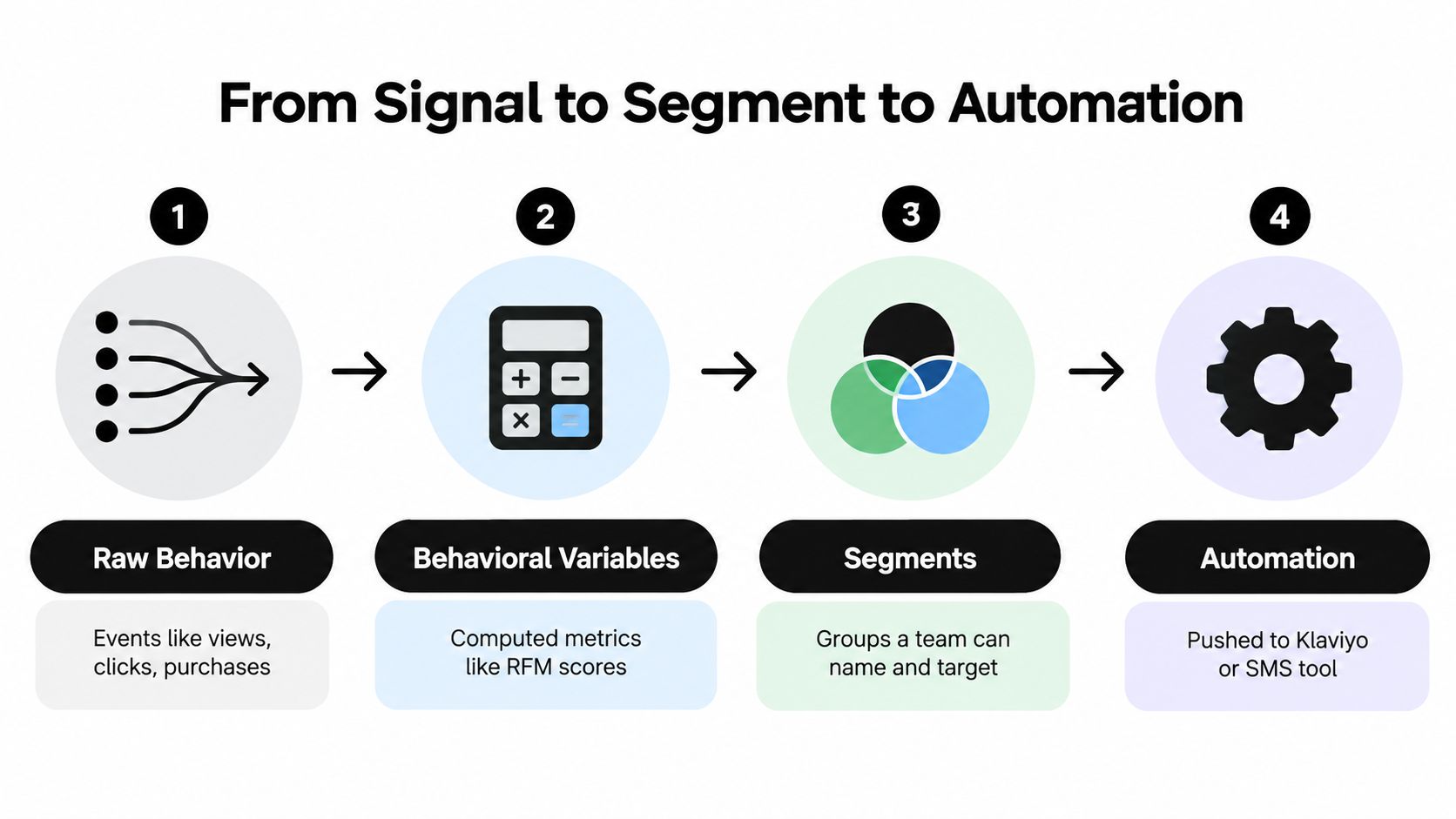
Treat customer segmentation data like a pipeline with four jobs:
A segment that doesn't change timing, content, offer, or suppression isn't a strategy. It's a reporting category.
That distinction matters because retention revenue rarely comes from sending more. It comes from sending differently to people whose purchase patterns are genuinely different, and from leaving alone the customers who'd buy anyway. Once you see segmentation as a data pipeline, your questions get sharper. You stop asking how many segments you should have and start asking whether your data can support the decisions you want to make.
Before you build any segment, answer a simpler question. What should one complete customer record contain? A good shopkeeper's notebook works this way. In a physical store, you would know a regular's name, what she bought, when she usually comes in, whether she wants a phone call about new stock, and whether she is a weekly visitor or someone you have not seen since winter.
Your Shopify and Klaviyo profiles need the same five things in digital form.
Identity is the name tag. That includes customer ID, email address, phone number, and name. It sounds obvious, but duplicate profiles are common when someone checks out as a guest once and creates an account later. Two half records will both make the actual person look less loyal than they are.
Transaction history is the receipt drawer. You need order dates, line items, amounts, discounts used, and refunds. Timestamps matter as much as totals because timing is what later lets you calculate purchase cycles. A lifetime spend figure with no dates can't tell you whether someone is accelerating or drifting away.
Shopify already exports much of the identity and transaction layer, and your email platform holds engagement and permission data. The gaps are usually the joins between them. If you're working through how those sources fit together, guidance on how to unify customer data for ecommerce is a useful starting point for the activation side, while a structured approach to building a complete picture of each customer profile helps you decide which fields belong on the record in the first place.
Start by auditing what you have against those five categories. Don't buy new tooling until you know which fields are missing, duplicated, or never updated.
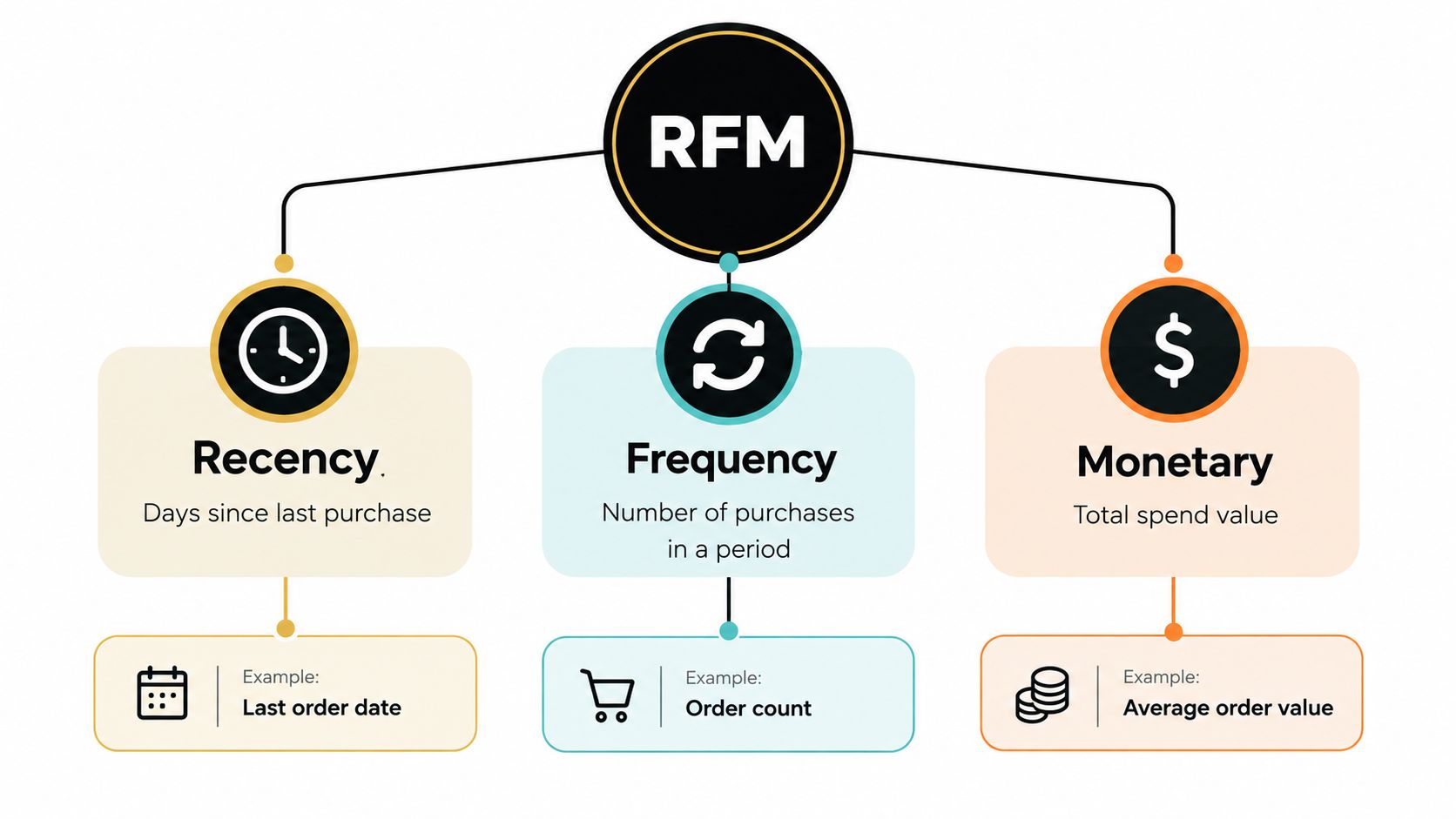
RFM stands for Recency, Frequency, and Monetary value. Recency measures how recently a customer purchased, frequency measures how often she buys, and monetary value measures how much she spends, and a common implementation scores each dimension from 1 to 5 to create combinations ranging from 111 to 555, or 125 theoretical combinations, as described in this overview of the RFM framework and its role in customer segmentation platforms.
Don't memorize the scores. Understand the three questions. How long ago did she buy? How often does she buy? How much does she spend? Those questions work because they use first party purchase data rather than demographic guesses, and you can calculate them from ordinary Shopify order history without advanced machine learning.
The diagram below maps each RFM branch to the plain data field behind it.
Two customers can share similar RFM totals and still need opposite treatment. A supplements buyer who reorders like clockwork is running on a replenishment rhythm. A skincare buyer whose gap between orders keeps stretching is slipping, even if her historical spend looks strong.
That's why RFM should be extended with repurchase time, average order value (AOV), and interpurchase interval, which is the typical gap between one customer's orders. A published online retail model derives those extended variables and applies a Gaussian Mixture Model to find probabilistic clusters instead of forcing everyone into rigid rules, as detailed in research on extended RFM variables and probabilistic clustering for online retail.
| Variable | Plain question it answers | Decision it powers |
|---|---|---|
| Recency | Is she still warm? | Win back timing |
| Interpurchase interval | When is she due? | Replenishment reminders |
| AOV | How big is a typical basket? | Bundle and threshold offers |
| Frequency | Is buying a habit? | Suppress unneeded discounts |
Picture interpurchase interval like a coffee bag running low. If a customer usually reorders before the bag empties, your reminder should land just before that moment, not on your campaign calendar's schedule. For recent one time buyers, the job is different. They need a second purchase journey built around confidence and product education, not a loyalty reward they haven't earned yet.
If you want a practical walkthrough of turning these scores into audience rules, these RFM and behavioral segmentation tips offer a helpful companion to the decision focused approach here. The trade-off to remember is that every added variable gives you sharper timing but demands cleaner order data. Start with RFM, add interval and AOV next, and only adopt clustering when rule based groups stop matching what you see in real order patterns.
A signal isn't a segment, and a segment isn't an automation. The work in between is where consistency fades, because one person builds a list in Klaviyo, another exports a spreadsheet, and within a month nobody knows which definition is current.
The flow below shows the path from raw behavior to an automated action your team can repeat.
First, pick an observation window. All time totals flatter old customers and hide recent change, so a fixed rolling window usually gives you a fairer comparison and cleaner tests. Someone who bought heavily two years ago but not since shouldn't sit beside a customer who bought last week.
Second, decide how often segments refresh. Timing sensitive flows, like replenishment or second purchase nudges, need frequent updates as new orders arrive. Strategic segments you review monthly can move more slowly. Write the cadence down next to the segment definition so a new team member doesn't have to guess.
Third, choose your building method. Rule based segments are transparent. You set conditions like purchased at least twice and last order within your active window, and anyone can audit why a customer qualifies. Model based clusters work differently. Techniques such as Bisecting K Means group customers by similarity across several variables at once, which can surface patterns like high spending frequent buyers or recent low spending buyers that rules might miss.
Practical rule: Use rules when you need your team to explain membership. Use clusters when you need the data to show you groups you couldn't have named in advance.
Every segment needs exit and exclusion logic. A customer in a win back journey shouldn't also receive aggressive cross sell offers. A customer who just purchased shouldn't get a discount email for the item already in transit. These aren't campaign details, they're part of the segment itself.
Document each segment with its purpose, data window, entry rules, exclusions, and the flow it feeds. That discipline connects directly to broader retention marketing strategies that coordinate lifecycle messaging, because channels only feel coherent to customers when the underlying definitions don't collide. The trade-off is maintenance. Fewer, well documented segments will outperform a long list of clever ones that nobody trusts or updates.
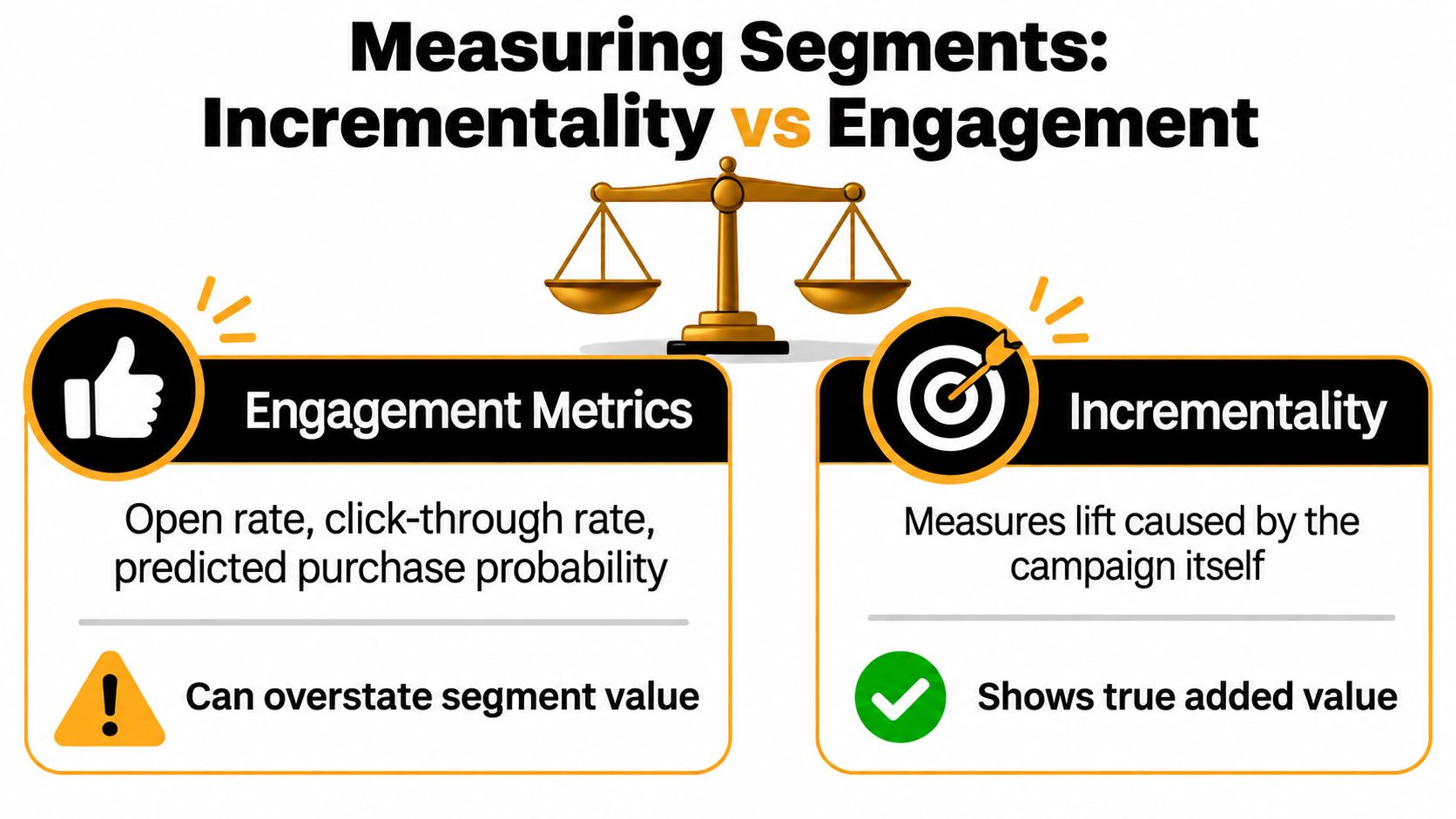
High open rates feel like proof. They aren't. A segment of your most loyal buyers will open and click almost anything, and many of them would've purchased without the email at all. If you judge that segment by engagement, you'll credit the campaign for revenue that was already coming.
The comparison below separates attention metrics from evidence that a message changed behavior.
This measurement gap is widening as tooling improves. Retail research indicates organizations prioritize advanced segmentation at 43%, predictive modeling at 42%, and real time data processing at 43%, while 44% of marketers use AI for customer segmentation and 42% for personalization, according to figures compiled in the 2025 retail AI and digital trends report. Building segments is getting easier. Proving they cause extra revenue is the harder, lagging skill.
The fix is a randomized holdout group inside each segment. A small portion doesn't receive the flow or campaign, and you compare repeat purchase rate and revenue per recipient over a full repurchase window. That comparison separates genuine lift from selection bias, where high value customers make any targeting look smart.
Uplift modeling takes this further by estimating the individual level effect of sending versus not sending, evaluated with measures such as Uplift AUC, Qini curves, and Precision@10%. One causal forest implementation found that campaign channel, customer recency, and loyalty tier were important drivers of treatment effectiveness, with response varying by lifecycle stage, device, and region, as reported in research on uplift modeling and causal evaluation for ecommerce campaigns.
You don't need that full machinery on day one. Rank customers by expected incremental profit instead of purchase probability. That's predicted conversion lift multiplied by contribution margin, minus message and discount cost. It reframes loyalty work, something explored further in guidance on building customer loyalty that lasts beyond discounts, because your most persuadable customer is often moderately active, not your biggest spender.
The short video below walks through how disciplined testing changes the way you read campaign results.
Track unsubscribes and complaints alongside revenue. A segment that lifts this month's sales while shrinking your reachable audience is borrowing from future campaigns.
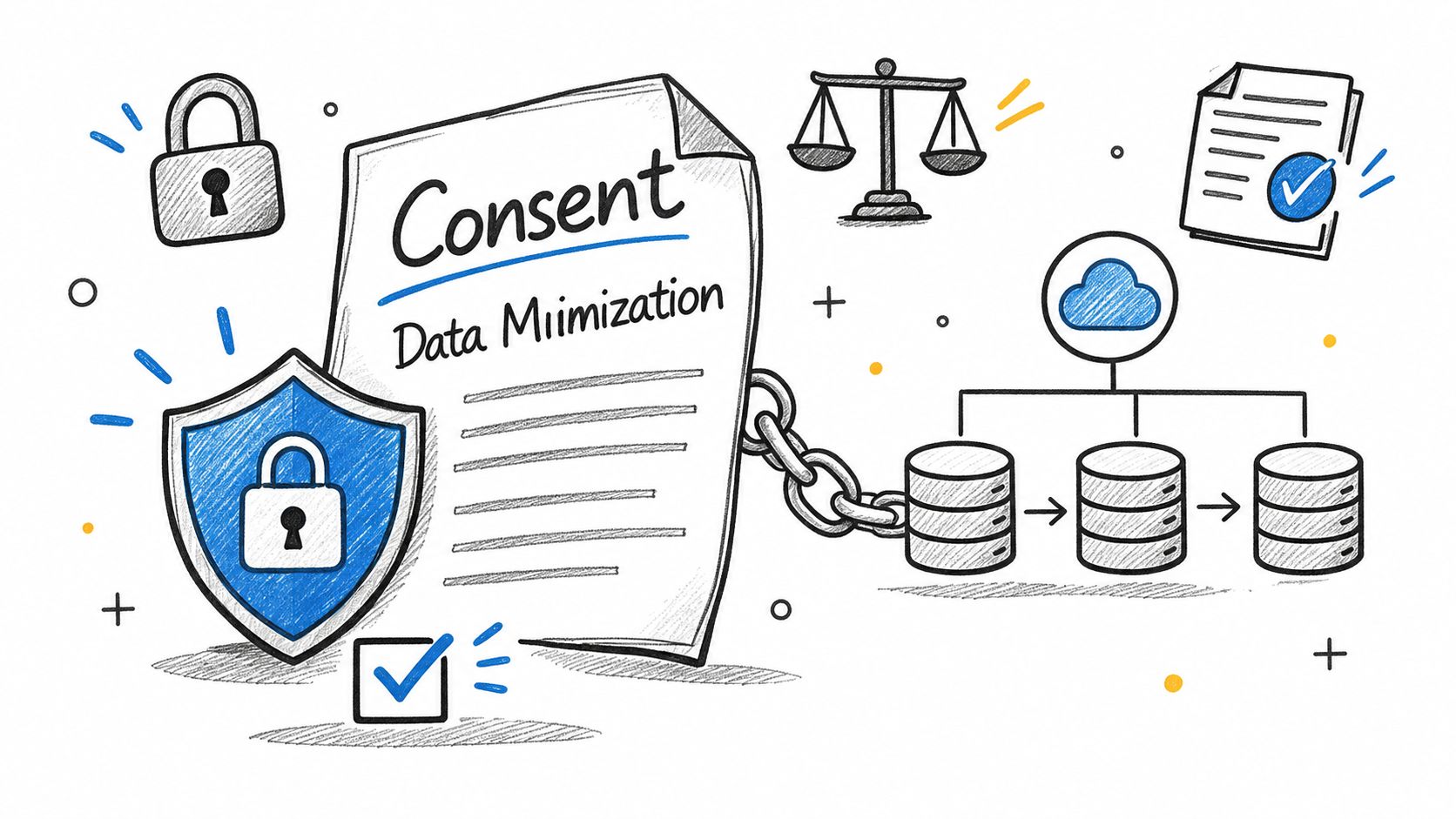
Consent isn't a checkbox you add after building segments. It's part of the infrastructure that decides who can receive what, and whether you can defend that decision later. The General Data Protection Regulation, which began applying on May 25, 2018, requires lawful grounds for processing personal data, clear processing purposes, and support for rights such as access and deletion, and frameworks including California's Consumer Privacy Act and Brazil's Lei Geral de Proteção de Dados have reinforced the shift toward consent based data, as outlined in this analysis of privacy regulation and privacy compliant segmentation growth.
That analysis estimates annual growth of 14.5% for privacy compliant solutions versus 11.2% for the broader customer segmentation market, with the global platform market placed at $2.91 billion in 2025 and projected to reach $7.53 billion by 2034 in the market estimate cited earlier in this guide. The commercial direction is clear. Brands are investing in data they can govern, not just data they can collect.
The illustration below frames privacy as a set of working controls rather than a legal document.
Fairness deserves the same attention. A 2026 systematic review of 41 studies found that personalization is generally associated with stronger perceived relevance, satisfaction, and loyalty, yet fairness, discrimination, manipulation, and consumer autonomy are only sporadically examined, according to the review of AI driven personalization and ecommerce segmentation research.
In practical terms, check whether segments produce materially different outcomes across geography, language, or device, and require human review for high impact segments that change pricing or offer access. Picture a shopkeeper who knows a lot about regulars. Remembering someone's usual order feels attentive. Revealing that you've tracked her browsing at midnight feels intrusive. Email and SMS carry that same line, and crossing it costs you the permission your whole program depends on.
Run this checklist before you launch, refresh, or audit any segment. A single retention lead can work through most of it without engineering support, and the items that need escalation are easy to spot.
If you can't explain why a customer received a message, which data drove it, and whether it caused the purchase, the segment isn't ready to scale.
Escalate to legal when consent language or retention policies change, to data support when profiles won't merge cleanly, and to leadership when a segment's short term revenue depends on treatment you couldn't comfortably explain to the customer herself. That combination of behavioral signals, incrementality, and consent is what turns customer segmentation data from a sorting exercise into a retention system you can trust.
If your flows are running but your segments still can't answer when to send, what to offer, and who to leave alone, Class A Media builds custom email and SMS automation systems for Shopify brands using data driven segmentation and lifecycle triggers tied to real purchase behavior. Visit the site to see how a one time, custom built retention system can turn your existing customer data into repeat revenue without an ongoing agency retainer.
Powered by Outrank app
Let's build retention system that drive predictable, scalable revenue - without ad spend, without retainers, without guesswork.


The Ultimate Ecommerce Email Marketing Agency
Get in touch: hello@classamedia.com